



The Risk of Pay Monthly Websites
Web Development
Pay monthly websites seem like a convenient way to get an affordable, professional site without upfront costs. But they come with serious drawbacks:
You don’t own your website: Stop paying, and your site disappears entirely.
Hidden costs add up: Monthly fees, feature upgrades, and transaction fees can make these plans far more expensive over time.
Limited customization: You’re stuck with basic templates and can’t make advanced changes or scale effectively.
Migration headaches: Switching platforms often requires starting from scratch, costing thousands.
Performance issues: Shared hosting impacts speed, reliability, and SEO.
A better option? Pay once, own your site, and avoid recurring fees. For example, Gatsboy offers a $500 one-time solution with full ownership, customization, and scalability - saving you money and giving you control.
Subscriptions Are Ruining Our Lives. Here's Why They're Everywhere Now.
Hidden Costs That Add Up Over Time
That low monthly rate you see advertised? It’s often just the tip of the iceberg. A $30 to $50 per month plan may seem affordable at first glance, but over time, hidden costs like renewal price hikes, feature paywalls, and transaction fees can significantly inflate your expenses. Let’s break down how these costs can quietly impact your budget.
Monthly Fees Add Up Over the Years
A $50 monthly plan might not seem too bad - until you realize it totals $1,800 over three years. Many providers use enticing promotional rates to hook new customers, offering deals like $1 or $2.99 per month. But after the initial term, those rates often jump to $39 or $10.99 per month, which translates to increases of 3,800% and 267%, respectively. These price hikes are rarely highlighted upfront, leaving small businesses blindsided when their bills suddenly balloon. And once those renewal rates kick in, you’re often hit with even more fees for essential features.
Extra Costs for Features and Services
Basic plans usually come with limitations. Need to sell products online? That’ll often require upgrading to a more expensive tier. Want advanced SEO tools or to remove platform branding? Be prepared to pay extra. For e-commerce businesses, transaction fees alone can be a big expense - most platforms charge 2.9% plus $0.30 per sale, which adds up to around $300 monthly on $10,000 in sales.
Then there are additional tools to consider:
Booking systems: Costs range from $9 to $159 per month.
Inventory management solutions: Typically $39 to $299 per month.
Professional email services: Around $6 to $12 per user per month.
These add-ons can quickly inflate your total costs, making it hard for small businesses to stick to a budget.
Unpredictable Costs Hurt Small Businesses
For small businesses, these hidden fees and renewal hikes can wreak havoc on cash flow. As Laura Odelius from Kineto Creative points out:
"DIY website builders often promote free trials or low initial starting rates. But monthly and yearly subscription costs accumulate over time, and core functionalities and features may be tucked behind higher-tier subscription plans".
In fact, 70% of businesses spend between $500 and $5,000 annually just to keep their websites running. For businesses operating on tight margins, these unexpected costs can drain resources that would otherwise go toward growth. What starts as a predictable monthly plan often ends up being anything but predictable.
Limited Customization Options
Hidden fees are just one hurdle; limited design flexibility can seriously hinder your brand's growth. Many pay-monthly platforms operate as "closed source", restricting you to predefined options within a selected template.
Generic Templates Hurt Your Brand
When your website looks like hundreds of others, it’s hard to make a memorable impression. Studies reveal that 84% of consumers gauge a company's credibility based on its website design, with custom designs being rated three times more trustworthy than cookie-cutter templates. Built-in integrations with stock photo libraries and AI-generated text often result in bland, uninspired content, leaving your brand looking generic and unprofessional.
No Access to Code or Advanced Editing
Need a custom tool like a service calculator or a booking system tailored to your business? Without access to the platform's code, you’re stuck with the limited features of your chosen template. Chris Yoko, CEO of Yoko Co, highlights this issue:
"Most website builders are 'closed source' in that they don't provide users access to the backend code. As a result, users are limited to the number of customization options available in the template they selected".
Even professional designers are boxed in by these restrictions. This makes it challenging to fine-tune performance, implement advanced SEO strategies, or integrate specific features that could give your business a competitive edge. As your business grows, these limitations only become more glaring.
When Businesses Outgrow Their Templates
Over time, the constraints of these platforms become a serious roadblock. For example, many website builders limit site architecture - some only allow a single sub-level in navigation menus. This can prevent you from creating a more complex, scalable site structure as your content expands. In some cases, making even basic changes may require a total site rebuild.
The financial impact of these limitations is significant. Businesses often face migration costs ranging from $8,000 to $15,000 after just 18 months on a proprietary platform. Adding to the frustration, research shows that 73% of revenue for website builders comes from subscription lock-ins rather than delivering real value. Essentially, you're paying to stay in a system that can't grow with your business.
Ownership Problems and Getting Locked In
One major downside of many website platforms is that you never actually own your site. These services typically operate on a rental model, where the platform retains ownership of the underlying code, templates, and infrastructure. What you own is limited to the content you upload - like text and images - which can lead to serious complications when you want to make changes or switch providers.
You Don't Actually Own Your Website
Using these platforms is like renting an apartment instead of owning a house. With pay-monthly services, you're essentially leasing digital space. Miss a payment, and your site doesn’t just pause - it’s gone. Completely. This is a harsh reality for many users.
Take the case of a contractor in Broward in early 2026. After building his site on a popular subscription-based platform, he decided to cancel his plan to pursue a custom-built site. The result? His entire website, including text, images, and form submissions, was deleted instantly. These proprietary platforms don’t offer a grace period; once you stop paying, everything is erased.
Difficulty Moving Your Website Elsewhere
Switching to another platform often means starting from scratch. The design and code of your site belong to the provider, making a seamless transfer impossible. Even when platforms allow content exports, the exported files are often incomplete, missing critical elements like SEO metadata, alt text, and page layouts. This can turn a simple migration into a costly and time-consuming rebuild, with costs ranging from $8,000 to $15,000 after just 18 months.
For example, in February 2026, a store owner using a subscription-based e-commerce platform decided to pause their subscription during a slow month. The platform immediately shut down their storefront, and rebuilding it elsewhere ended up costing three times more than the original setup. These challenges highlight how difficult - and expensive - it can be to escape digital lock-in.
Penalties and Barriers When Canceling
Canceling a pay-monthly service often comes with more headaches than just losing your design. Around 80% of marketing directors surveyed said their website vendors tried to block them from leaving. Some platforms impose extra fees to release your website files or databases. Others might provide a static HTML export, but these files are often uneditable without advanced technical skills.
Dallas Kashuba from DreamHost puts it plainly:
"If you can't export what you create, you don't fully own it. True ownership means control, and in the digital world, that equals portability."
Small businesses also face risks with domain names and DNS records. If these are registered by the platform or agency, you might need their permission to re-point your domain, adding another layer of difficulty. This lack of control not only drives up costs but also limits your ability to make strategic decisions. In the end, you're left paying monthly fees for a website that you can never truly call your own.
Growth and Performance Problems
As your business grows, pay monthly websites can become a bottleneck for performance. These platforms often rely on shared infrastructure, meaning hundreds of users share the same CPU, RAM, and network resources. If a neighboring site experiences a traffic spike, it can drain resources from your site, leading to slower load times or even checkout failures - right when you need your site to perform its best. This shared setup directly impacts bandwidth, integration flexibility, and uptime reliability.
Bandwidth and Resource Caps
Providers often advertise "unlimited" resources, but the reality is quite different. Many impose strict usage caps, and exceeding these limits can result in throttled performance or even account suspension. This becomes a serious issue as your business scales. Slow page load times can dramatically hurt user engagement - delays of just 1–3 seconds can increase bounce rates by 32%, while delays of 3–5 seconds can push bounce rates up by 90%. Beyond five seconds, bounce rates can double.
Performance issues like these also affect your search engine rankings. Google prioritizes user-friendly sites, so slow-loading pages caused by resource limits are pushed down in search results, cutting off valuable organic traffic. Additionally, restrictions on "inodes" (the number of files you can store) and concurrent processes may prevent you from expanding your site with new products or media-rich content as your business grows.
Problems with Integrations and SEO
Many pay monthly platforms lock you into closed systems, blocking access to custom tracking codes, advanced APIs, and specialized software. Basic plans often include only limited SEO features, while full optimization tools are locked behind premium plans that can cost $100 or more per month.
Tony Cooper, Founder of We Build Stores, highlights a common issue with these platforms:
"The 'update your site' promise is one of those myths that the web design industry has sold for years... the result is millions of sites where the owner logged in once, couldn't figure out the editor, and never went back."
Traditional WordPress-based subscription sites often have load times of 3–5 seconds, compared to modern frameworks that can achieve load times as fast as 0.3 seconds. If your team struggles to manage content or monitor performance effectively, your website's quality can degrade over time. Additionally, disconnected systems within these subscription models can create data silos, requiring time-consuming manual syncing between your website and other business tools. These limitations make it harder to optimize for search and scale your operations effectively.
Downtime and Reliability Issues
Shared hosting environments also increase the risk of downtime. Pay monthly websites often experience 12–15% annual performance degradation as the platform adds more users.
An uptime rate below 99.9% can mean over seven hours of downtime each month. If a major outage occurs, migrating your site to another platform might not even be an option, leading to complete operational downtime. Additionally, heavy reliance on plugins in these subscription models introduces security vulnerabilities. In fact, 95% of WordPress vulnerabilities are tied to plugins, increasing the risk of crashes as your site scales.
One-Time Payment Solutions for Long-Term Growth
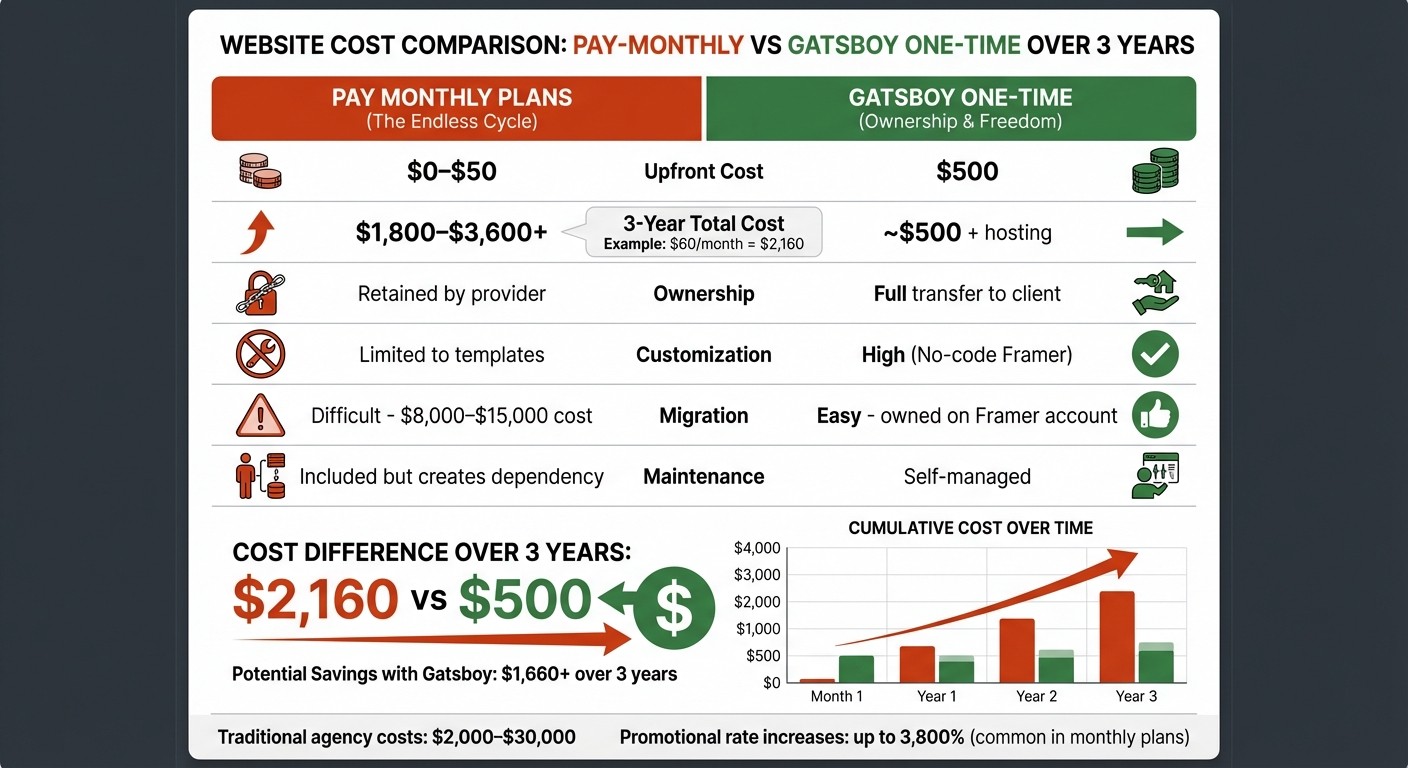
Cost Comparison: Pay Monthly Websites vs One-Time Payment Over 3 Years
Switching to a one-time payment model can turn your website into a lasting business asset. This approach eliminates ongoing monthly fees, giving you immediate ownership and control, which helps avoid the usual drawbacks of pay-monthly plans - such as limited customization, hidden costs, and ownership restrictions. By doing so, businesses can focus on scaling without being tied down by recurring expenses.
Full Ownership and Customization Control
With Gatsboy's $500 one-time fee, you gain full control of your website through your Framer account as soon as the project is completed. Unlike pay-monthly plans that often retain ownership, this model ensures you own your site's code, content, and data right away. Framer's no-code editor makes it easy to update your site without needing a developer or being locked into an ongoing agency contract.
Mark Reynolds from Reynolds & Co highlights the benefits:
"I'm impressed. The speed I can now update and manage my website is unreal. It's become a core part of our workflow."
This level of control means you can make changes on your timeline, without budget constraints. Plus, you have the flexibility to switch hosting providers or adjust your site architecture without rebuilding everything from scratch.
Growth-Ready Features and Tools
Gatsboy provides a centralized dashboard that streamlines lead management, bookings, and customer interactions - all in one place. The platform also offers Smart Modules tailored to business needs, such as:
StripePayments for seamless online transactions
Google Reviews integration to build trust and credibility
Automated Lead Collectors for managing your sales funnel
With over 3,000 websites delivered and a community of 15,000+ business owners, Gatsboy has a proven track record. Websites are typically launched within 7–10 days, and the use of Framer ensures fast, reliable performance.
Ella B from Brightline shares her experience:
"I love how simple it is to use and have everything in one place. Gatsboy gives me control without complexity. Our team picked it up quickly and now uses it daily."
This streamlined approach not only saves time but also reduces long-term costs.
Cost Comparison: Gatsboy vs. Monthly Plans
The financial advantage of Gatsboy becomes clear when comparing long-term expenses. While monthly plans may seem affordable upfront, they add up quickly - $60 per month amounts to $2,160 over three years. In contrast, Gatsboy's $500 one-time fee, combined with hosting costs, is far more economical, and you retain ownership of the website.
Feature | Gatsboy One-Time | Typical Pay Monthly Plans |
|---|---|---|
Upfront Cost | $500 | $0–$50 |
3-Year Cost | ~$500 + hosting | $1,800–$3,600+ |
Ownership | Full transfer to client | Often retained by provider |
Customization | High (No-code Framer) | Limited to templates |
Migration Flexibility | Easy (owned on Framer account) | Difficult, with potential costs of $8,000–$15,000 |
Maintenance | Self-managed | Included but creates dependency |
Traditional website projects from agencies often cost anywhere from $2,000 to $30,000, making Gatsboy's $500 option far more accessible for small businesses. Before choosing a service, carefully review ownership terms and calculate the total cost over three years to get a clear picture of the true value.
Conclusion: Choose the Right Website Investment
Paying monthly for a website might seem convenient at first, but it often turns into a long-term financial burden. Over 36 months, those fees add up, and if you decide to cancel, you lose control of your website entirely. You're also stuck with generic templates and vendor restrictions, making it tough - or even impossible - to move your site elsewhere.
Gatsboy offers a smarter alternative with its $500 one-time payment model. This approach gives you immediate ownership through your Framer account, allowing you to update, customize, and scale your site without being tied to recurring fees or an agency. Plus, it comes with features like Stripe Payments and automated lead collection, designed to support your business as it grows. This approach aligns with expert insights.
As Alex Jariv from Sage Digital Agency explains:
"Renting a website might seem like a short-term solution, but the long-term cost - financially and strategically - is far too high."
Before committing, take a close look at the total costs and confirm whether you'll actually own the website. Consider this: Are you building an asset you truly own, or just paying rent? Your website should align with your business goals and empower growth - not hold you back.
The choice between renting and owning your digital presence has far-reaching implications, not just for your current budget but for your business's future. Opt for a solution that provides real control, flexibility, and value - something more than just another monthly expense.
FAQs
How can I tell if I truly own my website?
To make sure you truly own your website, start by reviewing the terms of your agreement. Some platforms limit access to key elements like source code, content, or data, which can restrict your control.
Here’s what to prioritize:
Domain Registration: Make sure the domain is registered under your name, not someone else’s.
Hosting Control: Ensure you have full control over the hosting account.
Source Code Access: Confirm that you can access the website’s source code.
Be thorough when reviewing contracts. This is especially important if you plan to switch providers or platforms, as some agencies or developers may retain ownership rights. Knowing these details upfront can save you from unexpected challenges down the road.
What will I actually pay over 3 years with add-ons and renewals?
Over a three-year period, costs generally fall between $1,800 and $6,000 or more. This estimate covers essentials like domain registration, hosting, security, and optional add-ons. It also accounts for renewals, potential redesigns, and ongoing updates. The final amount depends on factors like the level of customization, ownership, maintenance needs, and any extra features you decide to include.
How hard is it to move my site if I cancel?
Moving your website after canceling a service can be a tough process. Many platforms rely on proprietary code and hosting, which means you can’t just pick up your site and move it elsewhere. Instead, you’ll probably need to rebuild everything on a new platform. This can take a lot of time and effort, so it’s worth thinking about ownership and flexibility when selecting a website service.
Related Blog Posts
Únete a nuestra comunidad de 15,000+ propietarios de negocios
Artículos populares
Artículos populares sobre su sitio web y la comercialización de su pequeña empresa


