



Small Business Guide to Competitor Positioning
Small Business Marketing
Many small businesses fail not because of poor products, but because they fail to stand out. 19% of small businesses close due to being outcompeted, and 14% shut down due to poor marketing, often rooted in unclear positioning. Competitor positioning helps you define what makes your business different, why customers should choose you, and how to claim your spot in the market.
Key Takeaways:
Positioning is not about your logo or tagline; it’s about the value your business offers and why you’re the best choice for a specific customer.
Businesses with clear positioning see 60% higher profits, 22% improved customer retention, and 33% better acquisition rates.
To succeed, small businesses must identify their target audience, the problem they solve, and how they’re better than competitors.
Quick Overview:
Define Your Position: Identify your audience, their problem, and your unique solution.
Understand Competitors: Map out direct, indirect, and substitute competitors.
Spot Market Gaps: Use tools like positioning maps to find unclaimed opportunities.
Align Your Strategy: Create a clear positioning statement and ensure your business reflects it.
Track and Refine: Use metrics like win/loss rates, customer feedback, and search trends to adjust over time.
Positioning is your foundation for standing out in a crowded market. Without it, your business risks blending in and losing to competitors.
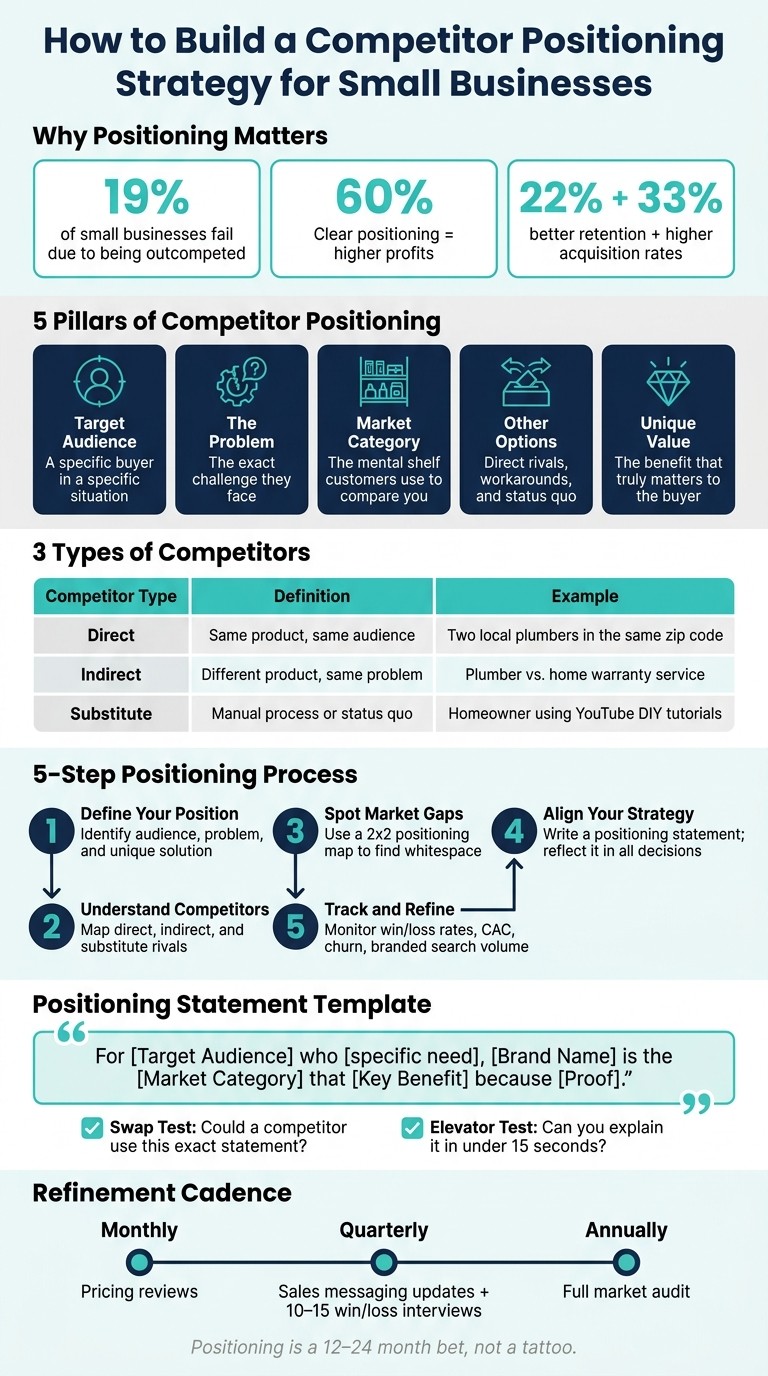
How to Build a Competitor Positioning Strategy for Small Businesses
Competitor Positioning Basics
What Is Competitor Positioning?
Competitor positioning is all about defining who your business serves, what problem you solve, the market you operate in, and the unique edge you bring to the table. While branding influences how you look and sound, positioning focuses on the value you deliver to your customers. Think of competitive analysis as your market map, and positioning as the exact spot you claim on that map.
When someone visits your homepage, they should understand within three seconds if you're the right fit - and why you're better than the alternatives. Nailing these basics is the foundation for effective competitor analysis.
Key Elements of Competitor Positioning
Effective positioning stands on five critical pillars:
Element | Description |
|---|---|
Target Audience | A well-defined buyer in a specific situation - not a broad group like "small businesses." |
The Problem | The exact challenge your customer is trying to solve. |
Market Category | The mental "shelf" where customers compare you to other options. |
Other Options Available | Alternatives your buyer might choose, including DIY solutions or simply doing nothing. |
Unique Value | The specific benefit you offer that solves the problem in a way that truly matters to the buyer. |
One common mistake small businesses make is ignoring competitive alternatives. Your competition isn't always a direct rival - it could be a workaround like using spreadsheets instead of software or even the decision to stick with the status quo. Addressing all three types of competition helps you refine your message and stand out.
To tie these elements together, many businesses use a straightforward internal statement:
"For [specific customer], we provide [category] that delivers [primary outcome] through [unique advantage], unlike [primary alternative]."
This isn't meant for external use - it’s an internal tool to ensure your pricing, features, and messaging stay aligned.
Why Positioning Matters for Small Businesses
Once you've got these elements in place, it's important to understand why precise positioning is critical. Vague positioning makes you blend into the crowd, but a focused approach can boost profits and customer retention.
Big brands often get away with unclear positioning because they have the resources to compensate with massive budgets and reach. As the AD Editorial Staff from Albee Digital explains:
"Large brands can survive unclear positioning through budget and reach. Small businesses cannot."
For smaller businesses, clear positioning means attracting the right customers and discouraging those who aren't a good fit. This improves lead quality without requiring extra spending. When your positioning resonates, the ideal customer immediately thinks, "This is exactly what I need."
However, strong positioning often requires making tough choices. As Ruud ten Have from Searchlab puts it:
"Positioning that doesn't lose anyone deliberately isn't positioning. It's hedging."
In other words, being specific means you won't appeal to everyone - and that's exactly the point.
8-Step Competitive Positioning Process (Find Your Difference)
How to Analyze Competitors and Find Market Opportunities
Building on the basics of competitor positioning, a deeper analysis can reveal where opportunities lie in your market.
How to Identify Your Competitors
Many small business owners tend to think of competition too narrowly. In reality, your competitive landscape includes three distinct layers:
Direct competitors: Businesses offering the same product to the same target audience.
Indirect competitors: Those providing a different product but solving the same underlying problem.
Substitute competitors: Alternatives that involve manual solutions or sticking to the status quo.
Competitor Type | Definition | Example |
|---|---|---|
Direct | Same product, same target audience | Two local plumbers serving the same zip code |
Indirect | Different product, same problem | A plumber versus a home warranty service |
Substitute | Manual process or status quo | A homeowner watching YouTube tutorials and choosing to DIY the fix |
"Status quo is often the number-one competitor. Never forget it." - Walter Von Roestel, CEO of FastStrat
To map out these layers, start by searching your main keywords on Google and note who shows up in the top 10 results. Then, look for "alternatives to [your product or service]" and explore the "People also search for" section for more insights.
How to Gather Competitor Insights
Once you've identified your competitors, it’s time to dive into their operations. Gathering this data is often free or low-cost. For instance:
Take screenshots of competitors' homepages to track changes in their messaging. A shift in their main headline can indicate a new strategy.
Use the Meta Ads Library to see which ads your competitors are running.
Monitor LinkedIn job postings - an increase in hiring for specific roles can hint at their future plans.
Customer reviews are another goldmine for insights. Focus on 3-star and 4-star reviews on platforms like Google or Yelp. These reviews often highlight areas where competitors fall short. Setting up Google Alerts for competitor names and relevant industry terms can also help you stay updated on new developments.
For a deeper dive into market data, tools like the Census Bureau's County Business Patterns (CBP) can provide geographic business statistics, while SEC EDGAR offers financial data for publicly traded competitors.
Armed with this information, you’ll be better equipped to identify gaps in the market.
How to Spot Gaps in the Market
With all the data you’ve gathered, it’s time to find the whitespace - those areas in the market that competitors haven’t claimed. A simple way to do this is by creating a 2x2 positioning map. Choose two factors that are important to your customers (e.g., "price" vs. "speed of delivery" or "DIY" vs. "done-for-you") and plot your competitors on the grid. Any empty quadrants can signal untapped opportunities.
Here’s an example: In 2026, a small video production agency analyzed their competitors and noticed that nearly everyone emphasized "quality." By using a positioning map, they found a gap for a boutique team delivering big-studio quality at mid-market speed. This repositioning helped them secure three new deals in just 60 days.
"The output of a good competitive analysis is a clear view of the competitive landscape, plus a specific position you can own within it." - Alexandra Thompson
Another helpful tool is the CR4 ratio, which measures the combined market share of the top four firms in your industry. A CR4 below 40% suggests a fragmented market, which might favor a cost-leadership or niche strategy. A CR4 above 60% indicates a concentrated market, where standing out through differentiation becomes critical. Understanding this ratio can simplify your decision-making when refining your positioning strategy.
How to Build Your Positioning Strategy
Once you've identified gaps in your market, the next step is to turn those insights into a strategy that shapes everything your business does.
How to Write a Positioning Statement
A positioning statement is your internal compass - a single sentence that keeps your team aligned on who you're targeting and the key benefit you offer. Here's a simple template to follow:
For [Target Audience] who [specific need], [Brand Name] is the [Market Category] that [Key Benefit] because [Proof].
Your target audience should be so clearly defined that you can name at least three real people who fit the description. And don't overlook the importance of "proof." Without evidence to back up your claim, your differentiator risks sounding like empty marketing. To test your statement's strength, use the Swap Test (if it works just as well for a competitor, it's too generic) and the Elevator Test (if you can't explain it in under 15 seconds, simplify it).
"If you can't explain why a customer should choose you over the alternative in one sentence, you don't have a positioning problem. You have a business problem." - KISSmetrics Editorial
How to Align Your Business Decisions with Your Positioning
A positioning statement only works if your business reflects it in practice. Think of it as your North Star, guiding decisions on pricing, service delivery, website messaging, and even which customers you choose not to serve.
Take Superhuman, for example. They built their brand around being the "fastest email experience" and rejected any features that could slow them down. For small businesses, the same principle applies. If you're known as the most reliable option, your operations need to back that up - whether that's through fixed quotes, written guarantees, or fast response times. Businesses with clear positioning enjoy 22% better customer retention and 33% higher acquisition rates compared to those without a defined focus. Sometimes, good positioning means saying no to certain customers so you can deliver exceptional service to the right ones. Just as competitor research helps you find market gaps, aligning your operations with your positioning strengthens your edge.
Using Gatsboy to Support Your Positioning
Once you've nailed down your positioning and aligned your business practices, your website should reinforce that promise. Every interaction - how you handle inquiries, accept payments, and more - either supports or undermines your position.
Gatsboy offers tools to help small businesses showcase their alignment. For example, its Google Reviews integration lets you display real customer feedback directly on your site, providing evidence of your credibility. If you're positioning yourself as the most trusted local option, reviews can be a powerful trust signal. Similarly, features like Online Bookings and Stripe Payments highlight availability positioning - making it easy for customers to engage with you. When someone can book and pay in minutes without back-and-forth emails, that seamless process communicates reliability before you've even spoken.
"The specialist almost always beats the generalist in the customer's mind." - KISSmetrics Editorial
For service businesses, how you deliver your service is just as critical as what you deliver. Gatsboy's advanced forms let you customize intake questions so that only the right leads self-qualify - keeping your pipeline filled with the audience your strategy is designed to target.
How to Track and Refine Your Positioning Over Time
Key Metrics to Track
Positioning isn’t a one-and-done effort - it requires ongoing measurement. Start by keeping an eye on win/loss rates against specific competitors, customer acquisition cost (CAC), and churn rate. These numbers reveal if your differentiation is delivering tangible results. Beyond the numbers, pay attention to how customers talk about your business. If a prospect says something like, "We chose you because you were the most reliable option", without being prompted, that’s a clear sign your positioning is hitting the mark. These insights confirm that your messaging stands out in the marketplace.
You should also track branded search volume and keyword rankings, especially for searches like “vs” or “alternative.” These metrics indicate how well your position is sticking in the minds of potential customers. Another metric to watch? How often AI tools recommend your business when buyers look up category suggestions - this is becoming an increasingly critical indicator.
How to Refine Your Strategy
Think of positioning as a living strategy that evolves over time, not a one-time decision. A good rule of thumb is to revisit and fine-tune your positioning every 12 to 24 months.
One of the most effective ways to refine your strategy is through win/loss interviews. Aim to conduct 10–15 interviews every quarter, splitting them between customers who chose you and those who didn’t. For lost deals, ask direct questions like, “What did you choose instead, and why?” These conversations can uncover unexpected competitors or messaging gaps you may have missed. To stay on top of things, plan for monthly pricing reviews, quarterly updates to sales messaging, and an annual market audit.
The insights you gather from these efforts can help you adjust your website and messaging to better reflect what your audience values most.
Using Gatsboy for Ongoing Performance Tracking
Incorporate these insights into your tracking efforts with tools like Gatsboy. Its business dashboard offers a centralized view of lead activity, bookings, and customer interactions, making it easier to spot trends and adjust your strategy without relying on guesswork.
The Google Reviews integration is another powerful feature. When customer reviews start reflecting the exact value claims in your marketing - like mentions of your speed or reliability - it’s a strong indicator that your positioning is resonating. On the flip side, if the language in reviews starts to drift away from your core messaging, it’s a signal to revisit and refine your strategy. Gatsboy’s advanced forms also capture valuable data on how new leads discover your business, creating a feedback loop that keeps your positioning grounded in real-world customer experiences.
Conclusion: Building a Positioning Strategy That Lasts
Competitor positioning isn’t a one-and-done effort - it’s a dynamic process that sets thriving businesses apart from those relying on fleeting taglines. Ruud ten Have, Marketing & AI Strategy expert at Searchlab, sums it up perfectly:
"Positioning is a 12-to-24-month bet, not a tattoo."
The stakes couldn’t be clearer. Research shows that 19% of small businesses fail due to poor competitive positioning. On the other hand, brands that prioritize customer-focused positioning enjoy profits 60% higher than those that don’t. The gap between success and failure is measurable - and it grows over time.
To stay ahead, you need to understand your competition, write a clear and compelling positioning statement, and align your decisions with it. Regularly reviewing your strategy is key: schedule monthly check-ins, quarterly updates, and an annual audit. A quick test to ensure your positioning stands out is the "Competitor Swap Test": if your homepage tagline could fit just as well on a competitor’s site, it’s time to rethink and refine.
Using data-driven tools can make this process even more effective. Platforms like Gatsboy offer features such as a business dashboard, Google Reviews integration, and advanced forms to provide continuous customer insights. These tools help keep your strategy grounded in real-world data.
"The goal of competitive positioning is not to be better at everything. It is to be definitively the best choice for a specific type of buyer in a specific situation." - GTM Playbook
FAQs
How do I pick the two axes for a positioning map?
When choosing axes for analysis, focus on what truly matters to your customers. Consider trade-offs they weigh when deciding on a purchase, such as speed vs. depth or self-serve vs. high-touch service. Steer clear of ambiguous terms like "quality", which are hard to measure and interpret.
To pinpoint relevant criteria, dive into resources like sales notes, customer feedback, and competitor analysis. These insights can reveal what drives customer decisions. Be cautious, though - if competitors are tightly grouped in one area of your chosen axes, it might indicate those dimensions aren't meaningful. The best axes should expose gaps in the market and highlight areas of tension where your offering can stand out.
What makes a positioning claim credible?
A positioning claim holds weight when backed by solid, current research and clear evidence from the market. This can come from sources like customer feedback, competitor analysis (such as pricing strategies or marketing approaches), and data that proves your unique edge. To make your claim even stronger, dive into comparisons of competitors' products or services, pinpoint gaps in the market, and ensure your distinct value matches what customers genuinely care about and experience.
When should I change my positioning?
If you’re noticing longer sales cycles, a dip in lead quality, or frequent pricing objections, it might be time to rethink your positioning. These are clear signs that your messaging or value proposition may no longer align with what your customers care about most.
Positioning isn't static - it should shift as the market evolves. A good rule of thumb is to revisit it every 12–24 months or sooner if your competitors make bold moves, like launching new products or tweaking their pricing strategies.
To stay ahead, leverage tools like Gatsboy, which helps small businesses monitor feedback and reviews. This kind of insight ensures you stay in tune with customer expectations and market trends.
Related Blog Posts
Join our community of 15,000+ business owners
Popular articles
Popular articles about your website and marketing your small business


