



How Testimonials Improve Online Bookings
Small Business Marketing
Testimonials help more people book because they lower risk at the last step. If someone likes your service but still hesitates, the right customer quote can help them move forward. In fact, 72% of people read reviews before taking action, and service businesses with 10+ testimonials can see 35% more booked appointments.
Here’s the short version:
Reviews build baseline trust on sites like Google and Yelp.
Testimonials let me place the right customer proof on my own pages.
The best quotes talk about results, price, timing, service quality, and ease of booking.
The best time to ask is right after a good result or kind comment.
Short, specific quotes near pricing, service pages, and booking forms can help more visitors finish the booking.
Photos, star ratings, and public reviews can make proof easier to scan.
A simple follow-up system keeps testimonials current instead of letting them sit for months.
A few numbers stand out:
72% of customers won’t act until they read reviews
12x more trust in customer reviews than business-written claims
35% more booked appointments for service businesses with 10 or more testimonials
Up to 25% higher click-through near calls to action when testimonials are placed well
30%+ more trust when a testimonial includes a photo
If I had to boil the whole article down to one point, it’s this: don’t just collect praise - collect specific proof and place it where people hesitate. That’s what helps turn visits into bookings.
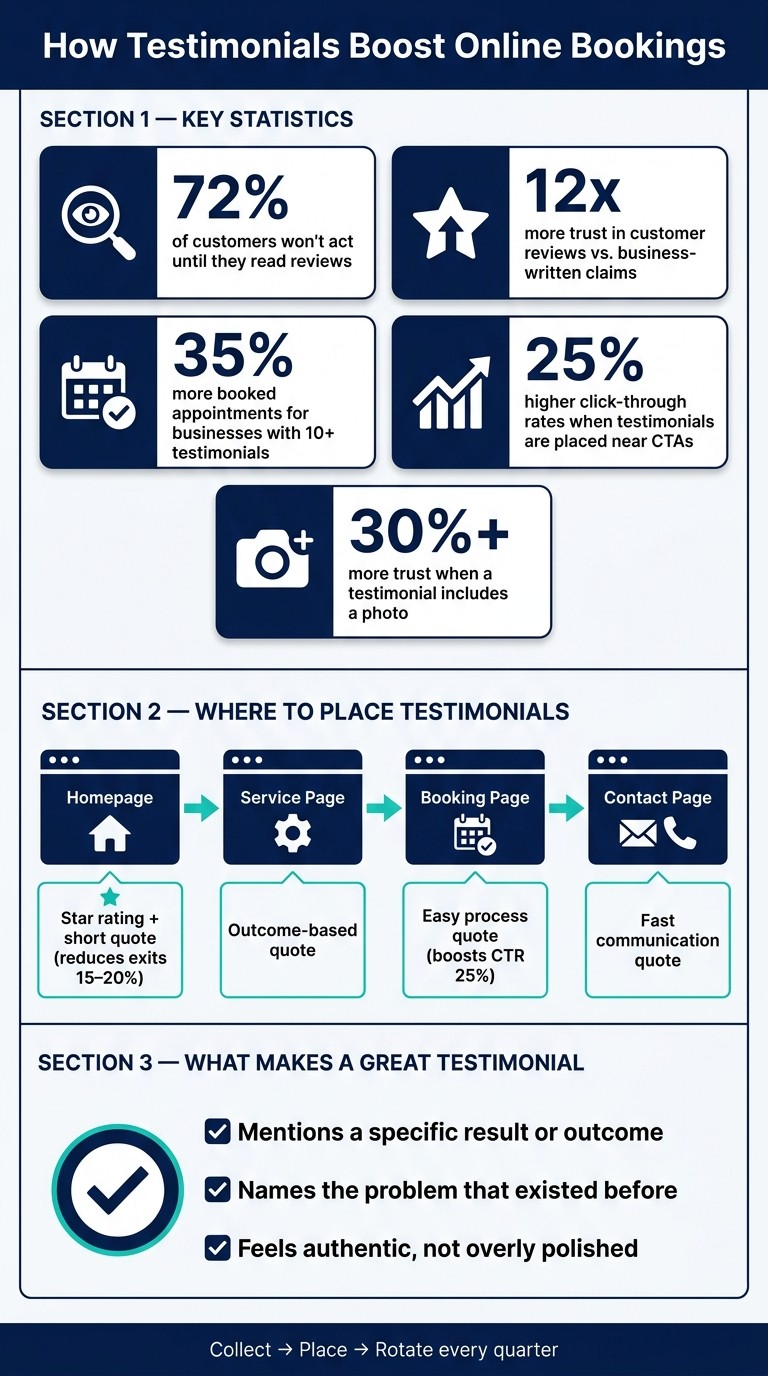
How Testimonials Boost Online Bookings: Key Stats & Placement Guide
Create Testimonials To Boost Your Credibility
How testimonials change booking decisions
When trust is the issue, testimonials help close the gap.
By the time someone lands on your booking page, they’re usually interested. But interest alone doesn’t get the appointment booked. People still want proof that they can count on you. Testimonials cut down that last bit of doubt by showing what the experience looked like for someone else. And the effect is clear: service businesses with 10 or more testimonials see a 35% increase in booked appointments.
Testimonials vs. reviews: how both build trust
Reviews are public comments posted on third-party sites like Google or Yelp, often with a star rating. You don’t control the wording or placement, and that’s part of why they carry weight. They feel like direct signals from actual customers.
Testimonials are quotes or short customer stories that you gather and place on your own site. You decide which ones to feature and where they appear. That gives you a big advantage: you can line up the right customer story with the exact concern a visitor has, whether that’s punctuality, price, or service quality.
Both play a part.
Reviews build baseline trust.
Testimonials add the right reassurance right where someone is about to book.
The goal isn’t to pile on more proof. It’s to show the kind of proof that answers the concern holding the person back.
What customers need to feel confident before they book
Before they commit, most people are silently running through the same checklist: Will this business be professional? Will they show up on time? Is the price fair for what I get? Will this work for me?
Your testimonials should answer those objections head-on.
Trust Signal | What Testimonials Should Address | How it helps bookings |
|---|---|---|
Professional service | Mentions of staff behavior and service quality | Builds brand authority |
Punctuality | Specific details on timing and reliability | Reduces fear of wasted time or money |
Value | Whether the experience was worth the cost | Supports higher price points |
Results | Proof of the actual outcome or experience | Moves visitors from uncertainty to action |
Ease of booking | Feedback on the booking or payment process | Reduces friction at the final step |
Generic praise like “great service” doesn’t do much. Specific comments about timing, professionalism, price, and results do. Those details answer the doubts that stop bookings.
That’s why the next move is simple: gather testimonials that speak to these exact concerns.
How to collect testimonials that help conversions
Getting strong testimonials isn’t just about having happy customers. You also need a simple, repeatable way to collect them. Ask at the right time, guide people toward specific details, and get clear permission to post what they share.
The aim is simple: gather proof you can place where people feel the most doubt before booking.
Start with timing. Then focus on prompts and permission.
Ask right after a positive result or compliment
"The single most important factor in getting a testimonial is timing." - Say About Us
If you ask too early, the outcome may not be clear yet. If you wait too long, people forget the details that make a testimonial useful.
The best time to ask is right after a clear win. That could be after a successful appointment, after a repeat visit, or right when a customer says something nice to you or your team. In that moment, the details are still fresh. And fresh testimonials are much easier to use on booking pages. Send a text or email with a single-click mobile form.
Use prompts that produce specific, believable details
A blank form tends to lead to generic praise. To get stronger responses, guide customers with three focused questions:
What was your specific challenge before booking?
What specific results did you get from the service?
Who would you recommend this service to, and what result would matter most to them?
You can also ask, "Can you share any specific numbers - like time saved or how quickly you saw results?" That kind of detail makes a testimonial more concrete and more convincing.
"The most effective testimonials share a specific outcome ('We reduced churn by 23% in the first quarter'), name the problem that existed before ('We were drowning in spreadsheets'), and feel authentic rather than polished to the point of sounding like ad copy." - Say About Us
Get permission and keep the format credible
Always get clear consent before you publish a customer’s name, photo, or edited quote. You can fix small grammar issues, but the customer should approve the final version before it goes live.
If someone doesn’t want their full name shared, use a format like first name, city, and service received. For example, Sarah M., Austin, TX - House Cleaning. It still feels believable without sharing too much.
Where to place testimonials to increase completed bookings
Once you have specific, credible testimonials, put them where booking hesitation is at its highest.
Collecting strong testimonials is only half the job. The other half is placement. Put them near pricing, booking forms, and service details, where people are weighing trust, cost, reliability, and how easy the booking process will be.
"A glowing 5-star review buried at the bottom of your About page is wasted. The same review next to your pricing CTA can increase conversions by 34%." - Shoutjar
Best pages for testimonials on a booking-focused website
Different pages deal with different doubts.
On your homepage, use one strong quote or an aggregate star rating above the fold, then add a small grid lower on the page. This can reduce early exits by 15% to 20%.
Your service pages are where people decide if a specific service is worth the cost. That makes them a good place for outcome-based quotes. This is the moment when visitors are asking themselves if your service is worth the risk.
Your booking page is the last hesitation point before checkout. A reassuring testimonial about an easy, low-stress process, placed right next to the booking form, can ease that last bit of friction. Testimonials near CTAs can increase click-through rates by 25%.
On your contact page, use a testimonial that points to fast, friendly communication. That small bit of proof can help turn hesitation into an inquiry.
Match testimonial content to common booking objections
Match each objection to the proof that answers it.
Customer objection | What to show | Recommended page placement |
|---|---|---|
Price feels too high | Value, results, and whether the service was worth the cost | Pricing section, service page |
I am not sure they are reliable | Punctuality, follow-through, and professionalism | Homepage, booking page |
I might not get a response | Fast communication and easy scheduling | Contact page, booking page |
I am not sure the quality will be good | Outcomes, consistency, and customer satisfaction | Service page, homepage |
Booking looks complicated | How simple the booking process was | Booking page |
Formats that make testimonials easier to trust and scan
Format matters.
People don’t study testimonials line by line. They scan. They want quick proof that says, “Yes, this looks safe.” Long paragraphs often get ignored. A short, specific quote with a name, job title, and photo is much easier to notice.
Including a photo with a testimonial increases trust by over 30%, while anonymous testimonials are 70% less trusted.
Use both text quotes and star ratings. You can also embed Google Reviews to add third-party proof.
Testimonial format | Strongest use case | Best website location |
|---|---|---|
Short quote | Quick trust signal near calls to action | Homepage, booking page |
Before-and-after story | Showing a clear problem and a measurable result | Service page |
Testimonial with star rating | Reinforcing satisfaction at a glance | Homepage, pricing section |
Embedded Google Reviews | Adding public, third-party verified proof | Homepage, contact page |
Photo testimonial | Making the feedback feel more personal and credible | Service page, about page |
Bold the key result so scanners catch it fast.
Build a simple testimonial system that improves bookings
Once you know where testimonials should go, the next step is simple: collect them and rotate them without creating extra work.
A repeatable testimonial system keeps your social proof current and matched to what visitors need to see before they book. Rotate featured testimonials every quarter so your homepage and booking page reflect current customer concerns.
Use one workflow for feedback, reviews, and booking follow-up
Tie post-service follow-up, feedback, and review requests into one workflow.
After a service or booking is done, send a short message built around three questions:
What was the challenge before the service?
What results did they get?
Who would they recommend it to?
Turn the strongest answers into testimonials, and guide happy customers to leave a Google Review. You can also use those same responses to shape your booking follow-up. That way, your best proof is ready for the pages where visitors are most likely to pause.
How Gatsboy can help small businesses use testimonials more effectively
One system can make this much easier to run. Gatsboy brings together Google Reviews, feedback forms, online bookings, and Stripe Payments, so visitors can go from proof to booking to payment in one flow.
Conclusion: Testimonials reduce risk and help more visitors book
Testimonials lower booking risk by clearing up the last doubts people have before they commit. A simple process keeps that proof current and useful over time.
FAQs
How many testimonials do I need?
There’s no magic number, but 3 to 5 highly specific, outcome-focused testimonials from real customers is a strong starting point.
As your business grows, having more testimonials matters even more. It shows scale and helps cut down skepticism.
What makes a testimonial believable?
A testimonial feels believable when it includes full attribution - like a real name, a photo, and, when possible, some form of verification.
It also helps when the testimonial gets specific. That means calling out the outcome, saying how long it took, and mentioning any bumps along the way instead of making everything sound perfect.
And timing matters too. A recent testimonial does a better job of showing what the current experience and quality look like.
Where should testimonials go on my website?
Place testimonials where they build trust at key decision points:
In the homepage hero section or right below the main headline
Near primary call-to-action buttons
In sign-up, purchase, or booking areas
A strong testimonial near the top can help ease skepticism early. Then, testimonials near checkout or sign-up can calm last-minute doubts and support more bookings.
Related Blog Posts
Join our community of 15,000+ business owners
Popular articles
Popular articles about your website and marketing your small business


