



124 Small Business Marketing Ideas for 2026
Small Business Marketing
Small businesses in 2026 face a tougher marketing environment, with challenges like economic uncertainty (66% of businesses cite this as a concern) and AI-driven search results reducing organic traffic. To stay competitive, speed and resourcefulness are key. This guide offers 124 actionable marketing strategies split into six categories to help businesses grow, even with tight budgets. Here's what you'll find:
Zero-Cost Marketing: Free tactics like optimizing your Google Business Profile, responding to reviews, and leveraging free tools like HubSpot CRM.
Low-Cost Digital Marketing: Affordable ideas such as retargeting ads, micro-influencer campaigns, and using AI tools for content creation.
Website Optimization: Improving website speed, mobile usability, and implementing SEO techniques to boost traffic and conversions.
Content and Social Media: Tips for creating engaging content, repurposing materials, and focusing on platforms like TikTok and Instagram.
Guerrilla and Creative Marketing: Out-of-the-box ideas like geofencing, QR codes, and partnerships with local businesses.
Service and Digital Product Marketing: Strategies for building trust, such as client portals, webinars, and personalized quizzes.
With 52% of small businesses managing marketing budgets under $1,000/month, these ideas focus on practical, no-code solutions that deliver results without requiring large teams or technical skills.
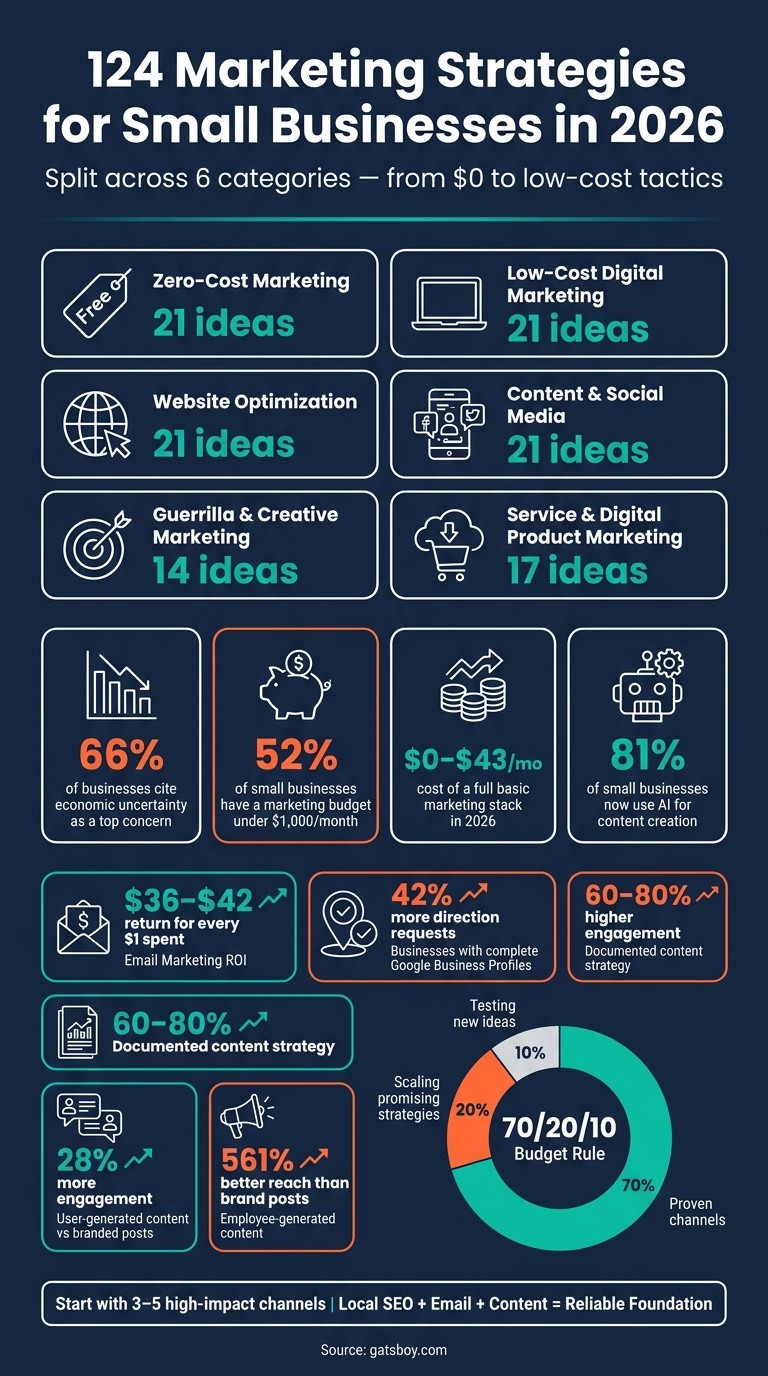
124 Small Business Marketing Ideas: Key Stats & Budget Breakdown 2026
Crazy Cheap Ways to Advertise Your Small Business in 2026 | ZERO Budget
1. Zero-Cost Marketing
Marketing doesn’t have to break the bank, especially for small businesses. Did you know that 46% of all Google searches have a local focus? That means there’s a large audience actively searching for businesses like yours - without costing you a dime.
Here are 21 practical ideas that require nothing but your time and dedication.
Claim Your Google Business Profile
Fill out every detail: business hours, photos, services, and a compelling description. Businesses with photos see 42% more direction requests. Regular updates, like weekly posts, signal activity to Google's algorithm - completely free.
Respond to Every Customer Review
Around 82% of consumers read online reviews for local businesses, with 88% trusting them as much as personal recommendations. Responding to reviews - good or bad - shows you’re engaged and builds trust.
Ask for Reviews After Service
Right after delivering a service or product, ask customers for a review during their "moment of satisfaction." Aiming for 5–10 new reviews monthly helps grow your credibility over time.
Use Local Keywords for "Near Me" Searches
Sprinkle local keywords across your website. For businesses serving multiple areas, create dedicated landing pages for each location to attract more targeted traffic.
Claim Directory Listings
Add your business to platforms like Google and Yelp, along with any industry-specific directories. Keep your Name, Address, and Phone (NAP) details consistent across all listings to avoid hurting your local rankings.
Start a Free Email Newsletter
Platforms like
Mailchimp offer free plans for up to 250 contacts and 500 emails per month. With email marketing delivering an average $36 return for every $1 spent, it’s worth the effort.
Leverage HubSpot’s Free CRM
HubSpot’s free CRM lets you manage up to 1,000 contacts with two users. It’s a great way to track leads and follow up efficiently.
Repurpose Blog Content for Social Media
Turn a single blog post into 5–10 bite-sized social media posts using free tools. One blog can fuel an entire week of engaging content.
Run Polls and Quizzes
Social media algorithms love interactive content. Polls and quizzes not only boost visibility but also provide insights into your audience’s preferences.
Post Short-Form Video
Platforms like TikTok, Reels, and YouTube Shorts offer incredible organic reach. A quick 30-second tip or behind-the-scenes clip can go a long way.
Showcase "Before and After" Results
Use photos or videos to highlight the transformation your services provide. These visuals perform well on social platforms and grab attention.
Encourage Employee Advocacy
Ask your team to share your brand’s content on their personal accounts. This simple step can expand your reach without spending a cent.
Be a Guest on Podcasts
Pitch yourself as a guest on podcasts that cater to your target audience. It’s a win-win: you gain exposure while offering valuable insights to listeners.
Engage in Reddit and Niche Forums
Join relevant forums and contribute by answering questions. This builds trust and establishes your expertise.
Offer a Free Lead Magnet
Create a one-page PDF, checklist, or template that solves a specific problem for your audience.
Canva’s free plan offers over 2 million templates to help you design it quickly.
Host a Free Webinar
Use platforms like Google Meet or Zoom to host a webinar on a popular topic. Record it to repurpose as a YouTube video or an email opt-in incentive.
Collaborate with Local Businesses
Partner with nearby businesses for events, newsletter swaps, or mutual referrals. Cross-promotion benefits both parties.
"Getting customers to refer other customers is a great way to get more out of your marketing dollars." - Jason Wong, Founder, Doe
Apply for Local Business Awards
Winning awards not only boosts your authority but also opens doors to free press coverage.
"Awards offer businesses a solid shot of authority, which is one of the keys to successful marketing; you want your audience to know that you offer the best of the best." - Stephen Light, CMO and Co-owner, Nolah
Share Customer Video Stories
Ask happy customers to record short, authentic video testimonials. These raw, unscripted clips often resonate more than polished ads.
Send Press Releases to Local Media
Write a concise, newsworthy press release about a new product, community effort, or milestone. Share it with local journalists and bloggers to gain free media coverage.
Track Performance with Free SEO Tools
Use
Google Search Console to monitor your website’s performance and identify any issues. Google Keyword Planner can help you discover new keyword opportunities - all at no cost.
These strategies lay a solid foundation for scaling your marketing efforts without spending a penny.
2. Low-Cost Digital Marketing
If you're ready to allocate a modest budget to marketing, even small investments can yield impressive results. For example, a basic setup that includes email tools, CRM, design software, and social media schedulers can cost as little as $0 to $43 per month by 2026. The key is to focus on 3–5 strategies and execute them consistently.
"The most common reason marketing fails for small businesses is... doing too many things at once with no system for measuring results." - StartupOwl Editorial Team
Much like no-cost strategies, these low-budget digital marketing tactics use modern tools to amplify your online presence without requiring significant spending. Here are 21 practical ideas to stretch your budget further:
Run Facebook or Instagram Retargeting Ads
Install the Facebook Pixel on your website to target ads at visitors who have already interacted with your site. Retargeting audiences are more likely to convert because they’re already familiar with your brand.
Try Streaming TV Ads
Platforms like Adwave make it possible to launch streaming TV ad campaigns starting at just $50. These ads boast a 94% completion rate, far higher than the 25% average for social media ads.
Use AI to Write Ad Copy
Tools like
AdCreative.ai (starting at $29/month) can generate ad creatives that improve performance by up to 40%.
Schedule Social Posts in Batches
Platforms like
Buffer offer free plans (3 channels, 10 posts per channel) that let you plan and schedule a week’s worth of content in one session. This can save up to 40% of the time spent on social media management.
Launch a Micro-Influencer Campaign
Collaborate with influencers who have 5,000–20,000 followers. They’re more affordable than larger influencers and often deliver better engagement rates. For example, The Tur-Shirt Company gifted products to parenting influencers on Instagram and generated £1,300 in sales over a single weekend in early 2026.
Add an Interactive Quiz to Your Website
A product recommendation quiz can guide visitors toward purchases while boosting engagement. Bluebird Provisions saw increased customer interaction and sales after adding a bone broth quiz to their site.
Collect SMS Leads with a Web Widget
Tools like
TextNinja (starting at $29/month) allow visitors to text you directly from your website. One healthcare business reported a 70% increase in homepage engagement after implementing this feature.
Optimize for Answer Engine Optimization (AEO)
Structure your content to answer specific questions that voice assistants and AI search tools rely on. This strategy is becoming as critical as traditional SEO.
Gatsboy’s AEO add-on ($147/month) helps local businesses appear in AI-driven search results.
Add Online Bookings to Your Website
If your business provides services, enabling online bookings directly on your site can reduce drop-offs and save time. Gatsboy offers a booking module that simplifies this process without requiring coding skills.
Use AI Tools for Email Personalization
Platforms like HubSpot use AI to segment email lists and optimize send times. Businesses using these features have reported up to a
3x improvement in lead conversion.
Upgrade to Canva Pro for Brand Consistency
For $12.99/month, Canva Pro’s Brand Kit ensures your fonts, colors, and logos stay consistent across all your posts and ads. As Ben Attwood, Founder of Clubhouse Skin, puts it:
"Design is one of the main things that unlocked doors for us that otherwise would've remained completely closed."
Use CapCut for Short-Form Video Editing
CapCut is a free tool that includes AI-powered auto-captions and templates designed for TikTok, Reels, and YouTube Shorts. It’s a quick way to create polished 20–60 second videos.
Promote a Mystery Box Offer
Bundle slow-moving inventory into discounted mystery boxes and promote them online. This approach can help clear stock while generating excitement and new orders.
Set Up a Link-in-Bio Page
Tools like Buffer’s Start Page let you turn a single social media profile link into a mini-website with links to your booking page, latest offers, or email sign-up.
Enable Online Payments on Your Website
Adding
Stripe-powered payments to your site eliminates the need for third-party checkout tools. Gatsboy integrates Stripe Payments, making it easy for small businesses to accept payments instantly.
Use UTM Parameters to Track Campaigns
Adding UTM tags to links in emails, social posts, or ads allows Google Analytics to track which campaigns drive traffic.
Use CallRail to Track Phone Leads
For businesses running digital ads, CallRail identifies which campaigns generate phone inquiries, bridging the gap between online efforts and offline results.
Add a Live Chat Widget to Your Site
A live chat feature captures visitors who have questions but may not fill out a form. This simple addition can help convert more traffic without increasing ad spend. Gatsboy includes live chat as part of its website tools.
Collect and Display Google Reviews
Embedding a Google Reviews feed on your website builds trust with visitors. Gatsboy’s integration automatically updates your latest reviews, keeping your social proof fresh.
Apply the 70/20/10 Budget Rule
Allocate
70% of your budget to proven channels, 20% to scaling promising strategies, and 10% to testing new ideas. This method keeps spending focused while allowing room for experimentation.
Clean Your Email List Regularly
Most email platforms charge based on contact count. Archiving subscribers who haven’t opened emails in six months or more can lower costs and improve open rates.
3. Website Optimization
Your website is your most reliable marketing tool - but only if it’s fast, easy to navigate, and designed to convert visitors into customers. With 68% of online experiences starting with a search engine and organic search driving 53% of all website traffic, even small tweaks to your site can make a noticeable difference in generating leads and sales. Below are 21 actionable tips to help you get more out of your existing website:
Fix your Core Web Vitals: Google evaluates three key performance metrics: Largest Contentful Paint (LCP under 2.5s), Interaction to Next Paint (INP under 200ms), and Cumulative Layout Shift (CLS under 0.1). About 43% of websites fail the INP benchmark, which directly impacts rankings and user experience.
Reduce third-party scripts: Each additional widget, heatmap tool, or ad pixel can slow your site down. Audit your scripts and remove any you’re not actively using to improve INP scores.
Switch to WebP or AVIF images: WebP images are generally 26% smaller than equivalent PNGs. Compress and convert your images, and ensure nothing above the fold exceeds 150KB.
Enable Gzip or Brotli compression: These server-side tools shrink the size of HTML, CSS, and JavaScript files, speeding up load times without altering your site’s design.
Use a Content Delivery Network (CDN): A CDN stores copies of your site on servers worldwide, allowing users to load pages from the nearest location. This is especially helpful if your audience is spread across the U.S..
Preload your hero image: Your LCP score often depends on how quickly your main above-the-fold image loads. Preloading this image ensures the browser prioritizes it over other resources.
Focus on service and pricing pages: Dedicate 70% of your SEO efforts to commercial pages - like services, pricing, and booking pages - because these are where visitors are most likely to convert.
Add schema markup: Include LocalBusiness, FAQ, and Product schema on your pages. These improve your chances of appearing in rich results on Google and being cited in AI-generated overviews.
Optimize for Generative Engine Optimization (GEO): AI tools like ChatGPT, Perplexity, and Google AI Overviews now factor into 26% of U.S. queries. Structure your content with clear, direct answers to increase the likelihood of being cited.
"Ranking #1 is no longer enough. You need to be cited as a source inside the AI Overview, or be the page a user clicks when they still want the full answer." - Walter Von Roestel, Author
Build topic clusters: Create a strong pillar page on a core topic, then link it to 6–15 supporting posts covering related subtopics. This approach signals expertise to search engines and keeps visitors engaged longer.
Test on real mobile devices: Google now uses mobile-first indexing, meaning it ranks your mobile site before your desktop version. With 73% of small business website traffic projected to come from mobile by 2026, testing on actual phones is a must.
Simplify forms: Keep contact and lead forms to four fields or fewer. Each additional field decreases the likelihood of completion.
Highlight your value proposition above the fold: Visitors decide within 5 seconds whether to stay or leave. Your headline and subheading should clearly state what you do, who it’s for, and why it matters.
Use sticky headers for navigation: A sticky header ensures your navigation and call-to-action are always visible as users scroll, making it easier for them to take the next step.
Fix broken links and 404 errors: High volumes of 404 errors frustrate visitors and waste server resources. Use tools like Google Search Console or free crawlers to identify and fix them regularly.
Add SSL if you haven’t already: Websites without HTTPS are flagged as “Not Secure” by browsers, which undermines trust and negatively affects SEO. Most hosting platforms now include SSL for free.
Optimize your fonts: Stick to 1–2 font families and use
font-display: swapto ensure text remains visible while fonts load.Run a speed audit with free tools: Tools like Google PageSpeed Insights, GTmetrix, and Lighthouse provide a prioritized list of fixes to improve your site’s performance.
Make your site accessible: Use high-contrast colors and add descriptive alt text to images. Accessibility not only improves rankings but also broadens your audience.
Keep one goal per page: Each page should guide visitors toward a single, clear action - whether it’s booking a call, filling out a form, or making a purchase. Avoid multiple competing calls-to-action, which can dilute focus.
"A $15,000 beautiful website that generates zero leads is worse than a $5,000 simple site that brings in 20 qualified inquiries per month." - Inzimam Ul Haq, Founder, Codivox
Use Gatsboy’s built-in modules to simplify functionality: Features like online bookings, lead capture forms, Google Reviews, and Stripe Payments often require plugins or developers. Gatsboy’s small business websites include these as built-in modules, so you can activate them without any coding.
These steps can help you turn your website into an efficient, high-performing tool that drives meaningful results for your business.
4. Content and Social Media
Once your website is optimized for conversions, it’s time to focus on creating engaging content and using social media effectively. With 96% of American small businesses active on social media by 2026, the challenge isn’t just showing up - it’s making an impact without overextending yourself. The key is a focused, consistent strategy that avoids the pitfalls of trying to do too much. Here are 21 practical, no-code ideas to help you grow your audience and build on the digital marketing strategies you’ve already implemented.
Start with one platform: Concentrate on the 1–2 platforms where your audience is most active. Spreading yourself too thin often leads to lower-quality results.
Follow the 40-25-20-15 rule: Divide your content into 40% educational, 25% behind-the-scenes, 20% social proof, and 15% promotional. This keeps your posts engaging without overwhelming followers with sales pitches.
Focus on short-form vertical videos: Formats like Reels, TikToks, and YouTube Shorts dominate in 2026. All you need is a smartphone and good lighting to get started.
Always include subtitles: Since 85% of social video is watched without sound, captions are essential for making your videos accessible.
Batch your content weekly: Dedicate 90 minutes each week to filming and scheduling posts. This keeps your content consistent and avoids the daily scramble.
Repurpose long-form content: Turn a single blog post into multiple pieces of content, like LinkedIn posts, newsletter snippets, and short videos, to maximize its reach across platforms.
Prioritize depth over volume: A well-researched 1,500–3,000-word guide will outperform multiple surface-level posts when it comes to building authority.
Optimize for AI-driven search: Use clear headers and concise answers in your content to increase visibility in AI-powered tools like Google AI Overviews and ChatGPT.
Start building an email list immediately: Email marketing offers an impressive return of $36 to $42 for every $1 spent. Free tools like Mailchimp make it easy to get started.
Adopt a 10-minute daily engagement routine: Spend 3 minutes replying to comments, 3 engaging with similar accounts, 2 on DMs, and 2 resharing customer content. These small efforts add up over time.
Encourage user-generated content (UGC): Posts created by your customers generate 28% more engagement than branded content. Ask them to tag you, and reshare their posts with credit.
Experiment with interactive formats: Simple ideas like "This or That" polls, myth-busting posts, or behind-the-scenes clips are easy to produce and consistently perform well.
Use AI tools for captions and scripts: Free tools like ChatGPT or Claude can help you brainstorm ideas, draft captions, and write video scripts efficiently.
Create visuals with Canva: Canva’s free plan offers millions of templates, while the Pro version ($12.99/month) adds features like brand kits and AI-assisted design tools.
Schedule posts with Buffer: Buffer’s free plan lets you manage 3 channels with 10 scheduled posts each. The Essentials plan ($6/month per channel) offers unlimited scheduling and analytics.
Add AI-generated music to videos: Use AI tools to create copyright-free background music for videos, avoiding platform restrictions and licensing fees.
Be transparent about AI use: Honesty about incorporating AI in your content builds trust and sets you apart in 2026.
Optimize for social search: As more users turn to platforms like TikTok and Instagram to discover businesses, include location-specific keywords and clear descriptions in your captions and bios.
Build a private community: Platforms like Circle, Slack, or Mighty Networks allow you to create a space you own, ensuring your audience isn’t at the mercy of social media algorithms.
Document your strategy: Businesses with a documented content plan see 60% to 80% higher engagement. Even a one-page outline can make a big difference.
Embed social feeds on your website: Tools like Smash Balloon ($49/year) let you display live Instagram or Facebook feeds directly on your site. Alternatively, use built-in modules like Gatsboy’s social feed feature to keep your site fresh without manual updates.
These tips round out your toolkit for building a strong online presence in 2026, pairing content creation with smart social media strategies to engage and grow your audience effectively.
5. Guerrilla and Creative Marketing
Content and social media are great starting points for marketing, but sometimes the most unforgettable campaigns come from thinking completely outside the box. Guerrilla marketing thrives on being bold, surprising, and resourceful - often with minimal or no budget. With 53% of small businesses growing through word of mouth, unconventional tactics that get people talking can lead to outstanding results. These approaches don’t replace your core strategies - they enhance them, offering fresh ways to grab attention and build excitement without breaking the bank.
Here are some guerrilla and creative ideas to inspire your next campaign:
Set up geofencing near competitors: Use virtual boundaries around competing businesses to send targeted mobile ads or exclusive offers to nearby customers.
Collaborate with micro-influencers: Swap products with local niche influencers in exchange for authentic posts. All you need is a great product and a personalized pitch - no cash required.
Create packaging that’s camera-ready: Design visually appealing packaging that encourages customers to share unboxing videos, generating organic buzz.
Add QR codes to physical materials: Use flyers, stickers, or signs with QR codes to guide offline audiences to your online content or store.
Team up with local businesses: Partner with a non-competing business for events or promotions, like a bakery and a flower shop hosting a joint pop-up to attract shared audiences.
Write playful product descriptions: Use fun, lighthearted copy like “Gifts you might just keep for yourself” to add personality and encourage clicks without being overly pushy.
Build excitement with waitlists: Instead of a typical launch, create buzz by offering an opt-in waitlist, making customers feel like they’re part of something exclusive.
Optimize for voice search: Tailor your content to answer conversational queries like “What’s the best pizza place in Denver?” to capture voice-activated searches on devices like Alexa or Google Assistant.
Blend interests into your brand identity: Combine overlapping themes - like wellness and eco-consciousness or tech and travel - to make your brand more relatable and memorable.
Use affordable digital signage: Turn a Fire Stick or Google Chromecast into a budget-friendly digital display for in-store promotions. These devices are easy to set up and require no technical know-how.
Focus on local search intent: Enhance your Google Business Profile and optimize location-specific content to rank higher in the 46% of Google searches that are local.
Share hyper-local content: Post short videos featuring well-known local spots or neighborhood details to connect with your community and boost visibility.
Simplify online payments: Add easy payment links or booking buttons - like those offered through Gatsboy’s Stripe Payments integration - to make the buying process seamless.
Showcase a multi-faceted brand: Don’t feel confined to one niche. Brands with depth and variety in their messaging often attract more loyal and engaged followers over time.
These ideas aren’t just about being different - they’re about connecting with your audience in ways that feel fresh and engaging. Sometimes, a little creativity is all it takes to turn heads and spark conversations.
6. Service and Digital Product Marketing
When marketing services and digital products, the challenge often lies in earning trust for something intangible. Since customers can't physically interact with these offerings before committing, your strategy needs to focus on building credibility, showcasing value, and simplifying the decision-making process.
Here are some effective ideas to help you market your services and digital products:
Publish long-form guides: Detailed guides can position you as an expert in your field. For instance, a consultant or lawyer might write "How to File an LLC in Texas in 2026" to establish authority.
Use a website quiz: Offering a personalized quiz can guide potential customers to the right solution while building trust. Connor Meakin, Founder of Bluebird Provisions, shares:
"People seem to love the quiz, they seem to love having a personalized recommendation." - Connor Meakin, Founder, Bluebird Provisions
Integrate an AI chatbot: AI chatbots can handle inquiries, qualify leads, and even book appointments 24/7 - saving time and improving efficiency.
Build a client portal: A private, professional space for clients to access deliverables, communicate, and track progress enhances the customer experience.
Automate digital product delivery: Use tools like Zapier to connect platforms such as Stripe and Mailchimp, ensuring instant delivery of downloads or access links after purchase.
Co-host webinars with partners: Collaborate with a non-competing business to deliver value through educational webinars. Follow up with attendees to convert interest into action.
Leverage industry awards and referral programs: Awards boost your authority, while referral programs encourage satisfied clients to spread the word. Stephen Light, CMO and Co-owner of Nolah, highlights the importance:
"Awards offer businesses a solid shot of authority, which is one of the keys to successful marketing; you want your audience to know that you offer the best of the best." - Stephen Light, CMO and Co-owner, Nolah
Jason Wong, Founder of Doe, adds:
"Getting customers to refer other customers is a great way to get more out of your marketing dollars." - Jason Wong, Founder, Doe
Refresh older content regularly: Updating your guides and service pages every 60–90 days can help maintain search visibility as rankings shift.
Post short demo videos: Quick 20–60 second clips demonstrating your service or showcasing digital product features can build trust fast, especially on platforms like Instagram Reels and TikTok.
Share behind-the-scenes content: Offering an authentic glimpse into your process or workspace can create a personal connection that resonates more than polished promotional content.
Optimize for AI search (AEO): Structure content to provide direct answers, making it easier for AI tools to recognize and cite your expertise.
Launch a digital mystery bundle: Combine slower-moving digital assets like templates or guides into a discounted mystery bundle to spark interest and drive impulse purchases.
Test demand with a micro-SaaS: Yannis, a marketer, validated his idea for PrintPigeon, a document mailing tool, by launching it in just three days with $38 in credits and $100 in Google Ads. This approach minimizes risk while testing the market.
Add thought leadership on LinkedIn: Publishing insightful articles and commentary on LinkedIn can establish you as a trusted authority in B2B services, especially in fields like consulting or accounting.
Create comparison pages: Develop transparent pages that compare your service to competitors, highlighting your unique advantages to help buyers make informed decisions.
Streamline client interactions: Adding tools like online booking modules to your website can make scheduling consultations seamless and convenient.
Encourage employee-generated content: Stories shared by your employees can significantly amplify your reach, with such content performing up to 561% better than posts from your brand.
Conclusion
With 124 ideas spanning zero-cost tactics, digital tools, content strategies, and service marketing, the real challenge is narrowing down the high-impact, no-code strategies that align with your business goals. As Ben Kazinik, Senior SEO Manager at monday.com, explains:
"Small business marketing success depends on systematic execution rather than sporadic bursts of activity."
To make the most of your efforts, start with the 70/20/10 rule and focus on 3–5 high-impact channels. For many small businesses, local SEO, email marketing, and content creation are reliable starting points. Build repeatable workflows around these areas to ensure consistent results.
The tools available in 2026 make it possible for smaller teams to compete effectively with larger players. For instance, 81% of small businesses now leverage AI for content creation, and you can get started with a marketing stack for as little as $0–$43 per month. Platforms like Gatsboy simplify the process even further by offering done-for-you website builds that include essential tools for bookings, lead collection, reviews, and payments - all without needing a developer.
Success comes down to focusing on what truly drives results. As Omid G, Founder of Marketer Milk, wisely points out:
"Your competitive advantage as a marketer is in your taste. It's in how you think about the design of things, whether it's a logo, a content strategy, or a customer journey."
FAQs
Which 3–5 marketing ideas should I start with first?
Claim and refine your Google Business Profile: This step is key for increasing local visibility and drawing in nearby customers who are searching for services like yours.
Consistently share content across platforms: Leverage AI tools to streamline your posting schedule and keep your audience engaged without overloading your team.
Take advantage of free tools: Platforms like Google Business Profile, Canva, and Mailchimp can help you grow your online presence without stretching your budget.
Prioritize SEO: Create blogs, FAQs, and short-form videos to bring in organic traffic and ensure your content aligns with what your audience is searching for.
Enhance your website and local listings: A well-optimized website and accurate local listings build trust and make it easier for people to find your business.
How can I track what’s working with a small budget?
To make the most of your efforts without spending a fortune, take advantage of free or affordable tools like Google Business Profile, email marketing platforms, and social media analytics. These tools can help you keep an eye on important metrics such as engagement rates, click-through rates, and conversions.
Make sure to set clear KPIs (Key Performance Indicators) that match your goals - whether that's increasing website traffic, boosting sales, or something else. Regularly reviewing your performance will allow you to spot what's working and refine your approach. Over time, consistent tracking will help you focus on the strategies that deliver the best results while staying within your budget.
How can I show up in AI search results in 2026?
To show up in AI search results by 2026, it's all about crafting top-notch, authoritative content that AI systems will want to reference. Make sure your website is tailored for AI-driven algorithms, and focus on building trust by consistently publishing reliable content.
Get your name out there by being featured on well-respected platforms and mentioned in trusted sources. Use no-code tools to streamline optimization efforts, and align your digital assets with emerging AI search trends. These steps can help boost your visibility in the evolving search landscape.
Related Blog Posts
Join our community of 15,000+ business owners
Popular articles
Popular articles about your website and marketing your small business


