



Why Small Businesses Need Email Lists
Small Business Marketing
Email lists are one of the most effective tools for small businesses. Unlike social media, email gives you full control over how you reach your audience - no algorithms, no platform restrictions. Plus, email marketing is cost-efficient and delivers a high return on investment (ROI), with studies showing you can earn $36–$52 for every $1 spent. It’s also personal, direct, and consistently reliable, as 93% of people check their inbox daily.
Key benefits include:
High ROI: Email outperforms most other marketing channels in revenue generation.
Ownership: You fully control your email list, unlike social media followers.
Customer Retention: Build loyalty with nurturing campaigns and personalized content.
Traffic & Sales: Emails directly drive website visits and purchases.
Scalability: Start small with free tools and grow as your business expands.
To build your list, offer lead magnets like discounts, templates, or quizzes, and promote sign-ups across your website, social media, and in-store. Use automation tools to save time and segment your audience for better engagement. Regularly clean your list to maintain high deliverability and avoid spam issues.
Email marketing remains an essential strategy for growing your business - cost-effective, measurable, and a direct line to your audience.
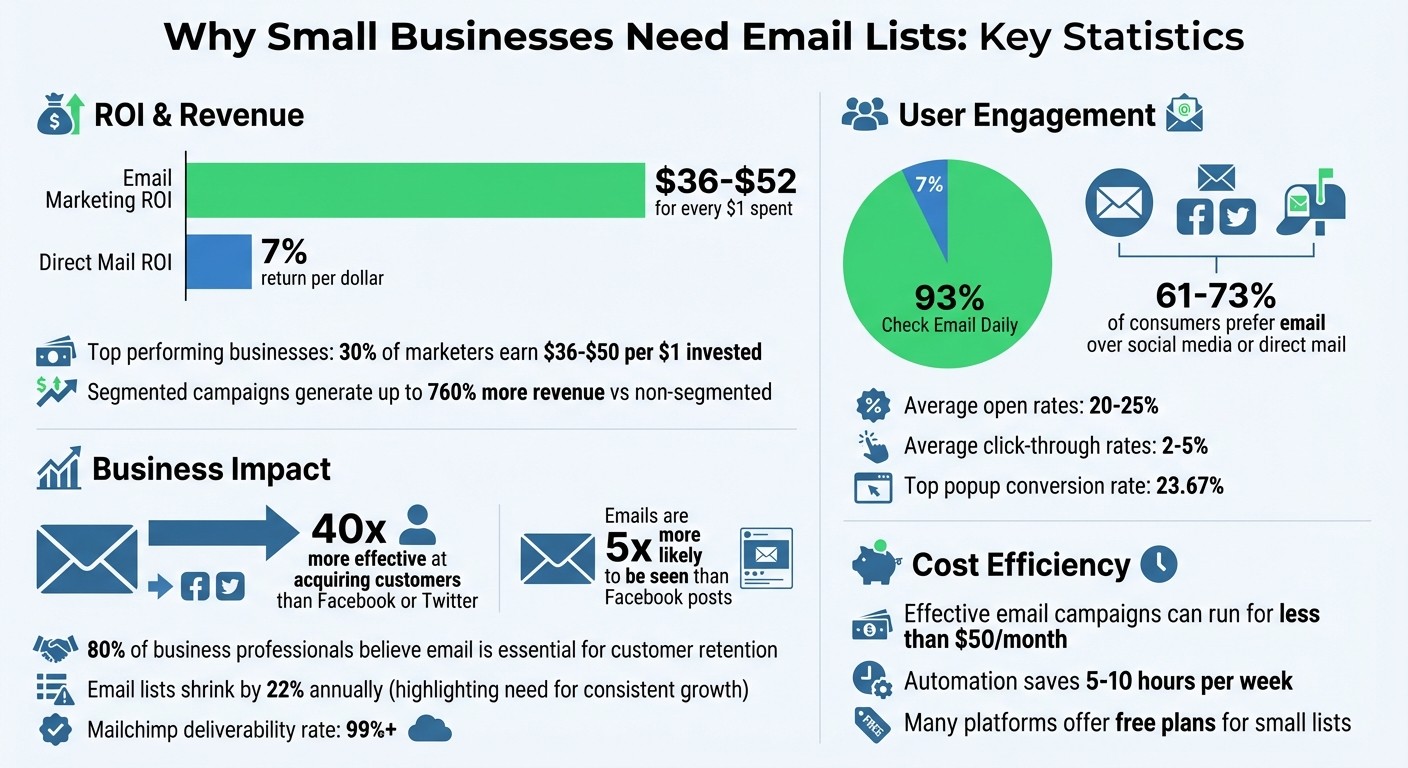
Email Marketing ROI and Key Statistics for Small Businesses
A beginner's guide to email marketing (for small businesses)
Why Email Lists Matter for Small Businesses
Email lists are a game-changer for small businesses aiming for steady growth. Unlike social media platforms, where algorithms can hide your content or accounts can be disabled unexpectedly, your email list is entirely yours. You can switch email providers, segment your audience in countless ways, and communicate directly with your subscribers without interference.
But the perks go beyond control. Email provides clear, actionable data - like open rates, click-throughs, and conversions - that directly tie to your revenue. In contrast, social media often focuses on "vanity metrics" like likes and shares, which don’t always show actual impact. Plus, your email audience has willingly opted in, meaning they’re already interested in what you offer. This combination of ownership and engagement makes email a powerful tool for driving business success.
Email Marketing Delivers High ROI
Email marketing is one of the most cost-effective marketing tools out there. Depending on the study, it generates between $38 and $52 for every $1 spent. Compare that to direct mail, which only nets about a 7% return per dollar. For small businesses with tight budgets, email marketing is an affordable way to achieve big results.
Even better, you can run an effective email campaign for less than $50 a month. Many platforms even offer free plans for businesses just starting to build their lists. You don’t need expensive tools or a large team - just a consistent way to deliver value to subscribers.
Email is also the preferred marketing channel for many people. Between 61% and 73% of consumers say they prefer email over social media or direct mail. And since 93% of people check their email daily, your message is far more likely to be seen than a social media post that might get lost in the shuffle.
Better Customer Retention and Loyalty
Email isn’t just for attracting new customers - it’s an incredible way to keep the ones you already have. In fact, 80% of business professionals believe email is essential for retaining customers. Why? Because it allows you to build ongoing relationships rather than relying on one-time transactions.
Modern email newsletters are no longer just dull company updates. As Lisa Slater, a copywriter and author, explains:
"View [newsletters] as an opportunity to communicate with people who care about what you have to say... View them as a community you want to engage with. Give value, and you'll get value back".
Sharing behind-the-scenes stories, personal insights, or exclusive content helps create a sense of belonging. Subscribers feel like part of a community, not just names on a list. This emotional connection can make a big difference. Marketing expert Jessica Campos highlights:
"Email and social media are great ways to build that connection with your audience and customers. Transactional emails and coupon codes are one thing, but you'll miss out if you don't create nurturing campaigns".
By moving beyond promotional emails to nurturing campaigns, you can build long-term relationships. These campaigns keep your brand in customers’ minds, encourage repeat purchases, and even inspire word-of-mouth recommendations.
More Website Traffic and Sales
Emails aren’t just about loyalty - they’re a direct way to drive traffic and boost sales. Unlike social media or SEO, email bypasses unpredictable algorithms. When you send an email linking to a blog post, product launch, or special offer, it lands directly in your subscribers’ inboxes. Whether they open it depends on the quality of your subject line and content, but at least you know it reached them.
Emails can also have a big impact on sales. With well-placed calls-to-action (CTAs), you can guide subscribers through the sales funnel - from awareness to purchase. For e-commerce businesses, automated workflows like abandoned cart emails can recover lost sales. For example, a reminder with a small discount can nudge someone to complete their purchase.
Small business emails typically see open rates of 20–25% and click-through rates of 2–5%. While these percentages might sound modest, they translate to real results when you’re working with an engaged list. The secret is segmentation - sending targeted emails based on purchase history or interests performs much better than generic blasts.
Email Type | Goal | Content Structure |
|---|---|---|
Promotional | Drive immediate sales | Hook → Offer → CTA |
Educational | Build authority/traffic | Problem → Tip → CTA |
Relationship-building | Increase loyalty | Personal story → Insight → CTA |
Abandoned Cart | Recover lost revenue | Reminder → Incentive → Checkout Link |
What makes email so effective is its versatility. You can send a promotional email today to boost this week’s sales, then follow up with educational content that builds your credibility. Over time, this mix of value and offers ensures your business stays top-of-mind when subscribers are ready to buy.
How to Build Your Email List
Growing your email list starts with offering clear benefits and making the signup process seamless. A great way to encourage sign-ups is by providing a lead magnet.
Provide Valuable Incentives
A lead magnet is something you offer in exchange for an email address. The key is to solve a specific, immediate problem rather than promising long-term benefits. For example, templates and checklists often outperform generic ebooks because they deliver quick, actionable results.
The type of lead magnet you choose should align with your audience. B2C businesses often succeed with discount codes, cheat sheets, or giveaway entries. Onyx Cookware, a Scandinavian brand, achieved a 43.03% conversion rate by offering giveaway entries instead of discounts. On the other hand, B2B audiences are more likely to engage with original research, ROI calculators, or case studies that help them make informed decisions.
Interactive lead magnets can be even more engaging. Tools like quizzes, calculators, or product recommendations keep visitors invested. For instance, Ditur, a watch and accessories brand, used a gamified "scratch-to-win" signup form and achieved a 43.03% conversion rate. Similarly, MCH, a Scandinavian experience center, ran an advent calendar campaign with daily reveals, reaching an impressive 81% conversion rate as subscribers returned for 24 consecutive days.
Another effective approach is offering content upgrades - bonus materials tied to specific blog posts. For example, if someone is reading an article on social media tips, you could provide a downloadable checklist or template on the same topic. This works because the reader is already engaged and eager for more.
Lead Magnet Type | Best For | Effort Level |
|---|---|---|
Checklists/Cheat Sheets | B2C & B2B | Low |
Discount Codes | E-commerce/Retail | Low |
Templates/Worksheets | Service-based/B2B | Medium |
Quizzes/Calculators | Personalized Recommendations | Medium |
Original Research | B2B Authority Building | High |
Mini-Courses/Webinars | Education/Coaching | High |
Add Sign-Up Forms and Pop-Ups
Once you have a lead magnet, you'll need forms to collect email addresses. The placement and timing of these forms can significantly impact conversion rates. While the average website popup converts at 3.8%, the top-performing ones exceed 23.67%.
Start by embedding forms in high-traffic areas like the top of your homepage, at the end of blog posts, on your "About" page, or in the sidebar of popular pages. Initially, only ask for an email address; you can gather additional details later through progressive profiling.
To boost results, add targeted pop-ups. These work best when triggered strategically, not immediately. For example, set pop-ups to appear after a visitor scrolls halfway down a page or spends at least 30 seconds browsing. Exit-intent pop-ups are particularly effective - they appear when someone's cursor moves toward the close button, offering a final incentive. BilligParfume, a Danish beauty retailer, used this strategy during Black Friday and achieved a 61.3% conversion rate with tailored product offers.
Replace generic "Subscribe" buttons with benefit-driven calls-to-action (CTAs) like "Get Your Free Template" or "Access Exclusive Content". For mobile users, ensure buttons are at least 44x44 pixels, and opt for small tabs instead of full-screen popups to avoid frustrating the user.
Promote Sign-Ups Everywhere
Your website isn't the only place to collect email addresses. Extending your efforts across multiple channels is crucial since email marketing is 40 times more effective at acquiring new customers than Facebook or Twitter. Plus, emails are 5 times more likely to be seen than Facebook posts.
On social media, include a direct link to your lead magnet in your Instagram bio and use "Link" stickers in Stories to drive sign-ups. For YouTube, add a signup link in video descriptions and pinned comments. TikTok offers built-in Lead Generation tools that can be used during "Live" sessions.
For brick-and-mortar businesses, the point of sale is a prime opportunity. Paradise Pen Co., a stationery company, collected 80% of its customer emails in-store by offering immediate discounts at checkout. Train your team to ask for emails with a clear benefit, like "Join our VIP list for 10% off today's purchase".
Don't forget offline-to-online opportunities. Add QR codes to business cards, receipts, and in-store displays that lead to a mobile-friendly signup form. Even your email signature can help - include a brief value proposition like "Get weekly marketing tips" along with a signup link. Every interaction is a chance to grow your list.
Joe Pulizzi, founder of Content Marketing Institute, emphasizes the importance of email lists:
"If I have one regret as a business owner, it's not focusing on building our email list earlier in the process".
Since email lists naturally shrink by about 22% annually, promoting sign-ups consistently across all channels is essential to keep your list healthy.
How to Manage and Grow Your Email List
Building your email list is just the first step. To keep it thriving and profitable, you need to manage it actively and adapt your communication to match your subscribers' preferences.
Segment Your Subscribers
Segmenting your audience means dividing them into groups based on behavior, preferences, or demographics. This approach allows you to send emails that resonate with specific audiences. And here's the kicker - segmented campaigns can generate up to 760% more revenue compared to non-segmented ones.
Start simple: create two main groups - customers and non-customers. As your list grows beyond 1,000 subscribers, add more layers, such as engagement levels.
A particularly effective strategy is RFM scoring, which categorizes customers based on three factors:
Recency: How recently they made a purchase.
Frequency: How often they buy.
Monetary Value: How much they typically spend.
RFM scoring helps you identify your top customers and those who may be at risk of disengaging. For example, you can avoid sending discount offers to someone who just paid full price by using exclusion logic. Andie Swim took segmentation to the next level by introducing a 12-question "Fit Finder" quiz that tagged subscribers based on their style and fit preferences. The result? Over $70,000 in revenue within eight months and a 55% year-over-year growth.
Another standout example is EasyJet. By leveraging hyper-segmented campaigns based on traveler data, they suggested personalized destinations, achieving a 7.5% booking rate - 14 times better than their generic promotional emails.
Once you've segmented your list, the next step is ensuring its quality through regular cleanups.
Clean Your List Regularly
Maintaining a healthy email list is crucial. If you don't remove inactive or invalid addresses, your engagement rates can plummet, and email providers might start flagging your messages as spam.
Start by identifying:
Hard bounces: These occur when an email address doesn't exist. Remove these immediately.
Soft bounces: These are temporary issues, like a full inbox. Give them a few months to resolve before taking action.
For subscribers who haven't interacted with your emails in 90 to 180 days, try a re-engagement campaign. This could include 2 to 4 emails with subject lines like "We miss you" or a special offer. If they remain unresponsive, it's time to let them go. As Mailchimp wisely puts it:
"Ten thousand uninterested subscribers generate fewer sales than 500 engaged ones. Quality trumps quantity every time".
Aim to clean your list twice a year to keep your data accurate and compliant with regulations.
Once your list is segmented and clean, automation can take your email marketing to the next level.
Automate Your Email Workflows
With a segmented and well-maintained list, automating your email workflows ensures timely and relevant communication without constant manual effort. Automation allows you to trigger emails based on specific actions, like signing up, making a purchase, or abandoning a cart.
A great starting point is a welcome sequence for new subscribers. These emails typically outperform regular campaigns in terms of open and conversion rates. Send the first email right after sign-up, followed by 2 to 3 emails over the next week to introduce your brand and provide value.
Another high-impact automation is an abandoned cart sequence. A three-part email series can recover 10–15% of missed sales. Post-purchase emails are equally powerful, helping you gather reviews, share product tips, or recommend related items.
In 2025, Daphne Bruno, Head of Marketing at ProShot and Tidal Sports, implemented a post-purchase email flow to educate customers about their products. The result? A 58% increase in orders and a 48% boost in revenue.
"Our post-purchase email flow is so important for our customers. It's so nice that we can have a chain of emails that ensures customers understand how to use our products after they purchase them."
Daphne Bruno, Head of Marketing, ProShot and Tidal Sports
Most email platforms offer automation tools, with pricing starting around $15 to $50 per month for small businesses. Many even provide free plans for smaller lists, making it easy to get started. By automating routine tasks, small business owners can save 5 to 10 hours per week while maintaining consistent and personalized communication.
Tools to Improve Your Email Marketing
For small businesses, email marketing can be a powerful tool to drive growth. With the right tools, you can automate processes, track results, and fine-tune campaigns to make them as effective as possible. Many platforms now come with built-in features designed to simplify these tasks, even for lean teams.
Set Up Automated Email Sequences
Tools like Mailchimp and ActiveCampaign make it easy for small businesses to automate email workflows. Mailchimp, for example, offers over 50 behavior-based triggers, 130+ templates, and an AI tool called "Intuit Assist" that helps generate content and predict customer behavior.
ActiveCampaign takes an "automation-first" approach, providing more than 250 pre-built automation recipes. Its AI-driven features, like "Active Intelligence" and AI Agents, handle repetitive tasks such as building campaigns and creating content. This allows small businesses to deliver highly personalized emails without the heavy lifting. On average, Mailchimp users save over 5 hours a week on audience management and 6 hours on content creation.
If you're gathering leads from various sources - like Facebook Lead Ads or Typeform - Zapier can link these tools to your email platform, automating the process of adding new contacts and triggering email sequences. For businesses using small business websites, Gatsboy integrates seamlessly with email collection tools, ensuring smooth workflows between your website and email campaigns.
Once your automated sequences are up and running, the next step is to measure their impact.
Track Your Campaign Performance
To understand how well your campaigns are doing, focus on key metrics like open rates, click-through rates (CTR), and conversions. According to the State of Email Report 2025, email marketing can deliver impressive returns, with 30% of marketers earning between $36 and $50 for every $1 invested.
A weekly dashboard that tracks metrics like emails sent, open rates, CTR, conversions, top-performing subject lines, and revenue can help you monitor your progress without being overwhelmed by data. Many email platforms provide built-in analytics to display these metrics, and some even include predictive sending, which uses AI to determine the best time to send emails to each subscriber.
For example, Mailchimp boasts an average deliverability rate of over 99%. However, achieving strong results requires maintaining a clean email list and keeping subscribers engaged. If you notice falling open rates or emails ending up in spam, it might be time to revisit your segmentation strategy or remove inactive subscribers.
Test and Improve Your Campaigns
Once you've reviewed your campaign performance, testing can help you refine your approach. A/B testing is a simple yet effective way to identify what works and what doesn't. To get the most accurate results, test only one variable at a time - such as a subject line or call-to-action (CTA) - to see what drives better engagement.
Start with subject lines. Compare questions versus statements or add an emoji to see how it impacts open rates. For example, one bakery discovered that emails sent at 6:00 AM performed 40% better than those sent later in the morning. When testing CTAs, use specific and actionable phrases like "Get Your Free Template" to encourage clicks.
Another area worth analyzing is the source of your signups. Determine whether subscribers from homepage popups or social media ads are more engaged, and adjust your list-building strategy accordingly. Most email platforms include A/B testing tools in their paid plans, which typically start at $15 to $50 per month - an affordable option for small businesses.
Conclusion
These approaches equip small businesses to build stronger connections with their customers while boosting revenue. An email list is a powerful tool for small business growth, offering a direct and personalized way to communicate - without worrying about algorithms getting in the way. With email marketing's unmatched reach and return on investment, it's one of the most budget-friendly methods to drive sales and encourage repeat business.
The tactics discussed - like creating effective lead magnets, segmenting your audience, and automating email workflows - serve as a practical guide for developing meaningful customer relationships. As Joe Pulizzi wisely said, having a solid email list is crucial for achieving long-term success.
Why wait? If you're using platforms like Gatsboy, you already have access to built-in tools for collecting emails that integrate effortlessly with your site. Start by crafting a lead magnet, placing signup forms on your homepage, and launching an automated welcome sequence right away.
FAQs
How many subscribers do I need to see results?
There isn’t a magic number of subscribers required to achieve results. What matters more is how engaged your audience is and whether you’re using focused strategies to reach them effectively. That said, building a larger, well-targeted email list can open up more chances for sales and help strengthen customer loyalty.
What’s the best lead magnet for my business type?
The best lead magnet hinges on understanding your audience and offering something valuable right away. Common examples include free guides, eBooks, checklists, templates, or discounts. For instance, a retail business might attract customers with a coupon, while a service-based business could offer a free consultation. The key is to create something that addresses a specific problem or need your audience has. This not only encourages sign-ups but also helps you build a highly targeted email list.
How often should I email my list without annoying people?
Email your subscribers on a regular schedule - weekly or biweekly works well - to maintain a connection without overloading their inboxes. Consistent communication helps strengthen engagement, but sending too many emails can irritate your audience. Make sure every email offers something valuable to keep them interested and coming back for more.
Related Blog Posts
Únete a nuestra comunidad de 15,000+ propietarios de negocios
Artículos populares
Artículos populares sobre su sitio web y la comercialización de su pequeña empresa


