


Local SEO vs Regular SEO: What’s the Difference
Small Business Marketing
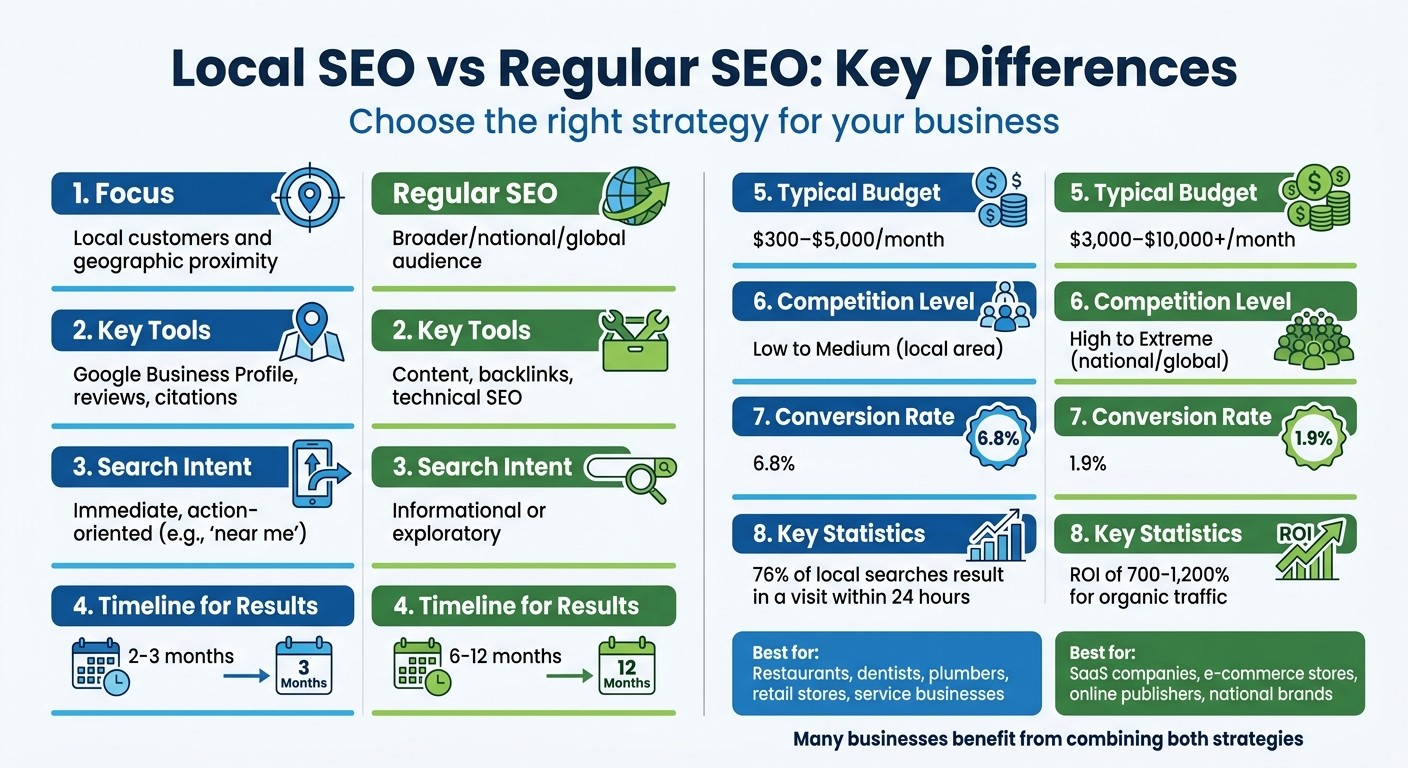
Local SEO targets customers in a specific geographic area, helping businesses like restaurants, law firms, or plumbers connect with nearby searchers. Regular SEO, on the other hand, focuses on reaching a broader, often national or global audience, ideal for companies like SaaS providers or e-commerce stores.
Here’s the difference in a nutshell:
Local SEO: Optimizes for location-based searches like “plumber near me.” Key tools include Google Business Profile, reviews, and local citations. It prioritizes proximity, relevance, and prominence.
Regular SEO: Optimizes for broader searches like “best accounting software.” Strategies include content creation, backlinks, and technical SEO to build authority and attract a wide audience.
Quick Comparison
Feature | Local SEO | Regular SEO |
|---|---|---|
Focus | Local customers and geographic proximity | Broader/national/global audience |
Key Tools | Google Business Profile, reviews, citations | Content, backlinks, technical SEO |
Search Intent | Immediate, action-oriented (e.g., “near me”) | Informational or exploratory |
Timeline for Results | 2-3 months | 6-12 months |
Typical Budget | $300–$5,000/month | $3,000–$10,000+/month |
If your business relies on local customers (e.g., a dentist or café), follow a small business website checklist and prioritize Local SEO. For national or global reach (e.g., SaaS or online stores), focus on Regular SEO. Many businesses benefit from combining both strategies to maximize growth.
Local SEO vs Regular SEO: Key Differences Comparison Chart
Local SEO vs Traditional SEO: Real Differences Explained
What is Regular SEO?
Regular SEO, sometimes referred to as traditional or national SEO, focuses on optimizing websites to rank for broad, non-location-specific search queries. This strategy is ideal for businesses aiming to reach audiences across large regions - whether statewide, nationwide, or even globally. For small businesses looking to grow beyond their local area, regular SEO can help create visibility on a much larger scale.
When someone searches for terms like "best accounting software" or "how to start a podcast", they’re not seeking a local provider. Instead, they’re looking for expertise, quality, or solutions that aren’t tied to a specific location. Regular SEO works to capture this type of traffic, connecting businesses with users who may be hundreds or even thousands of miles away.
"Traditional SEO drives broader, non-location-specific traffic. Both strategies support different business models, marketing goals, and growth stages." - Arman Advani, Director of SEO Strategist, Search Atlas
This approach is particularly effective for businesses such as SaaS companies, e-commerce stores, online publishers, and national brands - essentially, any organization where physical location isn’t a barrier to doing business. For these companies, the focus is on being visible to potential customers whenever they search for solutions, regardless of distance.
Main Goals of Regular SEO
The primary aim of regular SEO is to build visibility and authority on a large scale. Here’s how:
Increase organic traffic: By ranking for high-volume keywords and industry-specific topics, businesses can draw visitors from a broad geographic range. This strategy often delivers a return on investment (ROI) of 700% to 1,200%, far outpacing the 200% to 400% ROI typical of pay-per-click campaigns.
Build domain authority: Backlinks from reputable websites help establish trust with search engines. These links act as endorsements, boosting your site’s ability to rank for competitive terms.
Achieve high rankings for competitive terms: Whether it’s short-tail keywords like "project management tools" or more specific long-tail phrases like "best project management tools for remote teams", regular SEO aims to capture searchers’ attention. Long-tail keywords often face less competition and can lead to higher conversion rates.
Another key benefit? 72% of users trust organic search results more than paid ads. This trust fosters long-term growth, as content created today can continue to attract traffic and generate value months or even years down the line.
These goals are achieved through a mix of targeted strategies.
Common Regular SEO Strategies
Regular SEO employs a variety of tactics to improve search rankings, enhance user experience, and demonstrate authority to search engines. Key strategies include:
Keyword optimization: This begins with identifying high-volume keywords that align with your audience’s search intent. These keywords are then incorporated into page titles, headers, URLs, and content. For example, a SaaS company might focus on "CRM software for real estate agents" instead of the broader "CRM software". Remember, title tags are crucial - keep them under 60 characters and place primary keywords at the start.
Content creation: Producing high-quality, topic-focused content like blog posts, whitepapers, and guides is essential. Search engines increasingly favor content updated regularly; by 2026, 76% of AI-powered search engines will prioritize content updated within the last 30 days. Educational content not only drives traffic but also establishes your brand as an authority in its field.
Link building: Gaining backlinks from high-authority sites across different industries and regions is a cornerstone of regular SEO. This can involve digital PR campaigns, guest blogging, or creating resources that naturally attract links.
Technical SEO: Ensuring your site is easy for search engines to crawl, understand, and index is critical. This includes resolving crawl errors, improving page speed, and optimizing for mobile devices to improve your site's performance. Adding schema markup (structured data like "Article", "Product", or "FAQ") can boost click-through rates by up to 30%, thanks to rich search results.
What is Local SEO?
Local SEO focuses on optimizing your online presence to connect with customers in a specific geographic area - like when someone searches for "plumber near me" or "coffee shop in Brooklyn". These searches, often done on mobile devices, signal immediate intent. For example, someone looking for "pizza delivery" or "emergency dentist" is likely ready to take action right away. Local SEO works by targeting three key factors: proximity (how close your business is to the searcher), relevance (how well your business matches the search), and prominence (your reputation and trustworthiness).
The numbers back up its importance: 46% of all Google searches are location-based, 76% of smartphone users visit a nearby business within 24 hours, and 28% of those searches lead to a purchase .
For businesses with physical locations - whether a store, restaurant, or service provider - local SEO is essential for being seen by nearby customers and turning that visibility into real-world interactions.
"Local SEO is not a tactic. It's the infrastructure that determines whether your business exists for the customer standing two blocks away with their phone out."
Kaden Ewald, Founder & CEO, Grow Wild Agency Inc.
One of the biggest goals in local SEO is ranking in the Local Pack - the top three business listings that appear alongside a map in Google search results. Businesses featured in both the Local Pack and organic search results can get up to three times more clicks compared to those listed in just one spot.
Main Goals of Local SEO
Local SEO is all about driving specific actions from nearby customers, helping businesses grow both immediately and over time. Here’s how it works in practice:
Increase Foot Traffic and Bookings: Searches like "hair salon near me" suggest that users are ready to book an appointment or visit a location right away.
Secure a Spot in the Local Pack: Being one of the top three listings in the Local Pack is crucial for visibility, especially on mobile devices where these results dominate.
Build Trust Through Reviews: Customer reviews, ratings, and photos act as instant trust signals. Nearly all consumers (99%) read reviews, and 92% pay attention to how businesses respond to reviews as a sign of quality service.
Unlike paid ads, which disappear when the budget runs out, local SEO creates long-term benefits. By continuously optimizing assets like your Google Business Profile, you can stay relevant and competitive - even as a small business - by emphasizing local connections and relevance.
Common Local SEO Strategies
Local SEO uses a mix of tactics to boost visibility and build trust with nearby customers. Here are some of the most effective methods:
Optimize Your Google Business Profile (GBP): Your GBP plays a huge role in local rankings, accounting for about 32% of Local Pack ranking factors. Make sure to claim and verify your profile, fill out all fields (like business hours, services, and categories), and upload high-quality photos. Businesses with 50+ photos see 520% more direction requests and 240% more website clicks compared to those with fewer than 10 photos. Using Google Posts can also increase click-to-call rates by 34%.
Manage Reviews: Reviews contribute around 24% of Local Pack ranking factors. The speed at which new reviews are added (review velocity) also matters. Set up a system to request reviews soon after positive customer experiences, and always respond to reviews to show you're actively engaged.
Maintain NAP Consistency: Ensure your Name, Address, and Phone number are consistent across your website, GBP, and third-party platforms like Yelp, Apple Maps, and Bing Places.
Use Local Citations and Directories: Keep your business listed on major directories and local platforms to reinforce your legitimacy and geographic relevance.
Create Location-Specific Pages: If you serve multiple areas, develop unique landing pages for each location. Include neighborhood-specific content, photos of local projects, and embedded reviews. Adding LocalBusiness schema markup helps search engines confirm your business details like hours and services.
"The main takeaway here is that the more involved you are in the communities you serve, the more reason you will be giving local people to talk about and link to your business."
Miriam Ellis, Founder, Miriam Ellis Consulting
Local link building also plays a role. Focus on partnerships with community-based organizations like neighborhood blogs, local event sponsors, or the Chamber of Commerce rather than aiming for national backlinks. These connections strengthen your presence within the community and improve your local SEO efforts.
Search Intent and Audience Differences
The way people search online reveals a lot about their intentions. Regular SEO often caters to those conducting research or exploring options. For example, a search like "how to fix a leaky faucet" indicates someone looking for information, not necessarily ready to hire a professional. On the other hand, local SEO focuses on action-oriented searches such as "emergency plumber near me", where the user is likely ready to call or visit a business right away.
Here’s a telling statistic: 76% of local searches result in an in-store visit within 24 hours, and 28% lead to a conversion. In contrast, regular SEO users might take days or even weeks to weigh their options before making a decision. Local searches convert faster because proximity often holds more weight than brand recognition. Businesses that understand this can craft strategies to attract and convert customers more effectively.
"Someone searching 'how to unclog a drain' may be gathering information. Someone searching 'drain cleaning near me' is far closer to hiring."
This principle is backed by real-world examples. In March 2026, Dr. David McInnis Orthodontics saw a 472% jump in organic traffic and a 380% increase in patient conversions within six months. How? By restructuring their website to align with high-intent local keywords, proving that local search intent can deliver fast, measurable results. Similarly, an Austin-based DUI Law Firm optimized their Google Business Profile with local keywords over just four weeks. The result? 100% of their tracked map pins ranked in the top 3 or top 5 positions.
The distinction between regular and local SEO lies in their goals. Regular SEO builds long-term credibility by focusing on expertise, authority, and trustworthiness (E-A-T), targeting a broader audience - often national or global. Local SEO, on the other hand, emphasizes proximity, relevance, and prominence to appeal to users searching within a specific area. These searches often include terms like "near me" or zip codes, signaling a desire for nearby options over the best nationwide choice. For small businesses, tailoring strategies to these differences is critical for maximizing ROI.
How Ranking Factors Differ
Search engines assess websites differently depending on whether they're targeting local or broader, traditional search queries. Traditional SEO leans heavily on building authority. This means focusing on high-quality backlinks, comprehensive content, and technical performance - all aimed at achieving national or even global visibility. Local SEO, on the other hand, prioritizes factors that directly influence rankings in a specific area, such as physical proximity, an optimized Google Business Profile, and customer reviews.
Google's local algorithm is built on three key elements: Relevance, Distance, and Prominence. Relevance measures how well your business matches a search query. Distance evaluates how close your business is to the searcher. Prominence reflects how well-known and trusted your business is, which is often determined by reviews and citations. These factors carry different weights: Relevance contributes about 35%, Distance around 25%, and Prominence roughly 40%. Unlike local SEO, traditional SEO doesn’t factor in physical proximity, focusing instead on content quality and domain authority.
"Your Google Business Profile is still the single most influential factor in local pack rankings. The gap between a fully optimised profile and a neglected one keeps widening."
Lawrence Hitches, AI SEO Consultant
This quote highlights the critical importance of maintaining a fully optimized Google Business Profile for local rankings. For local organic results, link signals account for approximately 29% of ranking factors. However, in the Local Pack, the Google Business Profile dominates with a 32% influence. Meanwhile, traditional organic rankings remain largely dependent on backlinks.
User behavior also plays a significant role. For example, a business with a simple website but 80 glowing reviews might outrank a competitor with a technically flawless site but only 5 reviews - especially in map results. Behavioral signals differ between local and traditional SEO as well. Traditional SEO tracks metrics like page views, form submissions, and downloads, while local SEO measures clicks-to-call, direction requests, and check-ins. These interactions show how well a business engages its local audience. Businesses that respond to 80% of their reviews tend to rank higher, demonstrating the value of active customer engagement.
Next, let’s dive into how these differences in ranking factors shape keyword strategies.
Keyword Strategy Differences
Regular SEO focuses on broad, high-volume terms like "best accounting software" or "how to fix a leaky faucet", which aim to attract national or global audiences. On the other hand, Local SEO zeroes in on location-specific, long-tail keywords such as "emergency plumber in Austin" or "family dentist in Denver." These keywords are designed to prompt immediate, local action from users.
Local keywords typically follow a three-part structure: a modifier (e.g., "best", "emergency", or "affordable"), a core term (like "electrician" or "dentist"), and a location (such as "San Diego" or a specific neighborhood). This format helps search engines connect businesses with users who need nearby solutions. For instance, 76% of people conducting a local search on their smartphone visit a related business within 24 hours, and 28% of those searches lead to a purchase. In contrast, regular SEO keywords rarely drive such immediate actions. This difference underscores how search intent varies between the two strategies.
"A dental office, contractor, med spa, law firm, or restaurant is not trying to win attention from the entire internet. It is trying to win attention from buyers in the right area at the right moment."
Nextline Growth Editorial and Strategy Team
Competition also plays out differently. Ranking for a broad term like "track shoes" pits you against national retailers and major brands, but targeting "track shoes in Boise" narrows competition to local businesses. This makes it quicker and easier to secure higher rankings. Local SEO also captures both explicit intent (searches that include a city name) and implied intent (queries like "drain cleaning" that trigger local results based on the user's location).
A great example of Local SEO in action is Dr. David McInnis Orthodontics. Between September 2025 and March 2026, they saw a 472% boost in organic traffic and a 380% rise in patient inquiries by targeting over 250 high-intent local keywords. This strategy also reduced their cost-per-acquisition by 53%. To replicate this success, consider creating dedicated landing pages for each service area (e.g., /denver-plumbing), adding city and neighborhood names to title tags and headers, and incorporating "near me" phrases to capture voice search traffic. These steps can improve visibility and drive more conversions.
Tools and Tactics Comparison
When it comes to Regular SEO and Local SEO, each requires distinct tools to address its unique challenges. Regular SEO tools - like Google Search Console, Ahrefs, and Semrush - focus on building authority across the entire site and monitoring technical performance. On the other hand, Local SEO tools - such as the Google Business Profile (GBP) and citation management platforms like Whitespark or Semrush Listing Management - are designed to boost visibility in specific geographic areas. The GBP dashboard is particularly important for managing your presence on Google Maps and in the Local 3-Pack. Citation management platforms ensure your Name, Address, and Phone (NAP) details stay consistent across directories like Yelp and Bing Places. Beyond these, tools for reviews and rank tracking further highlight the differences between these SEO approaches.
For Local SEO, tools like GatherUp or Semrush Review Management help businesses keep track of and respond to customer feedback. This is essential because 99% of consumers read online reviews, and 92% view a business owner's response as a marker of quality service. Miriam Ellis, Local Search Scientist at Moz, emphasizes:
"Ignoring reviews results in a failure to serve and engage with your existing consumer base, win back customers who have left negative reviews, and benefit from the business intelligence gained when review sentiment is analyzed."
Rank tracking tools also differ. Regular SEO tools measure keyword rankings on a national or even global scale, while Local SEO rank trackers, like Semrush Map Rank Tracker, use precise geo-coordinates to show how rankings vary across neighborhoods or even individual blocks. Strategically, Regular SEO prioritizes on-site efforts such as content creation, schema markup, and technical optimizations. In contrast, Local SEO leans heavily on off-site efforts like managing map services, local directories, and review platforms.
Table: Tools and Tactics for Regular SEO vs Local SEO
Tool Category | Regular SEO Tools | Local SEO Tools |
|---|---|---|
Core Platform | Google Search Console, Ahrefs, Semrush | Google Business Profile (GBP), Bing Places, Apple Maps |
Keyword Research | Semrush Organic Research, Ahrefs Keyword Explorer | Google Search (SERP scanning), GBP Insights |
Technical & Audit | Semrush Site Audit, Google Rich Results Test | Rankley Local SEO Audit |
Rank Tracking | Traditional Position Tracking (National/Global) | Semrush Map Rank Tracker (Geo-coordinate based) |
Listings & Citations | N/A | Whitespark, Semrush Listing Management, Rankley |
Reputation/Reviews | N/A | GatherUp, Semrush Review Management, GBP Dashboard |
Analytics | Google Analytics 4 (GA4) | GBP Performance Reports, GA4 (Location reports) |
To maximize Local SEO efforts, try using the GBP dashboard to create a short URL or QR code that makes it easy for customers to leave reviews. Adding a Google Map to your "Contact" or "About" pages can also strengthen local signals. For Regular SEO, tools like the Google Rich Results Test ensure your structured data is properly configured for features like snippets. These tactical adjustments can significantly boost visibility depending on your focus area.
Search Results and Features
When it comes to how Google displays search results, the strategies behind Regular and Local SEO shine through clearly. Regular SEO focuses on influencing standard organic listings - those familiar "blue links" that often appear alongside features like featured snippets, "People Also Ask" boxes, and video carousels. On the other hand, Local SEO revolves around the Local 3-Pack (also called the Map Pack), which showcases a map alongside three top local business listings. This feature appears above traditional organic results, often grabbing attention - and clicks - before users even scroll. The way these results are visually presented has a big impact on user engagement.
Why does this placement matter so much? Because 76% of people conducting a local search on their smartphone visit a related business within 24 hours, and 28% of those searches lead to a purchase. The Local Pack is packed with visual trust signals like star ratings, review counts, business hours, and action buttons for "Call" or "Directions". As Rankley puts it:
"The Local 3-Pack sits above organic links, capturing disproportionate clicks and calls."
These trust-building elements not only drive clicks but also highlight the different priorities of Regular and Local SEO. Regular SEO leans on rich content and sitelinks, while industries like travel may see Google integrating pricing into extended listings. For local searches, Google Local Services Ads (LSAs) often appear at the very top. Unlike standard PPC ads, LSAs operate on a pay-per-lead model.
The sources of information also vary. Regular SEO pulls from website content, backlinks, and technical signals, while Local SEO relies heavily on Google Business Profiles (GBP). Keeping your GBP accurate and updated - with fresh photos, correct hours, and timely review responses - can significantly boost your chances of appearing in the Local Pack. Considering 68% of all search clicks go to the first five positions, and the Local Pack sits above those spots, businesses with physical locations should prioritize Local SEO to attract high-intent traffic. For small businesses, understanding these differences is key to choosing an SEO strategy that matches their audience's needs.
Here’s a quick comparison of the two approaches:
Feature | Regular SEO | Local SEO |
|---|---|---|
Primary Result Type | Organic "Blue Links" | Local 3-Pack / Map Pack |
Map Integration | Rarely included | Central feature (Google Maps) |
Information Source | Website content & metadata | Google Business Profile (GBP) |
Top-of-Page Ads | PPC (Google Ads) | Local Services Ads (LSAs) |
Key SERP Features | Featured Snippets, PAA boxes | Reviews, Directions, Call buttons |
Audience Reach | National or Global | Specific Service Area / Nearby |
Competition Levels
The level of competition can differ greatly depending on the type of SEO strategy you pursue. With Regular SEO, you're up against global players, well-established publishers, and national brands that often have hefty budgets and large editorial teams. For instance, trying to rank for a broad term like "track shoes" means entering a highly competitive space where building authority could take over a year.
Local SEO, on the other hand, narrows the playing field to businesses within your immediate service area. A search for "track shoes in Boise", for example, limits the competition to local sporting goods stores. Miriam Ellis, a Local Search Columnist, explains it well:
"Local SEO is easier than traditional SEO when you think of it in terms of needing to reach a small, geo-specific audience instead of a vast national or international one."
This localized approach gives smaller businesses a real chance to carve out a share of the market. Even if you can't outspend national brands, you can still dominate the Local 3-Pack in your area by focusing on key tactics like optimizing your Google Business Profile, gathering local reviews, and ensuring your NAP (Name, Address, Phone) information is consistent across directories. Here's a compelling stat: businesses that land in the top three local search results capture between 60% and 70% of all local search clicks. Achieving that level of visibility with Regular SEO would be a monumental challenge.
That said, while focusing on one city is relatively straightforward, multi-location brands face the added challenge of competing in numerous local markets. For small businesses with just one or a few locations, though, Local SEO often provides a quicker and more achievable route to boosting revenue compared to aiming for national rankings.
Timeline and Budget Considerations
When it comes to SEO, the time and money you’ll need to invest depend heavily on the type of strategy you choose. Local SEO can start showing results in about 60 to 90 days if you actively manage your Google Business Profile, citations, and reviews. On the other hand, Regular SEO usually takes anywhere from several months to a year - or even longer - to deliver noticeable improvements in rankings. Why the difference? Regular SEO focuses on building content authority and a strong backlink profile over time, while Local SEO targets a smaller, less competitive geographic area.
For small businesses, Local SEO is typically the more budget-friendly option. Monthly costs range between $300 and $5,000, depending on how competitive your market is and how many locations you’re managing. For example, a single-location business in a low-competition area might spend $300 to $800 each month on basic tasks like optimizing their Google Business Profile and managing citations. However, businesses in more competitive local markets could spend $2,000 to $5,000 monthly on strategies like robust content creation and aggressive link building. By comparison, Regular SEO campaigns come with heftier price tags, often requiring $3,000 to $10,000 or more per month to compete for high-volume keywords on a national or global scale.
The return on investment (ROI) also varies significantly. Service businesses using Local SEO often see an average conversion rate of 6.8%, compared to just 1.9% for national organic search - a difference of nearly 3.6x. Thanks to this higher conversion rate and quicker results, most service businesses using Local SEO break even in 5 to 7 months, while Regular SEO campaigns typically take 12 to 18 months to reach the same point.
Table: Timeline and Budget Comparison
Factor | Local SEO | Regular SEO |
|---|---|---|
Time to First Results | 60–90 days | 6–12+ months |
Typical Monthly Cost | $300–$5,000 | $3,000–$10,000+ |
Breakeven Point | 5–7 months | 12–18 months |
Conversion Rate | 6.8% | 1.9% |
Competition Level | Low to Medium (local) | High to Extreme (national/global) |
Investment Nature | Faster results, lower costs | Long-term growth, higher costs |
For smaller businesses with limited resources, Local SEO is often the more approachable path. A fully optimized Google Business Profile can start generating phone calls and direction requests in as little as 23 days on average. On the flip side, building the authority needed to compete nationally with Regular SEO requires both patience and a bigger budget. This clear breakdown of timelines and costs can help you decide which approach aligns best with your business goals.
How to Choose the Right SEO Approach
Deciding between Local and Regular SEO boils down to a simple but critical question: Where does your revenue come from? If your business thrives on in-person visits or on-site services, Local SEO should take center stage. Think restaurants, dental offices, plumbers, electricians, or retail shops. On the other hand, if your focus is selling products or services online to a nationwide audience - like SaaS companies, e-commerce stores, or national publishers - Regular SEO is the way to go. This decision is the cornerstone of crafting an SEO strategy that aligns with your revenue goals.
Check your eligibility: To leverage Local SEO, Google requires a physical address - this can be a home address, but P.O. boxes and virtual offices won’t cut it. Additionally, you must serve customers face-to-face. Without meeting these requirements, you won’t be able to create a Google Business Profile, which is the backbone of any Local SEO strategy. This step ensures you're ready to compete locally.
"Small businesses do not need to compete everywhere to win. They need to show up clearly when nearby buyers are ready to act." – Nextline Growth Editorial and Strategy Team
For most small businesses, Local SEO should be the starting point, with Regular SEO being a future expansion. Begin by optimizing your Google Business Profile and building local citations to attract high-intent customers. Once you’re consistently appearing in the Map Pack and seeing calls or visits, you can expand into content marketing to establish long-term authority. This approach is backed by compelling data: 76% of people who search for something nearby on a smartphone visit a related business within 24 hours, and 28% of those searches result in a purchase.
Some businesses can benefit from combining both approaches. For instance, a local law firm might use Local SEO to rank for “personal injury lawyer in Chicago” while also publishing educational content like “how to choose a lawyer” to build broader authority. Multi-location businesses should optimize each location individually while using Regular SEO to strengthen their overall brand presence. The key is aligning your strategy with your immediate goals - if foot traffic is your priority, Local SEO is the clear choice.
Conclusion
The comparisons above highlight how Local SEO and Regular SEO serve different purposes, each driving growth in its own way. At the heart of the difference is your audience - where they are and how they find you. Local SEO connects you with nearby customers, ensuring your business appears in the Map Pack or on Google Maps when someone searches "near me" or includes a city name. On the other hand, Regular SEO focuses on building visibility on a national or global scale by targeting broader informational queries and larger audiences. Misaligning these strategies can lead to wasted time and effort.
If you're a small business with a physical storefront or a defined service area, Local SEO is often the best starting point. Why? Because it delivers immediate results. For example, 76% of local searches result in a visit, and 28% of those visits convert into sales. That’s not just traffic - it’s revenue. Regular SEO, while excellent for building long-term authority, typically requires months or even years to show significant results. And as we look toward 2026, with AI-enhanced search making informational queries more refined, local intent will remain critical for service-based businesses.
"Traditional SEO builds reach. Local SEO builds relationships." – Rankley
For small businesses, aligning your SEO strategy with your specific growth goals is key. Think about your business model: If your customers need to visit your location or you provide services on-site, focus on Local SEO. Optimize your Google Business Profile, ensure your NAP (Name, Address, Phone) details are consistent, and actively manage customer reviews. If you’re targeting a national audience, invest in creating high-quality content and earning backlinks.
Many businesses eventually find success with a hybrid approach - using Local SEO to capture local leads quickly while leveraging Regular SEO to grow their brand over time. But remember, you don’t need to dominate everywhere; you just need to be visible when and where it matters most. Use these insights to fine-tune your strategy and align it with your specific business goals.
FAQs
Can I do Local SEO without a Google Business Profile?
Yes, it’s possible to do local SEO without a Google Business Profile. However, having one can significantly boost your visibility in local search results and improve your chances of appearing in Google’s local pack. While it’s not a strict requirement, a Google Business Profile is a highly effective way to strengthen your local SEO efforts and connect with nearby customers more efficiently.
How do I track ROI from Local SEO vs Regular SEO?
When it comes to measuring ROI for Local SEO, keep an eye on metrics that reflect your local presence. This includes:
Local search rankings: How well your business ranks for location-specific keywords.
Google Maps visibility: Your presence and performance on Google Maps.
Local pack appearances: How often your business shows up in the "3-pack" or local search results.
Conversions: Actions like foot traffic, phone calls, or inquiries from nearby customers.
For Regular SEO, the focus shifts to broader performance indicators:
Organic traffic: The number of visitors coming to your site from search engines.
Keyword rankings: How your site performs for targeted keywords.
Backlinks: The quality and quantity of links pointing to your site.
Website engagement metrics: Metrics like time on site, bounce rates, and pages per session.
The key is to align your KPIs with your specific goals. Whether you're aiming to drive local foot traffic or grow your online reach, matching your metrics to your objectives will give you a clear picture of your ROI.
What should I do first if I have one location but also sell online?
If you operate from a single location and also sell online, your first step should be to fine-tune your local SEO. Make sure your Google Business Profile is fully updated with the correct address, phone number, and relevant local keywords. This can improve your visibility in local search results and on Google Maps, making it easier for nearby customers to find and visit your store. Once you've established a solid local presence, you can shift your focus to organic SEO to reach online customers across a broader area.
Related Blog Posts
Únete a nuestra comunidad de 15,000+ propietarios de negocios
Artículos populares
Artículos populares sobre su sitio web y la comercialización de su pequeña empresa


