



Do I Need a Website or Social Media for My Business?
Small Business Marketing
You need both - a website and social media - to maximize your business's online presence. Here's why:
Websites build trust and drive conversions: 84% of consumers trust businesses with websites more, and 93% of purchase decisions start with a search engine. Websites work 24/7, handle bookings, and collect leads.
Social media creates visibility and engagement: Platforms like Instagram and TikTok are great for discovery, with billions of users and high engagement rates. However, posts have a short lifespan, and algorithms can limit your reach.
Key Takeaways:
A website is your owned space - you control the content, design, and customer experience.
Social media is a rented space - great for awareness but less reliable for long-term growth.
Combining both increases sales by 27% on average. Use social media to attract attention and direct users to your website for conversions.
If you're a service-based business, prioritize a website. For visually driven businesses, start with social media but don’t skip building a website. Begin small - choose one or two social platforms and create a site with essential website features, then expand as your business grows.
1. Website
Credibility and Control
A website is your own digital space - completely under your control. You decide the design, branding, and how customer data is managed. Compare that to social media, which is more like rented property. Platforms can change the rules at any moment, as happened in late 2024 when Meta overhauled its ad system, forcing many businesses to scramble and rethink their strategies. This difference between owning a website and relying on social media becomes even clearer when you weigh the benefits of stability and control against the unpredictable nature of social platforms.
A professional website also boosts your credibility. Roughly 84% of consumers see businesses with websites as more trustworthy, and 75% judge a company's credibility based on essential website design elements. When someone is searching for your hours or location, they want a single, reliable source - not a cluttered social media feed.
Cost and Resources
Building a website used to be a big investment, taking weeks and costing thousands. But now, platforms like Wix and Squarespace make it much simpler. Their plans range from $150 to $500 annually. If you're looking for something custom, agencies can still build websites for $2,000 to $15,000 upfront, with yearly maintenance fees of $1,000 to $5,000. On top of that, 58% of small businesses are now using generative AI to create professional websites in just hours instead of weeks.
While social media is free to join, maintaining an active presence can feel like a full-time job. In contrast, once your website is up and running, it only requires occasional updates. Even domain registration is affordable, typically costing just $10 to $20 per year.
Audience Reach and Engagement
Websites shine when it comes to attracting high-intent visitors. Organic search accounts for about 53.3% of all website traffic, while social media contributes a much smaller 5%. In fact, SEO generates over 1,000% more traffic than organic social media on average.
Another advantage of website content is its longevity. A well-written blog post can keep bringing in leads for years. On the other hand, social media content has a short shelf life - posts on X (formerly Twitter) fade quickly, and Instagram Stories disappear after 24 hours. Businesses that maintain blogs see about 67% more monthly leads than those without one.
Conversion and Business Growth
Your website works 24/7, handling everything from bookings to answering FAQs via dedicated service pages, and even collecting valuable customer data. Businesses with professional websites typically earn about 50% more revenue than those without one. Plus, 93% of business purchase decisions start with a search engine query.
"Your website is your best employee. Built to guide visitors, convert interest, generate leads, and support growth, even when you're OOO." - Kristine Gonzalez, Web Strategist
Websites also give you the tools to build email lists, which deliver an average return of $36 for every $1 spent. You can even create targeted landing pages for specific services. In contrast, social media often limits you to DMs and a single bio link, making the customer journey more complicated.
These website advantages provide a solid foundation for understanding how social media fits into a broader business strategy.
2. Social Media
Credibility and Control
Social media offers an incredible opportunity to put your brand in front of billions of people. But there’s a catch: you’re not in control. Platforms like Facebook, Instagram, and TikTok can tweak their algorithms at any moment, which can drastically affect your reach. Shockingly, one-third of small businesses have experienced account suspensions or restrictions without warning. Think of it this way: you’re renting space on a platform, and the landlord can change the rules - or even lock you out - whenever they choose.
That said, social media is unmatched when it comes to showcasing your brand’s personality. It’s a space for real-time interactions, quick responses to customer questions, and building a community around shared values. However, 84% of consumers still view businesses with websites as more trustworthy than those relying solely on social media.
Beyond the challenges of control, maintaining a strong social media presence demands significant time and effort.
Cost and Resources
It’s true - setting up social media accounts doesn’t cost a dime, making it an appealing option for businesses on a budget. But keeping those accounts active and engaging is a different story. To stay relevant, you need to constantly research trends, create fresh content, and interact with your audience.
Another challenge? Posts on social media have a short shelf life. For example, content on X (formerly Twitter) lasts about 15–20 minutes, while Instagram posts stay visible for around 48 hours. Compare that to a blog post on your website, which can keep attracting visitors for years. And as your business grows, you’ll likely need to invest in paid ads to maintain visibility, especially since organic reach on Facebook has plummeted to just 5.2%. On average, small businesses spend between $20 and $200+ per month on tools and advertising to keep their social media presence alive.
While the costs and effort of social media can add up, the potential to connect with a massive audience balances the equation.
Audience Reach and Engagement
The true strength of social media lies in its ability to reach and engage billions of users. For instance, Facebook has 2.9 billion monthly active users, and Instagram boasts over 1 billion. TikTok, in particular, shines when it comes to engagement, with rates reaching 7.5% for smaller accounts. Plus, a staggering 90% of social media users have interacted directly with brands through these platforms.
Social media is particularly effective as a top-of-funnel tool. It’s ideal for brand discovery and awareness, but it’s not as strong when it comes to closing sales. Think of it this way: social media acts as the invitation to your business, while your website is where the real transaction happens. Businesses that combine both channels see a 27% boost in sales compared to those that rely on just one.
"Social media is the bait and your website is the fishing net - you need both to catch customers." - YORK Digital Services
Conversion and Business Growth
While social media is fantastic for generating interest, it often falls short when it comes to sealing the deal. It works well for impulse buys and visually appealing products, but it struggles with high-value transactions. In fact, as of 2021, only 12.1% of U.S. retail ecommerce sales came from social commerce. The platforms are designed to keep users scrolling, which means every post has to compete with ads, competitor content, and other distractions.
The best strategy? Use social media to drive traffic to your website, where you have full control over the customer experience. Social media warms up your audience, but your website is where the sale happens. Make sure every post includes a clear call to action - whether it’s directing users to your website or encouraging them to join your email list. After all, while you don’t own your social media followers, your email list is entirely yours.
48. Pros and Cons of a Website vs Social Media
Pros and Cons Comparison
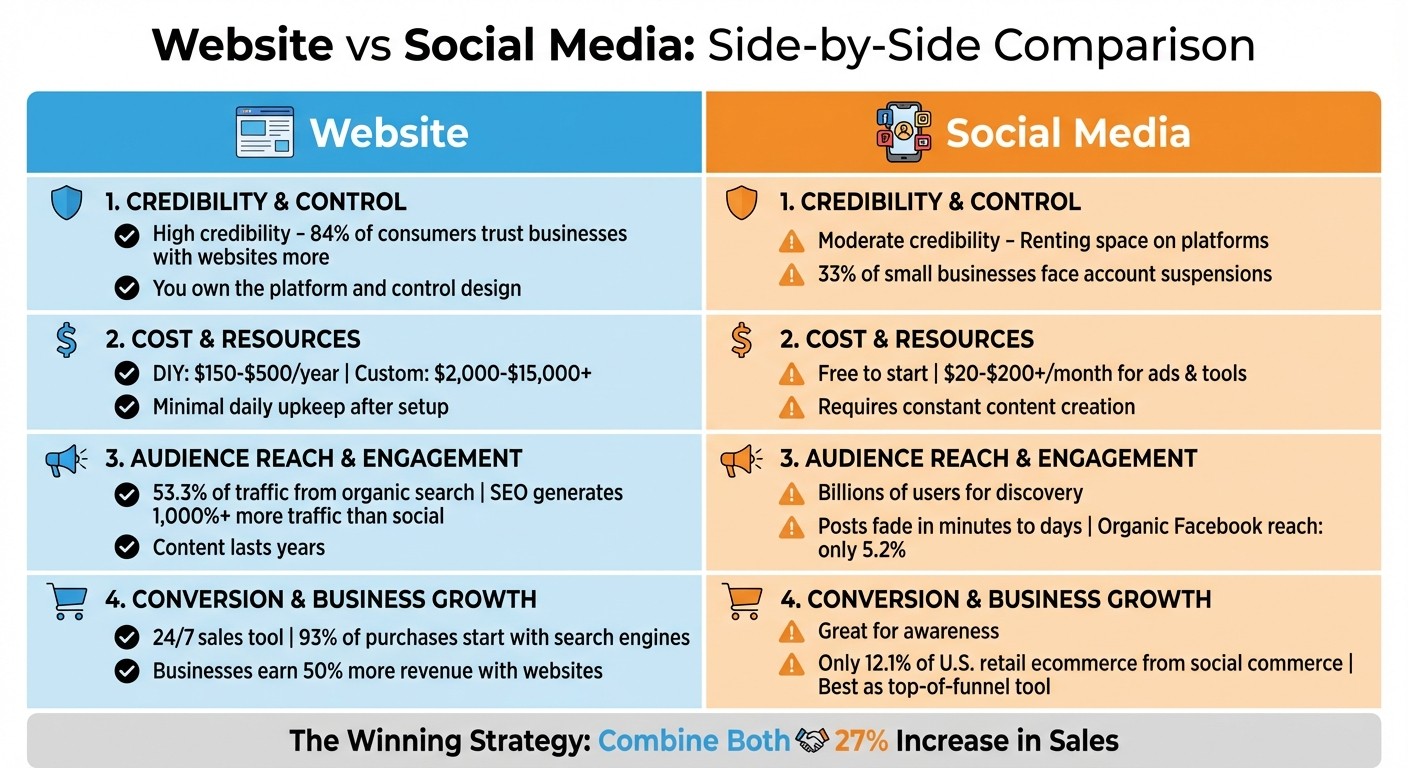
Website vs Social Media: Key Differences for Business Success
Here's a side-by-side look at how websites and social media stack up across key areas. This table summarizes the main points to help you understand their strengths and limitations.
Category | Website | Social Media |
|---|---|---|
Credibility & Control | High credibility - 84% of consumers see businesses with websites as more trustworthy. You own the platform, control its design, and set your own rules. | Moderate credibility - you're renting space on platforms that can change policies or suspend accounts. |
Cost & Resources | Higher upfront costs - DIY sites cost $150–$500 per year; custom builds range from $2,000 to $15,000+. Once set up, daily upkeep is minimal. | Free to start - but demands constant content creation. Expect to spend $20–$200+ monthly on ads and tools to stay visible. |
Audience Reach & Engagement | Sustainable, long-term reach - organic search drives 53.3% of website traffic and generates over 1,000% more visitors than organic social media. Content remains relevant for years. | Quick visibility - billions of users make it great for discovery and brand awareness, but posts fade within minutes to days. |
Conversion & Business Growth | Built for conversions - features like booking systems, online stores, and lead capture forms make it a 24/7 sales tool. | Top-of-funnel tool - great for building awareness, but social commerce made up just 12.1% of U.S. retail e-commerce sales in 2021. |
Websites provide a solid foundation for business operations, while social media shines at spreading the word and attracting attention. With 71% of businesses already owning a website, it's clear that websites are where transactions happen. Social media, on the other hand, acts as a powerful amplifier, driving visitors to your site. The smartest approach? Combine both - use social media to generate buzz and direct traffic to a website that's optimized to convert.
Conclusion
Websites and social media each serve distinct purposes: social media grabs attention, while a website builds trust and drives conversions. Deciding where to focus first depends on your business type, audience, and budget. Ultimately, the goal is to combine both for maximum impact.
For service-based businesses like law firms or plumbing companies, a website is essential. Why? Because 93% of online experiences start with a search engine, making it the go-to place for people seeking solutions. On the other hand, if you’re in a visually driven field like food or fitness, social media can generate buzz quickly. But even then, a website is crucial for capturing leads and turning followers into paying customers.
The numbers make it clear: businesses that blend a website with social media marketing see a 27% boost in sales compared to those relying on just one channel. The strategy is simple: use social media to draw people in and direct them to your website, where you can convert that interest into revenue.
As Moonlit Media puts it:
"Your small business website is your digital home base; one that you own and control. Social media is the rented storefront that helps bring people to your door."
Start small - maybe a single-page website and one or two social media platforms - and grow as your business expands. This balanced approach ensures you’re building a solid foundation while reaching your audience effectively.
FAQs
What should my website include at minimum?
Your website needs to cover the basics to make a solid first impression. At the very least, include:
Your business name: Clearly display it so visitors know who you are.
Contact information: Make it easy for people to reach out by providing a phone number, email address, or contact form.
Location: If you have a physical presence, let people know where to find you.
A description of your products or services: Give visitors a clear idea of what you offer and how it benefits them.
Branding elements: Incorporate your logo, colors, and other design elements to reinforce your identity.
These essentials build trust and ensure visitors can quickly find the information they need.
Which 1–2 social platforms should I pick first?
For small businesses just getting started, Instagram and Facebook are often the go-to platforms. Instagram shines when it comes to visual storytelling, making it perfect for showcasing your products or services in an eye-catching way. On the other hand, Facebook offers flexibility, making it great for building a sense of community and connecting with local audiences. Both platforms are incredibly popular in the U.S., come with powerful advertising tools, and serve as solid starting points for growing your online presence.
How do I turn followers into website leads?
To turn your social media followers into website leads, focus on using clear and compelling calls-to-action (CTAs) in your posts. These CTAs should guide users to visit your site. Once they’re there, make sure your website is designed to convert visitors effectively. This means having detailed, helpful content, simple navigation, and easily accessible contact options.
On social media, share content that builds trust and sparks interest. This could include testimonials, exclusive deals, or other posts that provide real value. The goal is to encourage clicks and turn casual followers into engaged leads.
Related Blog Posts
Únete a nuestra comunidad de 15,000+ propietarios de negocios
Artículos populares
Artículos populares sobre su sitio web y la comercialización de su pequeña empresa


