



No-Code Website Builders vs Custom Development: Which Wins?
Web Development
When deciding how to build your website, you have two main options: no-code website builders or custom development. No-code platforms like Wix, Squarespace, and Shopify are fast, affordable, and user-friendly, allowing non-technical users to create professional websites in days or weeks. On the other hand, custom development offers complete control, scalability, and tailored features but requires a higher budget, longer timelines, and ongoing maintenance.
Key Takeaways:
No-Code Platforms: Cost $300–$800/year, launch in 1–2 weeks, and are ideal for small businesses or startups with simple needs.
Custom Development: Costs $5,000–$50,000+, takes 2–6 months, and is best for businesses with complex or unique requirements.
Quick Comparison:
Criteria | No-Code Platforms | Custom Development |
|---|---|---|
Cost | $300–$800/year | $5,000–$50,000+ upfront |
Timeline | 1–2 weeks | 2–6 months |
Ease of Use | Drag-and-drop, no coding required | Requires developers and coding skills |
Customization | Limited to platform features | Fully customizable |
Scalability | Handles up to ~50,000 visitors | Unlimited with proper infrastructure |
Maintenance | Automatic updates included | Manual updates, $1,000–$5,000/year |
For small businesses prioritizing speed and affordability, no-code tools are often the better choice. If you need advanced features or complete control, custom development may be worth the investment.
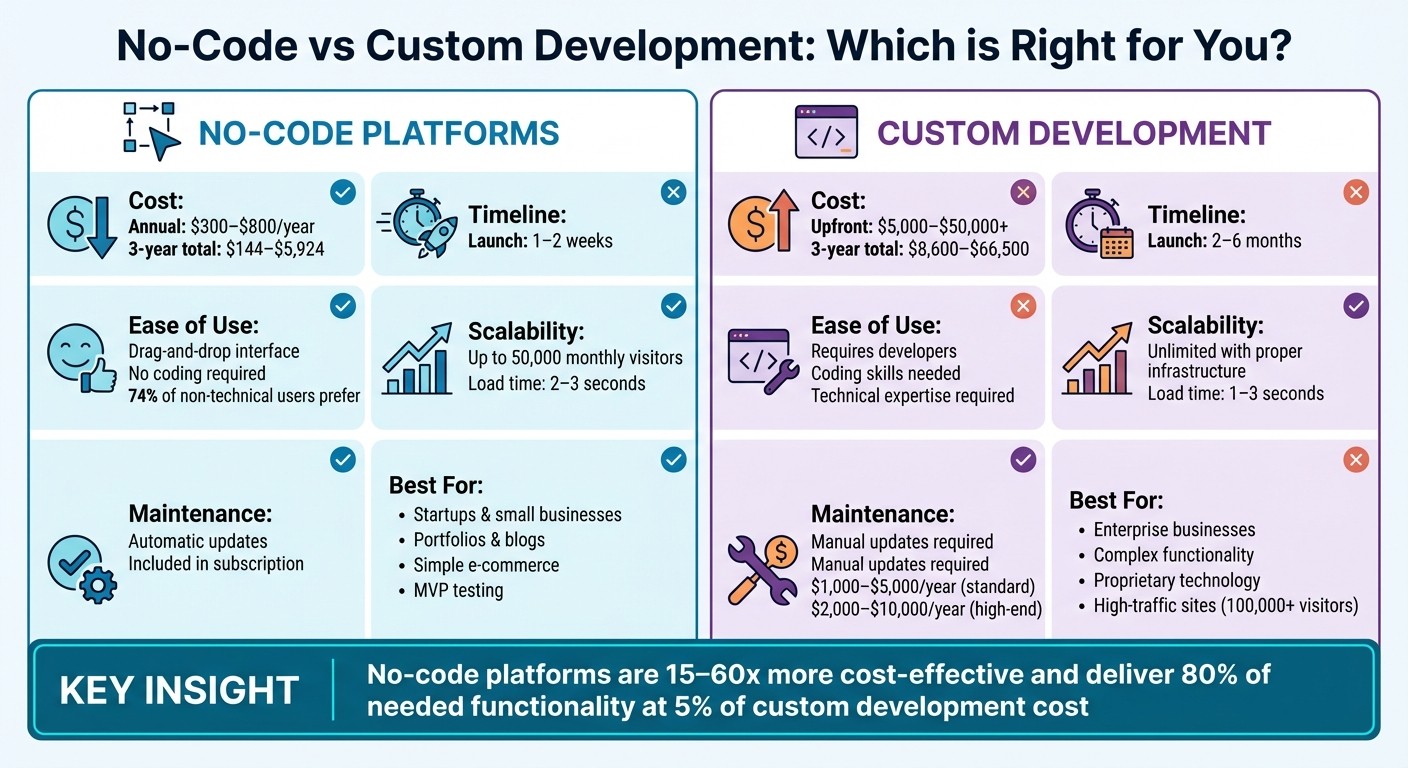
No-Code vs Custom Development: Cost, Timeline, and Features Comparison
No code development VS Custom Development | Which is better in 2023?
What Are No-Code Website Builders?
No-code website builders are platforms that let you create and launch professional websites without writing a single line of code. Instead of traditional coding, you use a drag-and-drop interface to arrange pre-designed elements like text, images, and buttons. Behind the scenes, the platform automatically generates the necessary code for you.
These tools are ideal for non-technical users such as freelancers, small business owners, and entrepreneurs who need a polished online presence without hiring a developer. They simplify the process by bundling hosting, SSL security, and updates into one subscription, removing the need for ongoing technical maintenance.
The demand for no-code website builders is on the rise, with the market projected to hit $2.7 billion in revenue by 2026. Popular platforms include Wix (starting at $17/month), Squarespace (ranging from $16 to $99/month), and Shopify (starting at $29/month after introductory offers). With these tools, you can have a functional website live in just a few hours and fully refined within one to two weeks - much faster than the two to six months often required for custom-built sites.
"Most people aren't technical, and even if they are, they don't have time to fiddle with code every time they want to tweak something." – Ben Sehl, Director of Product, Shopify
The cost savings are also significant. A complete setup with a no-code platform, including domain registration, hosting, and essential tools, typically ranges from $300 to $800 annually. In comparison, custom-built websites often start at $5,000 and can exceed $50,000 for similar features. This affordability and speed make no-code platforms an attractive choice for businesses prioritizing efficiency and budget.
Main Features of No-Code Platforms
Modern no-code platforms are packed with user-friendly features designed to streamline the website-building process.
One standout feature is the real-time drag-and-drop editor, which lets you move and customize elements easily. What you see while designing is exactly what visitors will experience. Additionally, pre-designed templates tailored to specific industries offer a professional head start, with layouts that automatically adjust for mobile, tablet, and desktop screens.
For those building e-commerce websites, these platforms include tools for inventory management, secure payment processing, and even abandoned cart recovery. Marketing tools like email sign-up forms, SEO meta tags, and automatic sitemaps are also built-in, eliminating the need for complex third-party integrations.
Another exciting development is the integration of AI-powered tools. Platforms like Shopify and Wix now use AI to enhance the user experience. For instance, Shopify’s AI tool, Sidekick, can analyze your business data to highlight trends like slow-moving inventory or top-selling products. AI can also assist with generating layouts, writing product descriptions, and improving SEO.
Benefits for Small Businesses
No-code platforms offer more than just ease of use - they deliver real advantages for small businesses.
One major benefit is cost savings. By avoiding the high costs of custom development, businesses can redirect those funds toward growth initiatives.
Speed is another key advantage. With no-code tools, a professional website can go live in as little as a few hours to two weeks. In contrast, custom development often takes months. This quick turnaround is invaluable for businesses that need to attract customers or test ideas without a lengthy wait.
Additionally, no-code platforms give business owners full control over their website content. Whether you need to update store hours, add a new product, or swap out an image, changes can be made in minutes. Meanwhile, the platform handles backend tasks like security updates and server maintenance automatically.
"Startups... should almost always opt for a no-code tool to build their website. Platforms like Shopify or Squarespace have put a ton of resources into giving you off-the-shelf solutions for complex capabilities." – Rafael Sarim Oezdemir, Founder and CEO, Zendog Labs
For small businesses, this means fewer technical headaches and more time to focus on growth. With built-in SEO tools, mobile-friendly designs, and professional layouts, no-code platforms help create a strong first impression while allowing businesses to prioritize what matters most: their operations and customers.
What Is Custom Development?
Custom development offers a tailored approach for businesses with complex and evolving needs, standing apart from the quicker, more affordable no-code platforms.
This method involves creating a website from the ground up using programming languages like HTML, CSS, JavaScript, React, Python, or PHP. Instead of adapting pre-made templates, developers craft unique code specifically aligned with your business goals. A team of developers, designers, and project managers collaborates to build features that reflect your brand’s identity. Starting with a "blank canvas", every detail is customized to meet your exact requirements.
One major perk of custom development is complete ownership. When you choose this route, you own the source code outright. This freedom allows you to host your website wherever you like, without being tied to any single platform or provider.
Despite the growing popularity of no-code solutions, custom development remains a go-to choice for high-traffic or highly specialized websites. For example, while WordPress powers over 43% of all websites, its share drops to 26.26% among the top 100,000 highest-traffic sites. This approach offers a unique blend of possibilities and challenges worth considering.
Advantages of Custom Development
Custom development shines when it comes to flexibility and performance. Developers can create any feature you imagine, from advanced algorithms to intricate user authentication systems, free from the restrictions of pre-designed templates. Performance is also optimized at every level, avoiding the "code bloat" often found in template-based sites. This matters because even a one-second delay on a mobile page can reduce conversions by 20%. Custom websites are built to handle rapid growth, heavy traffic, and complex databases without compromising speed or stability.
Security is another strong point. Custom sites use tailored protocols, unique encryption methods, and specific authentication systems. Unlike WordPress sites - 30,000 of which are hacked daily due to third-party plugins - custom websites are less vulnerable to large-scale attacks, thanks to their one-of-a-kind codebases.
Custom development also gives you unmatched control over SEO and technical optimizations. A clean, custom codebase allows for advanced internal linking strategies and tailored schema markup, helping to boost search engine rankings.
"Custom-built sites handle complex functionalities and accommodate future digital transformation and growth more smoothly than no-code tools, because they were already fundamentally tailored to the business' needs." – Fueled Blog
Challenges of Custom Development
That said, custom development does come with its own hurdles, starting with cost. A simple custom website might cost around $2,000, while professional small business sites range from $10,000 to $50,000. For more complex e-commerce or enterprise solutions, costs can soar past $100,000. These upfront expenses far exceed the annual fees associated with most no-code platforms.
Time is another factor. Custom projects typically take anywhere from two to six months to complete, covering everything from planning and design to development and testing. If you’re on a tight deadline, this timeline could be a dealbreaker.
Maintenance is also more demanding. Unlike no-code platforms that handle updates automatically, custom websites require manual updates, security patches, and technical monitoring. Annual maintenance costs can add another $2,000 to $10,000 to your budget.
"Custom development becomes a liability when it adds complexity without delivering proportional value." – Katie Fazekas, Marketing Strategist, Boldog Digital
Lastly, there’s the risk of a "double expense" scenario. Some businesses start with an inexpensive no-code solution but later outgrow its limitations, forcing them to switch to a custom setup. While this migration can be costly, custom development often proves to be a more stable investment when you look at the total cost of ownership over three to five years.
No-Code Website Builders vs Custom Development: Side-by-Side Comparison
When it comes to building a website, small businesses often weigh their options between no-code platforms and custom development. The choice impacts cost, speed, control, and flexibility, so understanding the differences is key to making an informed decision. Here's a breakdown of the main factors to consider.
The cost difference is striking. No-code platforms charge between $4 and $159 per month, which typically includes hosting, security, and maintenance. In contrast, custom development starts at around $5,000 for a basic site and can exceed $50,000 for more complex builds. Maintenance for custom sites adds another $1,000 to $5,000 annually. Over three years, no-code solutions may cost between $144 and $5,924, while custom development can range from $8,600 to $66,500. For small businesses, no-code platforms often deliver about 80% of the needed functionality at just 5% of the cost of a custom build.
Speed is another critical factor. No-code platforms allow you to launch a site in one to two weeks, enabling quick testing and revenue generation. Custom development, on the other hand, takes 8–12 weeks for standard projects and up to six months for more complex builds. This longer timeline can delay your ability to bring in revenue and increase costs.
Customization and Flexibility
No-code platforms offer drag-and-drop customization, and some, like Gatsboy, even allow limited HTML/CSS modifications and custom code embeds. While this is sufficient for common needs like portfolios, blogs, and simple e-commerce sites, it may fall short for businesses requiring intricate backend logic or proprietary workflows.
Custom development, however, offers complete flexibility. Every element can be built from scratch, making it possible to create unique features like proprietary algorithms, complex user flows, or advanced inventory systems that no-code platforms can't replicate.
Scalability and Performance
When it comes to scalability, no-code platforms handle hosting and scaling automatically. They can typically support up to 50,000 monthly visitors and include optimizations like caching and image compression, keeping load times around 2–3 seconds.
Custom development provides unlimited scalability when paired with cloud infrastructure. Developers can fine-tune the site to remove unnecessary code, achieving load times of 1–3 seconds. Even a small improvement in mobile site speed - like 0.1 seconds - can increase retail conversion rates by 8.4%.
"Though no-code website builders have low upfront costs, they can become expensive over time due to their maintenance requirements. Whereas custom built sites... offer more flexibility when it comes to maintaining them over the long term as you can choose what features to add or remove." – Prabhsharan Singh, Technical Head at Clinicspot
Maintenance and Updates
No-code platforms handle maintenance automatically. They manage security patches, software updates, hosting, and SSL renewals behind the scenes, saving users time and effort.
Custom sites, however, require manual attention. Every update, security patch, or bug fix must be handled by a developer. Maintenance costs range from $1,000 to $5,000 annually for standard sites, and high-end builds can cost between $2,000 and $10,000 per year. Ongoing developer support is essential to keep the site running smoothly.
Technical Expertise Required
No-code platforms are designed for non-technical users, offering simple drag-and-drop tools. In fact, 74% of non-technical users choose these platforms to quickly launch sites without learning to code. Platforms like Gatsboy, which use the Framer editor, make it easy for small business owners to manage their sites.
Custom development, on the other hand, requires knowledge of coding languages like HTML, CSS, JavaScript, and backend technologies such as PHP or Python. This often means hiring developers or agencies, which increases costs and reliance on specialized talent.
Ownership and Control
Ownership is a major consideration. Custom development gives you full control over your website's codebase, allowing you to choose your hosting provider, make modifications, and maintain independence from vendors. This level of control ensures long-term flexibility.
With no-code platforms, you rent the infrastructure and don't have access to the source code. This creates dependency on the platform, limiting your ability to switch providers or make extensive customizations in the future.
When to Choose No-Code Website Builders Like Gatsboy
No-code platforms are perfect when you need speed, affordability, and ease of use, especially if advanced custom features aren’t on your priority list. Whether you’re launching your first business website, testing an idea with a Minimum Viable Product (MVP), or lack technical expertise, these tools make the process straightforward.
For startups and freelancers, the appeal is clear: you can go live in just one to two weeks, saving both time and money while validating your business model. Over three years, costs range from $144 to $5,924, compared to $8,600 to $66,500 for custom-built sites. This makes them an excellent choice for freelancers, service providers, and local businesses looking to establish a professional online presence without hiring developers.
Service-based businesses benefit from standard features like appointment booking, contact forms, and simple e-commerce, which integrate seamlessly with no-code platforms. Gatsboy, for instance, offers smart modules for collecting leads, managing bookings, and customer messaging - all accessible through an easy-to-use dashboard. Larger marketing teams also use these platforms to create microsites quickly for campaigns, events, or product launches.
Financially, no-code platforms are 15–60 times more cost-effective than custom websites and can handle traffic for sites with 10,000–50,000 monthly visitors.
If your needs are straightforward - like a portfolio, blog, or basic online store - and you want to launch quickly without breaking the bank, no-code tools are the way to go. You can start small, generate revenue, and consider custom development later if your business outgrows the platform’s capabilities. While these tools shine in simplicity and cost savings, more complex requirements might call for a custom-built solution.
When Custom Development Is the Better Choice
Sometimes, off-the-shelf solutions just don’t cut it - especially when your business depends on proprietary technology or complex backend processes. For instance, if your core offering relies on a custom algorithm, real-time data processing, or an intricate recommendation engine, standard platforms might leave you frustrated. Think of fintech platforms requiring split-second performance or marketplaces that demand advanced vendor management systems. These are cases where tailored code becomes a necessity.
Security and compliance are other critical reasons to go custom. Industries like healthcare and finance deal with sensitive data, requiring specialized encryption, custom authentication, and strict regulatory compliance. These needs often go beyond what no-code platforms can handle. Additionally, a custom-built solution with unique architecture can provide better protection against cyberattacks. Beyond security, integration challenges can also push businesses toward custom development.
"When you need advanced features, have unique requirements, or if your business' main value proposition is precisely in a proprietary technology innovation, a custom-built website is the way to go." - Fueled
Legacy systems often complicate things further. If your business relies on older databases or proprietary systems with unusual APIs, no-code tools usually fall short. For example, if your sales team is stuck manually transferring data between your website and your CRM, it’s a clear sign that your current platform is hitting its limits.
Performance is another key consideration. While WordPress powers a massive 43.4% of all websites, its share drops to just 26.26% among the top 100,000 traffic-heavy sites. High-traffic businesses often need server-side rendering, optimized database queries, and lean code - areas where custom development excels. In contrast, no-code platforms can suffer from "code bloat", which hampers performance. This matters because 70% of online shoppers say slow page speeds influence their decision to shop elsewhere.
Here’s a practical way to decide: use the "80/20" rule. If a no-code platform meets only 80% of your needs, the cost of patching the remaining 20% could surpass the upfront expense of custom development. Basic custom websites typically start around $5,000, while more complex e-commerce or SaaS projects can exceed $15,000. Annual maintenance costs range from $2,000 to $10,000. While this investment might seem steep, it can save you from paying for premium subscriptions and an eventual rushed migration down the line.
Gatsboy Pricing and Plans
Gatsboy keeps things straightforward with two main plans. The Website Only plan costs a one-time fee of $500. This includes a 5-page Framer website, complete with SEO-ready structure, a contact form, a dashboard, and two rounds of revisions. (Note: Framer hosting is a separate purchase.)
For more advanced needs, the Website + Pro plan builds on the $500 base cost with an additional $47/month subscription. This plan offers enhanced features like advanced forms and pro modules for lead collection, bookings, and messaging - tools that would typically require a much larger investment if developed from scratch.
Gatsboy also provides modular add-ons for extra customization:
AEO (AI search optimization): $147/month
Citations (50 top directories): $247 one-time fee
Local Tracking: $99/month
This modular system ensures you only pay for what you actually need.
Affordability and Flexibility
Gatsboy’s pricing highlights the cost-saving advantages of no-code solutions compared to traditional custom development. To put it into perspective, a custom-built small business website typically starts at $5,000 and can climb to $15,000–$50,000 for advanced features. On top of that, annual maintenance costs range from $1,000 to $5,000. Gatsboy’s model, on the other hand, includes regular updates and security patches (with Framer hosting purchased separately), offering a more budget-friendly alternative.
Flexibility is another key advantage. You can start with the Website Only plan and upgrade to Website + Pro as your business grows. Need custom integrations down the road? No problem - you’re not locked into the platform. Framer’s ecosystem allows you to add functionality, and you can gradually transition specific components to custom solutions if necessary. This adaptability aligns with the preferences of 74% of non-technical users who prioritize simplicity and flexibility when launching a website.
These plans give businesses an affordable, scalable starting point, making it easier to tailor your website strategy as your needs evolve.
Making the Right Choice for Your Business Growth
Deciding between no-code platforms and custom development isn't about finding the "better" option - it’s about identifying what suits your business stage, budget, and technical needs. For startups, MVP validation, or small businesses with straightforward requirements (like booking systems, contact forms, or basic e-commerce), no-code platforms are a cost-effective way to get up and running. Experts often recommend no-code solutions for early-stage businesses due to their affordability and ease of use.
Start by evaluating your business's unique needs. Make a detailed list of the website features you absolutely need. Opt for custom development only if your business relies on proprietary algorithms, specialized backend logic, or complex API integrations that aren’t available in existing platforms. This approach ties directly to balancing cost, speed, and flexibility, as discussed earlier.
Take a long-term view by calculating your three-year Total Cost of Ownership (TCO) instead of focusing solely on launch expenses. If your development and first-year maintenance budget is under $10,000, no-code is likely your best option. Over three years, custom-built websites can cost 15 to 60 times more when you include expenses like hosting, security updates, bug fixes, and developer fees.
Another factor to weigh is who will manage and update your website regularly. If non-technical users will handle daily updates, no-code platforms are ideal since they allow for easy changes without needing a developer. Many businesses adopt a hybrid approach - starting with no-code to save costs and validate their business model, then transitioning specific components to custom development once technical limitations become apparent. This strategy strikes a balance between speed, flexibility, and scalability.
FAQs
When should I switch from no-code to custom development?
When your business demands advanced features, tailored functionality, or the ability to scale beyond what no-code platforms can offer, it might be time to consider custom development. This approach becomes crucial as your digital needs expand and evolve, ensuring your website can manage greater complexity and adapt to future growth.
What hidden costs should I budget for with custom development?
Custom development often comes with hidden costs that can add up over time. For instance, ongoing maintenance and support can cost anywhere from $500 to $2,000 per month. Beyond that, you might face extra expenses for things like design work, API development, system integrations, security measures, and thorough testing. Another common issue is scope creep, where additional features or changes increase the project's workload and, consequently, its cost. Make sure to factor in these potential expenses when setting your budget to avoid surprises down the line.
How do I know if my website needs custom features or integrations?
Your website might need custom features or integrations when it demands advanced functionalities, unique user experiences, or links to proprietary systems. For instance, custom development becomes crucial for complex e-commerce platforms, specialized workflows, or custom APIs that no-code tools can't support. On the other hand, if your requirements are straightforward - such as creating basic pages or forms - no-code platforms can be a practical choice. These tools come with built-in features that often meet the needs of small businesses without requiring extensive customization.
Related Blog Posts
Únete a nuestra comunidad de 15,000+ propietarios de negocios
Artículos populares
Artículos populares sobre su sitio web y la comercialización de su pequeña empresa


