



Impact Of Fake Reviews On Small Businesses
Small Business Marketing
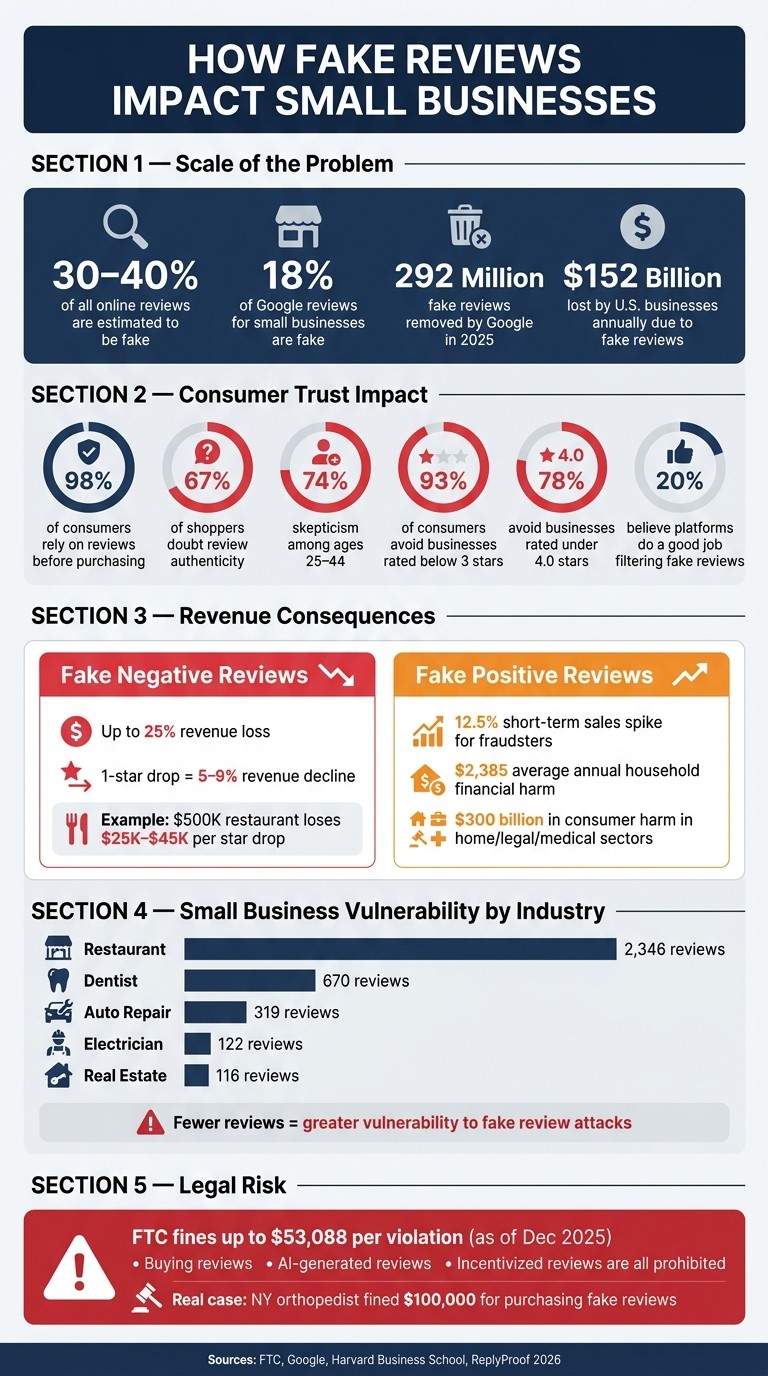
Fake reviews are a growing problem for small businesses, affecting consumer trust, revenue, and online visibility. With 30–40% of online reviews estimated to be fake, small businesses - especially those with fewer reviews - are hit harder than larger companies. A few fake negative reviews can tank a business’s rating, leading to revenue losses of up to 25%. On the flip side, fake positive reviews create unfair competition but erode trust across the board.
Key takeaways:
93% of consumers avoid businesses with ratings below 3 stars.
292 million fake reviews were removed by Google in 2025.
18% of Google reviews for small businesses are fake.
A one-star drop can reduce revenue by 5–9%, costing some businesses tens of thousands annually.
Fake reviews also harm search rankings, making it harder for honest businesses to compete. Small businesses can fight back by monitoring reviews, reporting suspicious activity, and encouraging genuine customer feedback. Tools like Gatsboy’s review management platform help track and address issues quickly, protecting both reputation and revenue.
How Fake Reviews Financially Devastate Small Businesses
What To Do After Receiving a Fake Review on Google
Why Fake Reviews Hit Small Businesses Harder
Fake reviews pose a unique challenge for small businesses, one that's much harder to overcome compared to larger companies. Big corporations can weather a handful of bad reviews without much impact. For example, a national chain with 10,000 reviews won't even notice a few fake 1-star ratings. But for a local business, like a plumber with just 15 reviews, even a couple of fake negatives can be catastrophic. The numbers alone highlight how much more vulnerable small businesses are, making it essential to grasp the scale and consequences of fake reviews.
How Common Fake Reviews Have Become
The prevalence of fake reviews is staggering. Industry estimates suggest that 30–40% of all online reviews might be fake, with about 18% of Google reviews for small and medium-sized businesses falling into this category. The rise of AI tools has made crafting convincing fake reviews incredibly cheap. What once cost $3–$5 per human-written review now costs mere fractions of a penny. Manipulation services further fuel this problem, offering fake reviews for as little as $5 each, often sold in bulk.
"Fake reviews are a tax on honest businesses. They distort the market, mislead consumers, and create legal risk for everyone involved." - Don Tran, Author, CoreVouch
How Much Small Businesses Rely on Reviews
For small businesses, online reviews are often their lifeline for attracting new customers. Unlike larger brands that can rely on advertising budgets or established reputations, small businesses like electricians or auto repair shops often depend entirely on their Google Business Profile to stand out.
The growing problem of fake reviews not only erodes trust but also amplifies the challenges for these businesses. Research from ReplyProof in 2026, which analyzed 3,844 local businesses, found that 13.1% of auto repair shops and 9.5% of electricians don’t even have a website and platform built for local businesses. For these businesses, their Google profile is their entire online presence, meaning a single fake negative review can dominate what potential customers see.
Industry | Median Reviews | % With No Website |
|---|---|---|
Restaurant | 2,346 | 0% |
Dentist | 670 | 1.2% |
Auto Repair | 319 | 13.1% |
Electrician | 122 | 9.5% |
Real Estate | 116 | 0.4% |
(Source: ReplyProof 2026 Research)
The numbers paint a clear picture. A restaurant with 2,346 reviews has a natural buffer against fake reviews. An electrician with just 122 reviews? Not so much.
How Consumers Use and Trust Reviews
The importance of reviews becomes even clearer when looking at consumer behavior. 98% of consumers rely on ratings and reviews before making a purchase. However, trust in reviews is declining, with 67% of shoppers doubting their authenticity, and skepticism rising to 74% among those aged 25–44.
This puts small businesses in a tough spot. Consumers depend on reviews but are also increasingly wary of them. When fake reviews - whether negative ones from competitors or inflated positives by unscrupulous actors - overshadow genuine ones, it undermines the trust that small businesses work so hard to earn. Unlike large corporations with dedicated PR teams, most small business owners are left to deal with this issue on their own, often lacking the time or resources to fight back effectively.
"A single coordinated fake review attack can create a downward spiral that takes months to recover from." - CoreVouch
How Fake Reviews Shape Consumer Trust and Decisions
Consumer trust in online reviews was already shaky, and the rise of fake reviews has made things worse. With an estimated 30–40% of reviews being fake, skepticism is growing rapidly. Right now, only 20% of U.S. consumers believe major review platforms are doing a good job of filtering out fake reviews. This trend is particularly troublesome for small businesses, which often rely heavily on their online reputation to compete.
How Awareness of Fake Reviews Changes Consumer Behavior
When people suspect reviews might be fake, their shopping habits shift. 36% of consumers now read reviews multiple times before deciding to buy something. Instead of building confidence, reviews are now a source of doubt. Once manipulation is suspected, trust drops by about 15% on average.
This creates what some call a "trust tax", as shoppers spend more time verifying reviews. For small businesses, this is a big deal. Even a glowing 5-star review from a loyal customer can lose its impact when buyers are already skeptical. Detailed, specific reviews are seen as 31% more trustworthy than vague ones. The generic tone often found in AI-generated fake reviews only adds to this suspicion, even if the reviews don’t have obvious red flags.
"Customers who suspect reviews are fake stop trusting them. This hurts every business, even those with entirely legitimate reviews." - Jamie Frost, Head of Content & Communications, Merrisk
Interestingly, the effects of fake reviews differ depending on whether they are negative or positive.
The Different Effects of Fake Negative and Fake Positive Reviews
Fake negative reviews are like weapons. They’re used to damage a competitor’s reputation, lower their ratings, and push them out of Google’s local search results. These reviews can slash a business’s revenue by as much as 25%. A well-coordinated attack can tank a rating so quickly that businesses see a noticeable drop in phone calls within just a few days.
Fake positive reviews, on the other hand, inflate a competitor’s reputation unfairly. While they can temporarily boost sales by about 12.5% in the first couple of weeks, they also contribute to the broader problem of mistrust. Every fake 5-star review makes it harder for consumers to trust genuine ones.
"Fraudsters know that they can drive potential customers away from your business simply by creating incremental declines in your average rating." - Miriam Ellis, Founder, Miriam Ellis Consulting
Review Type | Consumer Trust Impact | Business Consequence |
|---|---|---|
Fake Negative | Immediate avoidance; 94% of consumers avoid businesses after negative reviews | Up to 25% revenue loss; loss of local search visibility |
Fake Positive | Long-term skepticism of review platforms | Unfair competitor advantage; 12.5% short-term sales spike for the fraudster |
Verified Review | 12% increase in perceived credibility | 8–12% higher click-through rates; stronger conversion |
Using Review Monitoring Tools
With consumer behavior shifting and the impact of reviews becoming more pronounced, catching fake reviews early is critical. For small business owners who don’t have time to monitor reviews daily, tools like Gatsboy's Google Reviews integration can be a game-changer. These tools help businesses track reviews, identify unusual activity, and respond quickly before a fake review damages their reputation.
Beyond spotting fake reviews, Gatsboy’s platform simplifies overall reputation management. It allows businesses to maintain credibility and protect their growth. Publicly responding to reviews - whether fake or genuine - can increase repeat purchases by 12% and reduce the impact of complaints by 20%. For suspected fake reviews, a calm and factual response pointing out the lack of a transaction can signal inauthenticity to other readers. This approach also creates a record for requesting removal from the platform if needed.
The Financial Cost of Fake Reviews for Small Businesses
Fake reviews don’t just harm a small business’s reputation - they have a direct impact on its bottom line.
Revenue Loss Caused by Fake Negative Reviews
Even a single star can make a big difference. According to research from Harvard Business School, a one-star change in a business’s average rating can lead to a revenue shift of 5% to 9%. For example, a restaurant earning $500,000 annually could lose anywhere from $25,000 to $45,000 just from a one-star drop.
"A one-star rating increase translated to a 5–9% revenue increase for independent restaurants. For the independents, the star rating was the brand." - Michael Luca, Associate Professor, Harvard Business School
This impact is especially harsh for small businesses. Unlike chain restaurants or large brands that have established reputations, independent businesses rely heavily on their star ratings to attract customers.
Fake negative reviews make this problem even worse. A coordinated attack of fake reviews can drag down a business’s rating overnight. Even if the platform eventually removes the fraudulent reviews, the damage is done. Recovery can take months, during which the business may see fewer calls, less foot traffic, and a drop in search visibility.
Short-Term Revenue Gains from Fake Positive Reviews
On the other hand, some businesses turn to fake positive reviews for a temporary boost. These reviews can help businesses charge higher prices and appear more appealing to potential customers.
However, this practice has serious consequences for consumers. In industries like home services, legal, and medical sectors, review fraud is responsible for $300 billion in annual consumer harm. For individual households, the financial toll is significant - on average, each U.S. household loses $2,385 every year due to misleading fake positive reviews.
"Each household suffers, on average, $2,385.43 in economic harm annually from exposure to illegitimate positive reviews." - Roberto Cavazos, Professor and Economic Researcher
There’s also the growing risk of legal penalties. With the FTC’s 2024 rule targeting fake reviews, businesses caught engaging in this practice can face fines of up to $51,744 per violation. For example, a New York orthopedist was fined $100,000 by the New York Attorney General after investigators discovered the business had been purchasing fake positive reviews and offering patients $50 copay refunds to remove negative ones.
These financial and legal risks highlight why monitoring reviews closely is so important for businesses.
Connecting Revenue Data with Review Patterns
To understand the financial impact of fake reviews, small business owners need to connect revenue trends with review activity. A sudden drop in sales might not immediately point to fake reviews, but tracking these patterns together can help uncover the cause.
Tools like Gatsboy's Stripe Payments integration and Reviews Management features make this process easier. By combining payment data with review activity, business owners can quickly identify whether a spike in negative reviews aligns with a decline in bookings or transactions. This evidence can support disputes or guide response strategies. Additionally, monitoring key metrics like clicks-to-call, direction requests, and website visits from a Google Business Profile alongside review trends can reveal whether fake reviews are impacting customer engagement.
How Fake Reviews Affect Search Rankings and Online Visibility
How Reviews Shape Local Search Visibility
Reviews play a critical role in determining which local businesses Google highlights first. Key factors like star ratings, the number of reviews, and how recent they are directly influence local search rankings.
The impact is enormous. Businesses featured in Google's 3-Pack enjoy 126% more traffic and 93% more actions (like calls, clicks, and directions) compared to those ranked 4–10. Dropping below a 4.0-star rating can knock businesses out of this coveted spot. Considering that 78% of consumers avoid businesses rated under 4.0, even a slight dip in ratings can significantly hurt visibility. On the flip side, fake positive reviews create an uneven playing field. For example, a new business with 200 fake five-star reviews might outrank a well-established competitor with 50 genuine 4.5-star reviews.
As one expert explains:
"A business with 200 reviews and a 4.7 rating will, all else being equal, outrank a business with 15 reviews and a 4.9 rating." - Digital Promenade
Adding to this, platforms are cracking down on fake reviews, which further threatens the visibility of businesses engaging in manipulative practices.
Platform Penalties and Reputation Risks
In 2025, Google took action against 292 million policy-violating reviews and removed 13 million fake Business Profiles. Following the introduction of Google's Gemini AI to its moderation system, review deletion rates skyrocketed by 600% between January and July 2025.
These enforcement measures come with serious risks for businesses, including:
Penalty Type | What It Means | Duration |
|---|---|---|
30-Day Block | New reviews are blocked; existing ones may vanish | 30 days |
Review Jail | No new reviews allowed on the profile | 6–8 months |
Warning Label | Public banner flags the profile for manipulation | Ongoing |
Complete Wipeout | All reviews removed, rating drops to zero | Permanent |
Silent Filtering | Reviews appear posted but never show publicly | Permanent |
One particularly tricky penalty is silent filtering. In 2024, about 25% of reviews submitted to Google never appeared on profiles. These reviews weren’t necessarily fake - Google's AI flagged them based on patterns like sudden spikes in review submissions or multiple reviews coming from the same Wi-Fi network.
"The era of 'get 100 five-star reviews as fast as possible' is over. Google's systems are specifically designed to catch that pattern now." - Kemal Esensoy, Founder, Wunderlandmedia
Tracking Local Rankings Over Time
Keeping an eye on local rankings is just as important as monitoring reviews. For small businesses, tracking fluctuations in rankings can help maintain their online presence, especially when unusual review activity coincides with visibility drops. Geo-grid rank trackers are particularly effective because they show how a business ranks across various locations within its service area, accounting for Google's geography-based personalization.
When ranking shifts align with a surge in negative reviews, it’s a clear signal to act. Tools like Gatsboy's Local Tracking add-on ($99/month) make it easier for small businesses to detect ranking drops and correlate them with review activity. This eliminates the need for a dedicated SEO team. The tool also helps identify competitor ranking changes, enabling businesses to respond quickly. If a ranking drop coincides with negative review spikes, it’s time to investigate and take action - whether that means reporting fake reviews, responding publicly, or escalating the issue through Google's appeal process.
Laws, Legal Risks, and Platform Rules Around Fake Reviews
FTC Rules and Consumer Protection Laws
As small businesses face increasing financial and reputational pressures, staying compliant with legal standards around reviews is more important than ever. The Federal Trade Commission (FTC) has taken a firm stance against deceptive practices, including fake reviews, AI-generated testimonials, and suppressing negative feedback. The FTC's Consumer Review Rule, which went into effect on October 21, 2024, carries steep civil penalties - up to $53,088 per violation as of December 2025. Even if a business hires a third-party firm that engages in these tactics, the business itself is still on the hook.
"Fake reviews not only waste people's time and money, but also pollute the marketplace and divert business away from honest competitors." - Lina M. Khan, Chair, Federal Trade Commission
Here’s a quick breakdown of what’s allowed and what isn’t under these regulations:
Practice | Legal Status |
|---|---|
Buying positive reviews | Prohibited - no exceptions, even with disclosure |
AI-generated reviews | Prohibited - must come from actual customers with genuine experiences |
Incentivized reviews (sentiment-conditioned) | Prohibited - incentives cannot be tied to positive feedback |
Incentivized reviews (general, disclosed) | Allowed - only if the incentive is clearly disclosed |
Employee reviews without disclosure | Prohibited - employee relationships must be made clear |
Threatening reviewers to remove feedback | Prohibited - considered illegal suppression |
By December 2025, the FTC had already started sending warning letters to businesses suspected of violating these rules.
How Platforms Detect and Remove Fake Reviews
Platforms like Google, Amazon, and Yelp are stepping up their efforts to combat fake reviews. They use automated systems to identify and remove suspicious activity. For example:
Amazon blocked over 200 million suspected fake reviews in 2022.
Yelp flagged 19% of all reviews as "not recommended."
In June 2023, Google filed a lawsuit against a group accused of posting 14,000 fake reviews across 350 fake business profiles.
These actions highlight how serious platforms are about maintaining trust. For small businesses, this means staying vigilant and using tools that help monitor and respond to potential issues quickly.
Using a Centralized Dashboard to Manage Review Issues
When fake reviews surface, small businesses need a streamlined approach to address them. Start by documenting review timelines, using platform tools to flag suspicious activity, and keeping records of all correspondence for escalation purposes.
Tools like Gatsboy's business dashboard simplify this process by centralizing review management. It allows businesses to track Google Reviews, flag questionable activity, and respond promptly - all from one place. With a clear overview of review history, businesses can ensure compliance with FTC rules while protecting their online reputation. Proactive management through tools like Gatsboy enables businesses to stay ahead of potential issues and maintain trust with their customers.
How to Detect and Deal With Fake Reviews
Signs That a Review May Be Fake
Spotting fake reviews often comes down to recognizing common red flags. Look for profiles created just days before their review, with no prior activity, stock avatars, or overly generic names. These accounts often leave vague comments like "terrible experience" or mention nonexistent staff or products. Timing is another clue. A sudden influx of negative reviews - especially within a short window - can signal a coordinated attack. For instance, a dental clinic in South Delhi faced this in late 2025 when seven one-star reviews appeared within 36 hours. These accounts were less than six weeks old, and many used nearly identical language, alleging "unhygienic conditions." The clinic documented these patterns and successfully reported the reviews to Google for violating its policies.
When you suspect a review’s authenticity, cross-check the reviewer’s name and date against your CRM or booking system. If no matching transaction is found, this becomes solid proof when reporting the review to platforms like Google. Additionally, cultivating a strong base of legitimate reviews can help dilute the impact of any fake ones.
Getting More Genuine Customer Reviews
A steady stream of authentic reviews is your best defense against fake ones skewing your ratings. Take Lake Powell Paddleboard as an example - they grew their Google reviews from fewer than 11 to nearly 400 by consistently asking every customer for feedback. Their 4.9-star average ensured that occasional negative reviews had minimal impact.
How you ask for reviews matters. Google’s filters are increasingly cautious with reviews submitted via on-site QR codes, especially if the reviewer has no prior interaction with your business on Google Maps. A better strategy is to send review requests via email or SMS within 24–48 hours of service. Use open-ended prompts like "share your honest feedback" instead of directly asking for a specific rating.
"The safer your process looks to a customer, the safer it usually looks to Google." - Reputation Rhino
A secure and transparent review process not only reassures customers but also aligns with Google’s guidelines. If you do receive a questionable review, respond calmly and factually. Mention that you have no record of the transaction and invite the reviewer to resolve the issue privately. Continuous monitoring of reviews ensures you can address any problems quickly.
Using Tools to Monitor Reviews Consistently
Fake reviews can harm your reputation and bottom line fast, so keeping a close eye on them in real time is crucial. Delaying action even by a few days can allow a coordinated attack to lower your star rating significantly, which might lead to a noticeable drop in customer inquiries.
"A coordinated attack lowering your rating from 4.8 to 4.2 can cause a decline in calls within days." - Linda Donnelly, Reputation Specialist, BSMG
Tools like Gatsboy's reviews management features can help small businesses stay ahead. With a centralized dashboard, you can track reviews, spot unusual activity, and respond promptly - minimizing the potential damage caused by fake reviews.
Conclusion: Steps Small Businesses Can Take Against Fake Reviews
Fake reviews are more than just an annoyance - they're a serious financial issue. In fact, they cost U.S. businesses around $152 billion every year. For small and medium-sized businesses, 18% of Google reviews are estimated to be fake, making it a challenge that no business owner can afford to overlook.
Taking action starts with a systematic approach. Begin by comparing new reviews with your CRM or booking records. If a review doesn’t align with a real transaction, you have solid grounds to report it to Google. Timing matters - reports made within the first 30 days have the highest chance of success. Use Google's Review Management Tool, choose the most relevant policy category (like "Spam" or "Conflict of Interest"), and document every case ID for follow-up. Once you've reported suspicious reviews, focus on strengthening your defenses by collecting more genuine feedback.
"A bad review is feedback. A fake review is fraud. Treating them the same way is why most fake reviews never come down." - TrueReview
Building a steady stream of authentic reviews is your most reliable safeguard. It not only lessens the impact of fake reviews but also boosts your reputation and trustworthiness. Keep in mind that 73% of consumers only trust reviews written in the last 30 days, so consistency is key. Send review requests via email or SMS within 24–48 hours of service, and keep the message simple and straightforward.
Automating review management can make this process much easier. Tools like Gatsboy's reviews management features offer a centralized way to monitor reviews, flag suspicious activity, and respond quickly. With automated systems, you can save time and stay ahead of potential issues, ensuring your business's reputation remains strong and resilient.
FAQs
How can I prove a Google review is fake?
If you're trying to spot a fake Google review, you might not be able to confirm it 100%, but there are telltale signs to watch for. Keep an eye out for things like sudden surges in reviews, overly generic or repeated text, or accounts that seem questionable. To dig deeper, compare the review with your records to see if the person actually interacted with your business. If something feels off, flag the review in your Google Business Profile and save evidence like screenshots in case you need to escalate the issue further.
What should I say publicly when I suspect a fake review?
If you come across a review that seems fake, handle it with a calm and professional tone. Stick to the facts. You can mention that there’s no record of the experience described and, if necessary, note that you’ve reported it to the platform for further investigation. Avoid making accusations or engaging in arguments, as these actions can damage your credibility.
For reviews that include hate speech or private information, it’s best to avoid responding publicly. Engaging with such content could unintentionally amplify it. Focus instead on addressing the issue through the proper channels.
How can I get more real reviews without getting filtered?
To stay on the safe side of Google's guidelines, aim to request reviews steadily over time rather than all at once. Consistency is key. Keep your requests straightforward - don’t suggest exact wording or offer any kind of reward. The best time to ask? Shortly after a customer has completed their service or appointment, using either a text message or email.
Tools like Gatsboy’s PRO Messaging & Leads and the PRO Google Reviews module can make this process easier. These features help you manage requests, collect feedback, and showcase verified reviews seamlessly.
Related Blog Posts
Join our community of 15,000+ business owners
Popular articles
Popular articles about your website and marketing your small business


