



7 Local SEO Benefits Of Customer Reviews
Small Business Marketing
Customer reviews are one of the most important factors for improving your local SEO. They directly influence your business's visibility, trustworthiness, and engagement in local search results. Here’s what you need to know:
Boost Rankings: Reviews account for 17% of factors impacting Google’s Local Pack rankings. Quantity, recency, and keywords in reviews help you rank higher.
Increase Visibility: Businesses with more than 112 reviews rank better. Recent reviews hold more weight than older ones.
Build Trust: 97% of consumers read reviews before deciding. A 4.0–4.5-star rating is ideal for earning customer trust.
Drive Clicks: Listings with star ratings see a 35% increase in click-through rates.
Keyword Relevance: Google uses review content to match your business with search queries. Keywords in reviews improve local relevance.
Encourage Engagement: Responding to reviews signals to Google that your business is active, improving rankings further.
Stay Ahead of Competitors: A strong review profile with consistent updates gives you an edge in crowded markets.
Quick Comparison of Key Review Factors
Factor | Impact on SEO | Best Practice |
|---|---|---|
Quantity | Higher rankings | Aim for 100+ reviews |
Recency | Signals relevance | Collect reviews monthly |
Star Rating | Builds trust | Ideal range: 4.0–4.5 stars |
Keywords in Reviews | Matches search queries | Encourage specific feedback from customers |
Response Rate | Improves engagement | Respond within 24–48 hours |
Customer reviews are more than just feedback - they’re a powerful tool to grow your local presence and attract more customers.
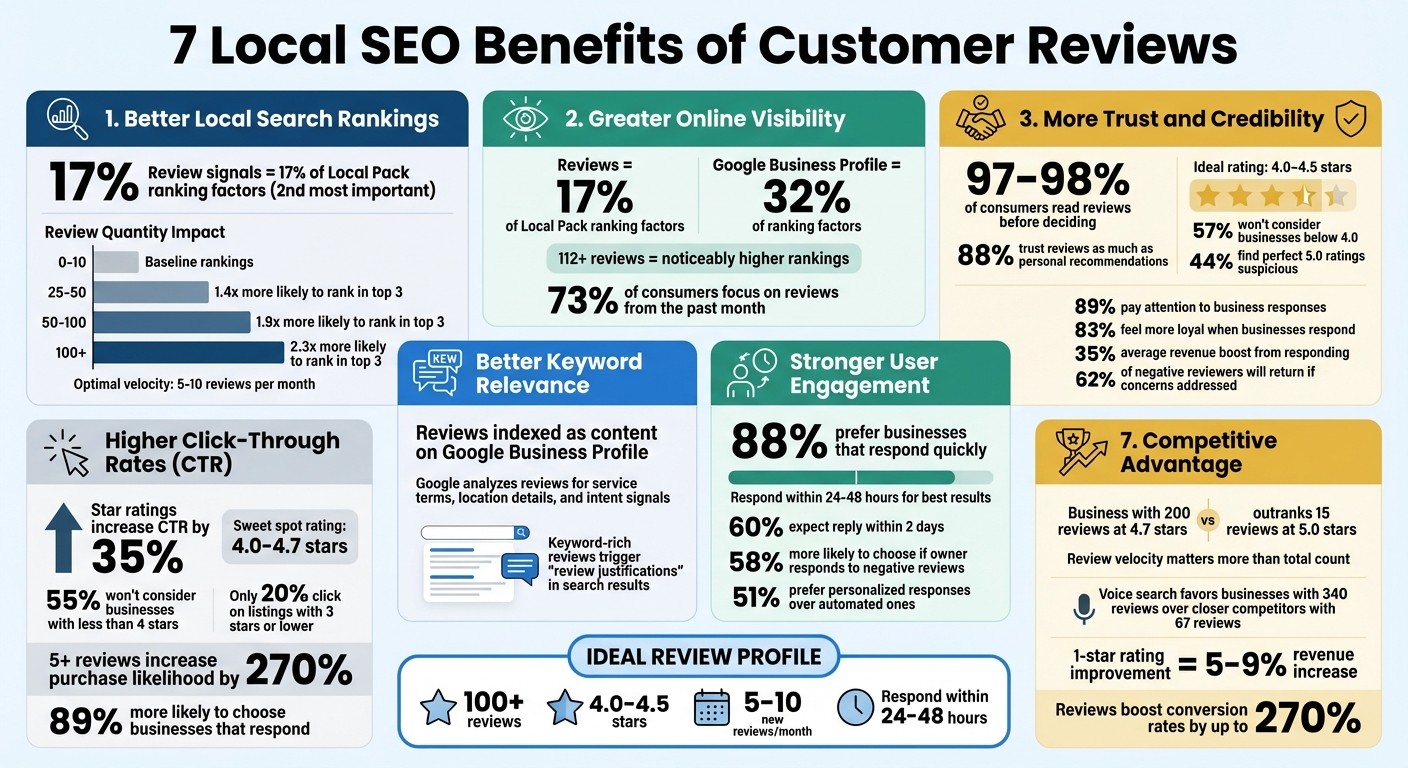
7 Local SEO Benefits of Customer Reviews: Key Statistics and Impact
The Easy Local SEO Trick Competitors Don't Want You to Know
1. Better Local Search Rankings
Customer reviews play a big role in determining where your business appears in local search results. Google relies on three main factors to decide local rankings: Relevance, Distance, and Prominence. Reviews are a key part of that Prominence factor. In fact, review signals are the second most important factor for showing up in the Local Pack (those top three map results), right after your Google Business Profile.
Google’s algorithm looks at five key review signals to assess your business:
Quantity: The total number of reviews.
Velocity: How often new reviews are posted.
Diversity: Reviews from a mix of accounts and locations.
Recency: How recent the reviews are.
Keywords: Services or terms mentioned in the reviews.
Here’s an example of why these signals matter: A business with 100 reviews and a 4.3-star rating will often outrank one with only 15 reviews but a 4.9-star rating. That’s because quantity and consistency outweigh perfection.
Review Quantity | Impact on Ranking Likelihood |
|---|---|
0–10 reviews | Baseline rankings |
25–50 reviews | 1.4x more likely to rank in top 3 |
50–100 reviews | 1.9x more likely to rank in top 3 |
100+ reviews | 2.3x more likely to rank in top 3 |
Consistency is just as important as the total number of reviews. A steady stream of 5–10 reviews per month tells Google your business is active and trustworthy. For example, 10 recent reviews from this month will carry more weight than 50 reviews that are several years old. Keeping that steady flow of reviews ensures you remain competitive in local search rankings.
Responding to reviews also strengthens your presence. When you reply - especially within 24 hours - it creates fresh content for Google to index. Including natural mentions of your services and location (like "Thank you for choosing us for your brake repair here in Austin!") boosts your relevance for local searches.
2. Greater Online Visibility
Customer reviews play a key role in making your business more visible in local searches. The more reviews you gather - and the more recent they are - the higher the chances that Google will showcase your business in the Local Pack (the top three map results) and in standard search results below the map.
Why do reviews matter so much? They directly impact your visibility. Review signals account for about 17% of the factors influencing Local Pack rankings. That makes them the second most important factor, right after your Google Business Profile, which contributes roughly 32%. Reviews also represent around 7% of the factors affecting organic search rankings. This makes them a vital piece of your local SEO strategy.
Here's the kicker: Businesses with 112+ reviews tend to rank noticeably higher. But it’s not just about the total number of reviews - it’s about keeping them fresh. For instance, a business with 80 reviews and recent feedback often outranks a competitor with 200 reviews if those reviews are outdated. Recency matters because it signals relevance; in fact, 73% of consumers focus on reviews from the past month.
The consistency of your review volume and ratings also strengthens your online presence. Businesses with 15–30 reviews and ratings between 4.0–4.3 stars may see fluctuating rankings. But once a business hits 50–100 reviews with ratings in the range of 4.4–4.6 stars, they often secure a stable spot in the Local Pack. Companies with 150+ reviews and ratings of 4.7+ stars enjoy consistent, top-tier visibility.
Additionally, reviews influence where your business appears beyond the Local Pack. When customers mention specific services - like "root canal" or "brake repair" - Google uses that text to better match your business with related searches. So, detailed reviews not only boost visibility but also help connect you with the right audience.
3. More Trust and Credibility
When your rankings and visibility improve, the next vital piece of the puzzle is earning customer trust. And let’s face it - trust can make or break your local SEO success. Think about this: nearly 97% to 98% of consumers check online reviews before deciding on a local business. Even more striking, 88% of people trust those reviews just as much as personal recommendations from friends or family. In today’s digital world, reviews are the new word-of-mouth, and their impact is hard to overstate.
The star rating is often the first thing people notice. It’s a quick snapshot of quality. In fact, 57% of consumers won’t even consider a business with a rating below 4.0 stars. But here’s a twist: having a perfect 5.0-star rating might not always work in your favor. 44% of consumers actually find a flawless score suspicious. A mix of glowing reviews and a few minor critiques feels more authentic to potential customers. The ideal rating? Somewhere between 4.0 and 4.5 stars, which boosts both trust and click-through rates.
"Consumers trust the aggregated opinions of strangers almost as much as they trust their closest friends." - ReviewScout AI
This quote perfectly captures how customer feedback can elevate your reputation and authority in local search results.
But it’s not just about collecting reviews - it’s about how you handle them. 89% of consumers pay attention to how businesses respond to reviews during their decision-making process. Thoughtful, professional responses show you care, and they pay off big time. 83% of consumers feel more loyal to businesses that take the time to respond to reviews, and these businesses see an average revenue boost of 35%. Even better? 62% of negative reviewers are willing to give you another shot if you address their concerns effectively.
These reviews don’t just build trust with customers - they also send strong signals to Google. Reviews account for about 17% of the factors that influence Local Pack rankings. So, by managing reviews well, you’re not only enhancing your credibility but also giving your local SEO a solid boost.
4. Higher Click-Through Rates
Star ratings and review counts do more than just make your listing look good - they directly impact how often people click on it. While earlier sections focused on improving rankings and visibility, this part explains how reviews turn those impressions into actual clicks. Think of those gold stars next to your listing in search results as a trust shortcut. In just seconds, they communicate credibility before users even read a single word. These visual markers not only establish trust but also improve key performance metrics.
Here’s the kicker: star ratings in search snippets can increase click-through rates by up to 35%. That’s a major boost from something as simple as visible feedback. And the stakes are high - 55% of consumers won’t even consider businesses with less than 4 stars. On the flip side, only 20% of users will click on a listing with 3 stars or lower. Your star rating isn’t just a nice touch; it’s often the deciding factor between earning a click or being ignored.
Review volume plays a big role here, creating what’s known as a "visible consensus". For example, a 4.7-star rating with 200 reviews feels rock-solid, while the same rating with just five reviews doesn’t carry the same weight. In fact, having at least five reviews can increase purchase likelihood by up to 270%. Even better, businesses that actively respond to reviews see 89% of consumers more likely to choose them.
This sets off a powerful cycle: better reviews lead to higher visibility and more clicks, which bring in more customers who leave additional reviews, driving even more clicks. For example, a plumbing company grew its review count from 23 to over 180 within six months, resulting in a 63% increase in phone calls from their Google listing. Similarly, a dental practice accumulated 420 reviews over 18 months, becoming the top local search result for dentistry and cutting their cost per new patient acquisition by 40% through increased organic traffic.
"If your rating is strong, people are willing to click and learn more. If your rating looks shaky, they don't just hesitate, they often skip you entirely." - Muhamad Eissa, Content Marketer, NiceJob
Want to hit the sweet spot for clicks? Aim for a rating in the 4.0–4.7 star range. This balanced range builds trust and attracts clicks, driving more local traffic and boosting your overall SEO performance.
5. Better Keyword Relevance
Building on improved click-through rates and trust, keyword-rich reviews can align your business with the exact search terms your local customers use. Unlike your website content, which might lack conversational language, customer reviews often reflect how people naturally describe your services. For instance, when someone writes "best chiropractor in Clearwater" or mentions "shingle roof replacement" in a review, those phrases become indexed content on your Google Business Profile. This makes it easier for search engines to match your business with the specific queries people are searching for.
Google's algorithms take a deep dive into reviews, analyzing them for service-related terms (like "Invisalign" or "dental implants"), location details (such as neighborhood names), and intent signals (words like "emergency" or "same-day service"). The more specific the review, the stronger the relevance signal. For example, a dentist whose reviews frequently mention "teeth whitening", "sedation dentistry", and "root canal" is far more likely to rank for those terms than a competitor whose reviews simply say "great dentist".
Here's an added bonus: when reviews consistently include specific keywords, Google may showcase "review justifications" in search results. These snippets highlight why your business matches a user’s query. Additionally, Google uses review content to power features like "Place Topics" and the "Ask Maps about this place" tool, making reviews a critical part of modern search functionality.
A real-world example? In early 2025, Dr. Patel, a dentist in Clearwater, updated his post-appointment email templates to ask patients about the specific treatment they received. Within 60 days, his practice’s Google Business Profile gained multiple new reviews mentioning phrases like "teeth whitening in Clearwater" and "dental implants." This led to a noticeable boost in Map Pack rankings for those keywords and an increase in phone calls from non-branded searches.
"Keywords in reviews are generally believed to help local rankings... keyword-rich reviews can still provide meaningful value for local SEO beyond pure rankings." - Darren Shaw, Founder, Whitespark
Want to make this happen naturally? Instead of asking for generic feedback, try prompting customers with specific questions like, "Which service did we help you with?" or "Was there a particular technician you'd like to mention?". When responding, weave in the service and location naturally, like saying, "We’re thrilled your Clearwater dental cleaning went smoothly". This approach not only strengthens local SEO but also reinforces those keyword connections for even better results.
6. Stronger User Engagement Signals
Driving traffic with keyword relevance is important, but user engagement signals are what really set the foundation for long-term success in local SEO. Engaging with customer reviews, for example, sends a strong message to search engines about the quality of your business. When you respond to feedback - ideally within 24 to 48 hours - Google sees this as proof that your business is active and focused on its customers.
Every time you reply to a review, it adds more substance to your Google Business Profile and strengthens your local relevance. Plus, businesses that regularly respond to reviews tend to see more interactions on their profiles - things like clicks, phone calls, and requests for directions. These actions act as behavioral signals that reflect the quality of your business. Over time, this creates a feedback loop: more engagement improves rankings, better rankings boost visibility, and increased visibility drives even more engagement.
The stats paint a clear picture: 88% of consumers prefer businesses that respond quickly, with 60% expecting a reply within two days. Meeting these expectations not only builds customer satisfaction but also signals to search engines that your business is actively managed. Interestingly, 58% of consumers are more likely to choose a business if the owner responds to negative reviews with a clear resolution. These engagement signals build trust with customers and improve your local search performance.
"An active response history tells Google that your business is engaged and current. This contributes to your prominence score." – ReviewScout AI
This connection between engagement and visibility was demonstrated by a Seattle chiropractor in 2025. By committing to respond to every customer review within 24 hours - and making no other changes to their digital strategy - they moved from rank five to rank two in the local pack within six months.
The takeaway? Consistent interaction makes a difference. Focus on crafting genuine, personalized responses (51% of customers prefer them over automated ones). Take the opportunity to mention your services and location naturally, and always address negative feedback with actionable solutions. This kind of steady engagement shows search engines - and your customers - that your business is not just operational but thriving and customer-focused.
7. Advantage Over Local Competitors
In crowded local markets, having a strong review profile can set your business apart in ways that competitors struggle to replicate quickly. Google's local ranking algorithm heavily factors in prominence - essentially, how well-known and credible your business appears compared to others. Customer reviews play a major role here. Businesses with a higher number of reviews and better ratings often secure those coveted top three spots in local search results, while those with fewer reviews risk being buried on later pages. This isn’t just a theoretical edge - it’s a real, measurable advantage for businesses that know how to make reviews work for them.
For example, a business boasting over 200 reviews with a 4.7-star rating will consistently outperform a competitor with just 15 reviews, even if that competitor has a perfect 5-star score. Review velocity - the pace at which you collect new reviews - matters just as much. Ten reviews this month carry more weight than fifty reviews that are several years old. If your competitor averages three new reviews monthly, aiming for eight to ten fresh reviews can signal stronger current engagement to Google.
Review Profile | Local Pack Presence | Competitive Advantage |
|---|---|---|
15-30 reviews, 4.0-4.3 stars | Unstable rankings | Vulnerable to competitors |
50-100 reviews, 4.4-4.6 stars | Regular presence | Competitive in most markets |
150+ reviews, 4.7+ stars | Dominant visibility | Positioned as a market leader |
Beyond just numbers, a high review count can help offset location-related disadvantages. For instance, in voice search scenarios, Google has been known to recommend businesses with 340 reviews over closer competitors that only had 67 reviews. This kind of prominence becomes even more critical as voice search and AI-powered assistants increasingly rely on review data to make recommendations.
Building this competitive edge takes consistent effort. Start by analyzing your top three local competitors - track their total reviews, average ratings, and how quickly they’re accumulating new reviews. Next, focus on increasing your own review velocity rather than scrambling to match their total numbers overnight. Simplify the process for your customers by using direct Google review links or QR codes on receipts and business cards. And don’t wait too long - ask for feedback within 24 hours of completing a service, when customer satisfaction is at its peak.
How to Use Customer Reviews for Better Local SEO
Using customer reviews effectively can make a big difference in boosting your local SEO. It starts with collecting and managing reviews in a way that encourages both volume and quality.
Timing is key. The best moment to ask for a review is within 24 hours of providing a service - especially when a customer has just expressed their satisfaction. Train your staff to spot these moments and ask naturally, whether during checkout or a follow-up call. A simple script like, "We'd love to hear your feedback - could you leave us a quick review?" works well to invite responses.
Make it easy for customers to leave reviews. Use direct Google review links or QR codes to simplify the process. You can create a short review link from your Google Business Profile and share it through email, SMS, or even printed materials like menus, receipts, and business cards. Data shows that combining email and SMS requests increases response rates to 26%, compared to just 15% for email alone or 20% for SMS alone.
Once you've streamlined the process of collecting reviews, it's crucial to respond promptly. Reply to every review - positive or negative - within 24 hours. This not only shows your commitment to customer service but also signals to Google that you're actively engaged, which can improve your placement in local search results. For positive reviews, thank the customer by name and mention specific details they highlighted. For negative reviews, apologize sincerely, acknowledge the issue, and aim to resolve it offline.
"A negative review is not the end of the world, but that it is, in fact, the last chance the business will likely be given to make amends and win back the customer" - Moz
Interestingly, 62% of customers who leave negative reviews are willing to give your business another chance if you respond effectively and resolve their problem.
Finally, take your strategy a step further by showcasing reviews on your website. If you're using a small business website through Gatsboy, you can integrate Google reviews directly onto your site using their Google Reviews module. This not only builds trust with potential customers but also enhances your local SEO by leveraging Business Schema, which helps search engines display your reviews in search results. With tools like the centralized Business Dashboard, you can easily manage reviews, leads, messages, and bookings - all in one place.
Conclusion
Customer reviews play a major role in driving local SEO success. They don’t just help boost your local search rankings - they also build trust and credibility with potential customers. Reviews impact nearly every aspect of your online presence, with review signals being a critical ranking factor.
Making review management a part of your growth strategy amplifies all the benefits of local SEO. Think of it as a self-reinforcing cycle: more reviews improve rankings, better rankings attract more customers, and those customers leave even more reviews. This "flywheel effect" is why businesses that actively collect reviews tend to outperform their competitors in local search results.
The numbers back this up: almost every consumer checks online reviews before making a decision, and displaying reviews can boost conversion rates by up to 270%. Even more striking, improving your rating by just one star can lead to a 5–9% increase in revenue for independent businesses. These aren’t just stats - they’re game-changing for your business.
The key is consistency. Whether it's asking for feedback shortly after a customer interaction, responding to reviews within a couple of days, or showcasing reviews on your small business website, sticking to a regular process is what sets thriving businesses apart. Start collecting reviews regularly, and you’ll create a growth engine that keeps your business moving forward.
FAQs
How many reviews do I need to see local SEO results?
Having 10-15 reviews is often enough to help your business show up in local search results. However, if you’re aiming for stronger visibility, many businesses target 40-50 reviews to rank in the local pack. To stand out even more, accumulating 75-100 reviews can give you a noticeable edge over competitors. The key is to focus on gathering consistent and genuine reviews to improve your local SEO performance.
How can I ask customers for keyword-rich reviews without being pushy?
To encourage keyword-rich reviews in a way that feels natural, focus on when and how you ask. Timing matters - reach out shortly after a customer has had a positive experience. Keep your tone friendly and conversational, not pushy. You can gently suggest specifics by saying something like, "If you loved our [specific service], feel free to mention it in your review." To make it even easier, provide a direct link to where they can leave their feedback. Convenience goes a long way!
Do negative reviews hurt local rankings if I respond quickly?
Negative reviews can influence your local rankings. However, responding quickly can help minimize their impact. Timely replies signal to Google’s local algorithm that you’re actively managing your reputation. Plus, handling concerns professionally not only softens the blow of a negative review but also helps build trust with future customers.
Related Blog Posts
Join our community of 15,000+ business owners
Popular articles
Popular articles about your website and marketing your small business


