


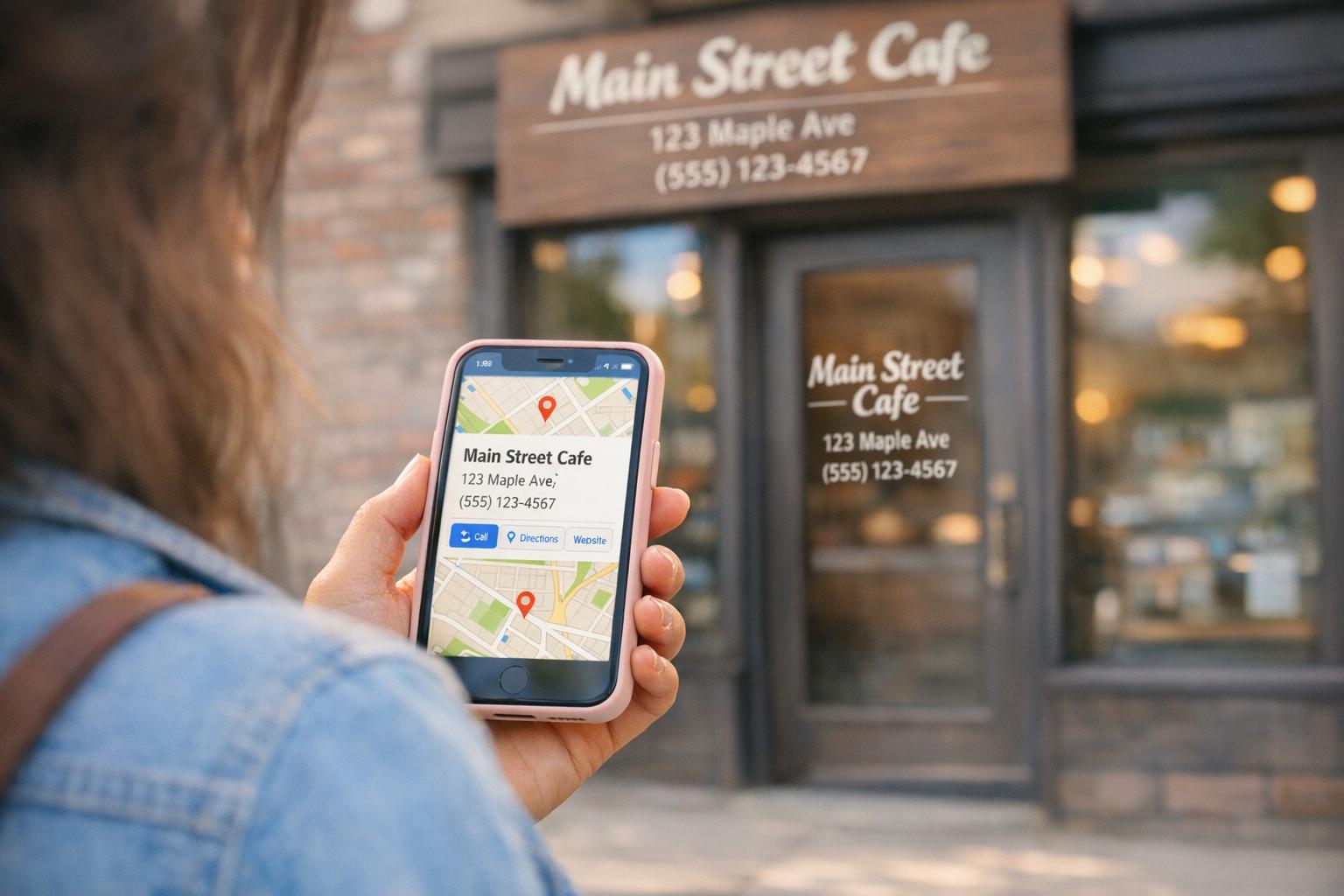
NAP Consistency vs. Rankings: Why It Matters
Small Business Marketing
NAP consistency - ensuring your business's Name, Address, and Phone number are identical across all online platforms - is critical for local SEO success. Why? Search engines and AI systems like Google and ChatGPT rely on this data to verify your business's legitimacy and location. Inconsistent details confuse algorithms, erode trust, and can drop your local rankings by up to 40%. Here's what you need to know:
NAP accuracy boosts rankings: Consistent details help search engines confidently display your business in the Local Pack (top 3 map results).
AI-driven searches demand precision: Tools like ChatGPT and Gemini cross-check your NAP data before recommending your business.
Customer trust depends on accuracy: Over 80% of consumers lose confidence in businesses with incorrect contact details.
To improve rankings and credibility:
Audit and standardize your NAP across major platforms like Google Business Profile, Yelp, and Apple Maps.
Use LocalBusiness schema markup on your website.
Regularly update key data aggregators like Data Axle to prevent errors from spreading.
Inconsistent NAP data doesn’t just hurt rankings - it also frustrates customers and reduces revenue opportunities. Fixing it is one of the most impactful steps you can take for local SEO.
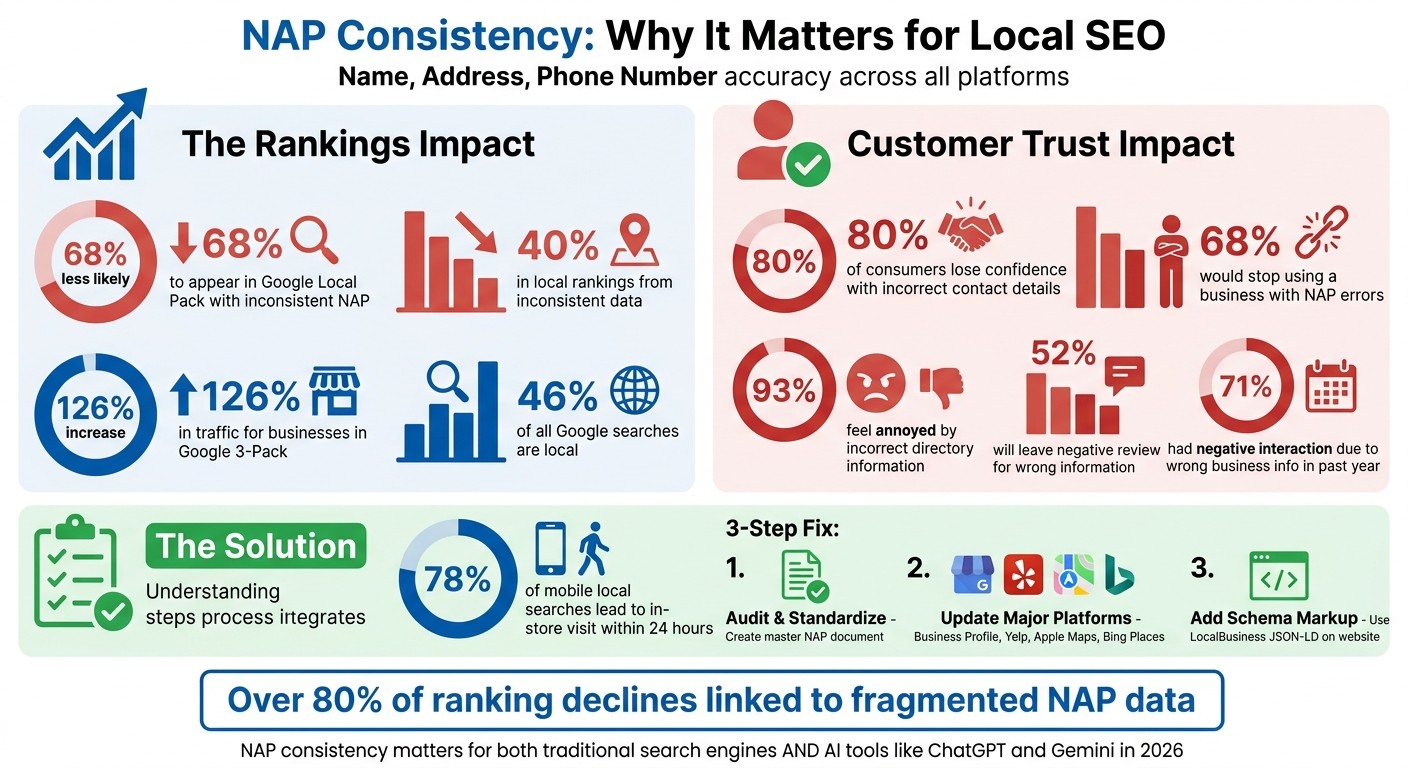
NAP Consistency Impact on Local SEO Rankings and Customer Trust
Local SEO Truth: NAP Consistency Matters
How NAP Consistency and Rankings Affect Local SEO
Local search algorithms hinge on three key factors: proximity (how close your business is to the searcher), relevance (how well your business matches the search query), and prominence (how trustworthy and established your business appears). Each of these factors is directly tied to maintaining consistent NAP (Name, Address, Phone number) information.
When your NAP details are consistent across platforms like Google Business Profile, Yelp, and Apple Maps, search engines can confidently cross-reference this data with structured databases like Data Axle and Foursquare. This consistency strengthens algorithm confidence in your business. On the flip side, conflicting information can lead to exclusion from the Local Pack - the highly visible top three map results that appear above organic listings.
"Google operates like a digital detective. The algorithm cross-references your business data across hundreds of directories, databases, and aggregators." - Weekthink
This "detective work" not only verifies your business information but also determines how far your visibility extends in local search results.
Accurate and consistent NAP details confirm your business's location, helping to broaden your visibility across your entire service area. If your data is inconsistent, however, your reach may shrink, limiting your visibility to nearby searches. With Google Business Profile completeness accounting for approximately 32% of Local Pack ranking weight, ensuring your NAP details are accurate is one of the most impactful steps you can take to improve your rankings.
Inconsistent NAP data also weakens your citation authority. For example, discrepancies like "123 Main St." versus "123 Main Street, Suite 5" can confuse search engines, making it harder for them to credit mentions of your business to the right entity. This fragmented data can create duplicate or "ghost" profiles that split your reviews, further complicating ranking algorithms. Looking ahead, tools like ChatGPT and Gemini rely on NAP consistency to verify and recommend businesses. Conflicting records can make it harder for these systems to accurately represent your brand.
The impact of inconsistent NAP data is significant. It can cause local rankings to drop by as much as 40%, with over 80% of ranking declines linked to fragmented data. The solution? Adopt a standardized format for your business name, address (including suite formatting, such as "Ste 100" versus "Suite 100"), and phone number. Start by updating primary data aggregators, as these feed information to countless smaller directories. Without this step, manual corrections risk being overwritten by inaccurate source data. Fixing these issues is essential for building a strong local SEO presence.
1. NAP Consistency
Building on the importance of NAP (Name, Address, Phone Number) in local SEO, this section explores how keeping your information consistent can significantly impact your online visibility and reputation.
Impact on Local SEO
Think of NAP consistency as your business's digital fingerprint. If your information is inconsistent, you're 68% less likely to show up in Google's Local Pack - one of the most visible spots for local search results. With over 1 billion people turning to Google Maps each month, being visible here can directly affect your bottom line. When conflicting details appear across platforms, Google may limit your visibility by narrowing your search range.
Fast forward to 2026, and the role of NAP consistency has grown even further. AI assistants like ChatGPT, Gemini, and Perplexity now rely on accurate business data to provide recommendations in their conversational answers. If your NAP details are inconsistent, these systems may struggle to verify your business, leaving you out of AI-driven local recommendations.
"NAP consistency remains one of the most practical and misunderstood factors in local SEO, and in 2026 it matters not just for Google Business Profile visibility, but for how AI search engines interpret business identity across the web." - LSEO
Trust and Credibility
It's not just about rankings - NAP inconsistencies can erode customer trust. A whopping 80% of consumers lose confidence in a business and 68% would stop using it if they encounter errors in its contact details.
What's more, most customers hold businesses accountable for these mistakes. While 31% blame the business for inaccurate directory information, only 18% fault the directory itself. This perception gap shows that every inconsistency directly impacts your reputation. Worse, 52% of customers will leave a negative review if they find incorrect information about your business online.
Frustration runs high, too - 93% of consumers report feeling annoyed by incorrect directory details, and 71% experienced a negative interaction in the past year due to wrong business information. These aren't just numbers - they reflect lost trust, missed opportunities, and revenue slipping through your fingers. Consistent NAP data lays the groundwork for maintaining both credibility and strong local SEO performance.
Tools and Solutions
To fix NAP inconsistencies, start by creating a master document that serves as your single source of truth. This document should include your official business name, address format (e.g., "Suite" vs. "Ste."), and primary phone number. Use this as your guide for updating all platforms.
Begin with the heavy hitters: Google Business Profile, Apple Business Connect, Bing Places, and Yelp. Then address key data aggregators like Data Axle and Foursquare, which feed information to smaller directories. Cleaning up these major sources prevents incorrect data from spreading.
On your website, ensure your NAP is displayed as crawlable text (not an image) in your header, footer, and contact page. Add LocalBusiness schema markup using JSON-LD to help search engines process your information accurately.
If you're short on time, professional citation cleanup services are available, typically costing between $500 and $2,000 for small businesses. However, manual updates provide permanent corrections that you own, unlike API-based software subscriptions, which may revert changes if the subscription ends.
2. Search Rankings
While NAP consistency lays the groundwork, your search rankings decide if customers can actually find you. Rankings act as the bridge between accurate business data and customer discovery. Let’s delve into how rankings can extend your local reach.
Impact on Local SEO
Search engines validate your business by assessing its "entity confidence", which influences your visibility radius - how far away from your location potential customers will see you in search results. When your NAP information is consistent across numerous directories, Google increases this radius, making your business visible to users farther away. On the flip side, conflicting data shrinks your reach, often limiting visibility to just your immediate area.
Here’s why this matters: 46% of all Google searches are focused on local information, and 78% of mobile local searches lead to an in-store visit within 24 hours. Businesses featured in the Google 3-Pack (the top three map results) enjoy a 126% increase in traffic and 93% more user actions compared to those ranked lower (fourth through tenth). In fact, the 3-Pack captures 40% to 50% of all clicks for local searches.
Fast forward to 2026, and the stakes are even higher. AI tools like ChatGPT and Gemini now rely on your NAP data to verify your business before recommending it in conversational search results. If your information is fragmented, these AI systems struggle to include your business in "best near me" suggestions, which can severely impact your ranking stability.
Now, let’s look at the tools and strategies that can help boost your rankings.
Tools and Solutions
Start by claiming and optimizing your profiles on essential platforms like Google Business Profile, Apple Business Connect, Bing Places, and Yelp. These platforms have a direct impact on your search visibility. Make sure your website prominently displays your NAP details as crawlable text in the header, footer, and contact page.
To further enhance your visibility, implement LocalBusiness schema markup using JSON-LD. This structured data provides search engines with a direct and reliable way to verify your business details, reducing reliance on third-party directories.
If outdated or duplicate listings (often called ghost listings) are causing issues, search for your old contact details in quotation marks. Claim these profiles and either delete them or update them to reflect your current information. For businesses with multiple locations, create a unique landing page and local phone number for each one. Avoid generic labels like "Brand Name - City" unless this matches the signage at your storefront.
Pros and Cons
When it comes to local SEO, NAP consistency (Name, Address, Phone number) and search rankings play different but complementary roles. Each has its own strengths and challenges, and knowing how they differ can help you allocate your time and resources more effectively.
NAP consistency acts as the foundation of your local SEO efforts. It’s something you can control by auditing and standardizing your business information across directories. This improves "entity confidence" and expands your local visibility. However, keeping your NAP data consistent can be time-consuming, especially if frequent updates lead to temporary verification hiccups.
On the other hand, focusing on search rankings is all about gaining visibility and attracting customers quickly. But rankings are harder to manage because they’re influenced by factors like proximity, competitors, and algorithm changes. Even if you rank high, inaccurate NAP data can frustrate potential customers, leading to missed calls or visits to outdated locations.
Here’s a quick comparison of the trade-offs between prioritizing NAP consistency and search rankings:
Criteria | Emphasizing NAP Consistency | Prioritizing Search Rankings |
|---|---|---|
SEO Impact | Builds stability and entity trust | Offers high visibility but can be unstable |
Customer Trust | High; avoids incorrect contact info | Mixed; bad data can frustrate users |
Ease of Management | Directly manageable through audits | Influenced by external factors |
AI Visibility | Essential for accurate AI verification | Moderate; conflicting info may hurt visibility |
Control | High; you control your data | Low; depends on algorithms and competition |
Both elements are crucial for local SEO success. Research shows that over 80% of service businesses facing sudden ranking drops have inconsistent business information. Think of NAP consistency as the foundation that keeps your SEO stable, while search rankings serve as the visibility layer that helps customers find you. Together, they create a balanced strategy for local SEO.
Conclusion
Keeping your NAP (Name, Address, Phone number) consistent is the backbone of local SEO. When your business information matches perfectly across platforms like Google, Yelp, and other directories, search engines gain "entity confidence." This trust allows them to confidently recommend your business in search results and through AI-powered tools.
Inconsistent NAP data can cause serious damage, potentially lowering your local rankings by up to 40%. On the flip side, 78% of mobile local searches result in an in-store purchase within just 24 hours. Mismatched details don't just confuse search engines - they also cost you customers and revenue.
Start by treating NAP cleanup as a foundational task. Create a master document that includes your official business name, a USPS-standardized address, and your main local phone number. Begin by updating critical listings like your Google Business Profile, Apple Business Connect, Bing Places, Yelp, and the contact details on your website. After that, focus on major data aggregators like Data Axle and Foursquare to stop incorrect details from spreading. To stay ahead, conduct quarterly audits to catch any errors before they hurt your visibility.
Once your NAP is consistent, shift your focus to growth strategies. These might include increasing customer reviews, creating hyper-local content, and keeping your Google Business Profile active. A solid NAP foundation not only boosts rankings and customer trust but also strengthens your presence in AI-driven search, paving the way for steady local growth.
FAQs
What counts as a NAP inconsistency?
A NAP inconsistency occurs when a business's name, address, or phone number isn't the same across various online listings, directories, or platforms. This mismatch can create confusion for both search engines and potential customers, which may hurt your local search rankings and erode trust. Keeping your NAP details consistent across all platforms is crucial for boosting local SEO and maintaining your business's reputation.
How long does it take for NAP fixes to improve rankings?
When you update your NAP (Name, Address, Phone Number) details, you might start seeing improvements in rankings within a few weeks. However, for more stable and noticeable changes, it usually takes about 4 to 6 weeks. This time frame gives search engines the chance to confirm and trust the new information. Keeping your details consistent across all directories and platforms can help speed things up and ensure the results stick.
What should I do if duplicate or old listings keep reappearing?
To tackle duplicate or outdated listings, start with a detailed cleanup and make sure your NAP (Name, Address, Phone Number) information is consistent across all platforms. Regularly check your website, directories, and data aggregators to fix any discrepancies and stop them from happening again. Tools designed for monitoring and managing citations can simplify this process, ensuring your listings stay accurate. This not only prevents customer confusion but also builds trust with search engines.
Related Blog Posts
Join our community of 15,000+ business owners
Popular articles
Popular articles about your website and marketing your small business


