



Why Local Keywords Matter for Small Businesses
Small Business Marketing
Local keywords are the secret to connecting with customers in your area who are ready to take action. Here’s why they’re crucial:
46% of Google searches are local, meaning people want nearby solutions.
76% of local searches on smartphones lead to a visit within 24 hours, and 28% result in a purchase.
Using terms like "coffee shop near me" or "plumber in Brooklyn" helps your business show up in search results when it matters most.
Skipping local keywords means competing with big brands, missing out on Google’s Local Pack (the top 3 map listings), and losing potential customers who can’t find you online. Local SEO also offers better ROI than paid ads, with long-term benefits like higher visibility and more sales.
To succeed, focus on:
Adding location-specific phrases to your website, Google Business Profile, and reviews.
Tracking performance metrics like calls, direction requests, and rankings.
Optimizing for voice search and mobile users.
Local keywords aren’t just about traffic - they’re about attracting the right customers at the right time. Start optimizing today to grow your business.
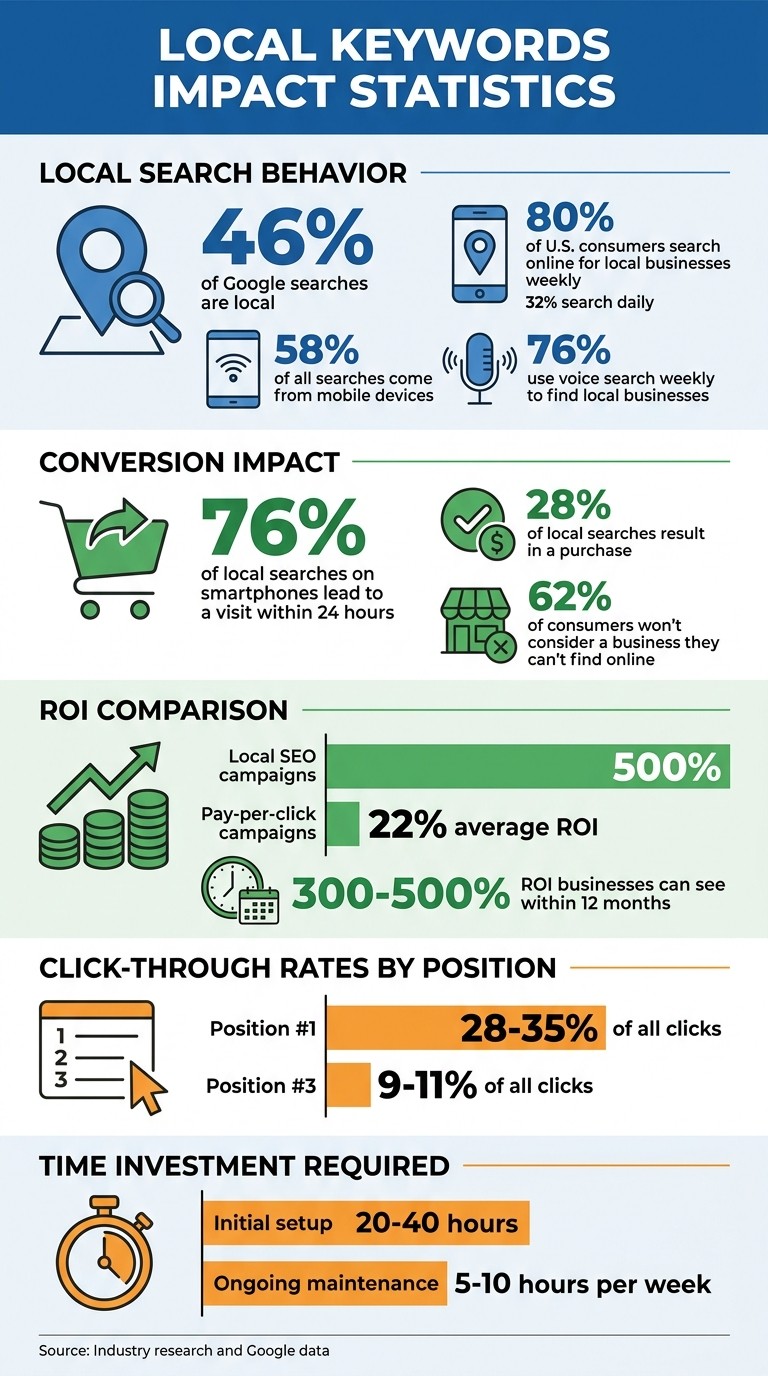
Local Search Statistics: Why Local Keywords Matter for Small Business Growth
Boost Your Small Business: Mastering Local SEO
Why Small Businesses Struggle with Local Search Rankings
Small businesses often face an uphill battle when it comes to getting noticed in local search results. The main culprit? Google's algorithm tends to favor big-name brands. A key factor in rankings is prominence - essentially, how much online information Google can gather about a business from sources like links, articles, and directories. Naturally, national chains have the upper hand here, as their established online presence gives them a significant boost, leaving smaller businesses struggling to compete for competitive keywords.
Another major hurdle is resources. Small businesses typically operate with tight budgets and lean teams, which limits their ability to invest in SEO. Setting up local SEO initially can require 20 to 40 hours, while ongoing tasks like responding to reviews and updating listings can take 5 to 10 hours per week. On top of that, many business owners lack the technical know-how for advanced SEO tactics, such as using schema markup or analyzing performance data.
"Small businesses that ignore local SEO aren't just missing opportunities - they're actively losing ground to competitors who understand the game." - Keyframe Tech Solution
What Local Search Intent Means
Understanding local search intent is crucial to tackling these challenges. Local search intent refers to queries where people are looking for something specific in a particular area. For instance, while a broad search like "how to fix a pipe" is informational, a local search like "plumber near me" signals a sense of urgency and a readiness to act. These users aren't just browsing - they're often ready to visit a business or make a purchase within hours.
This is a big deal because 80% of U.S. consumers search online for local businesses weekly, and 32% do so daily. For example, when someone searches for "best coffee shop" without mentioning a location, search engines use local signals to show nearby options. If your business isn’t optimized for these local signals, you won’t show up, even if you’re the perfect match. In short, ignoring local search intent means missing out on customers who are actively looking for what you offer.
What Happens When You Skip Local Keywords
Not using local keywords can be a costly mistake. Competing with global brands for generic terms like "real estate developer" puts small businesses at a severe disadvantage, as they lack the massive marketing budgets of larger corporations. This struggle is compounded by limited resources, making it even harder to connect with potential customers in your area.
The impact extends beyond search rankings. 62% of consumers won’t consider a business they can’t find online. Without local keywords, your business won’t appear in the Google Local Pack - the map and top three listings that drive most foot traffic and inquiries. You’ll also miss out on mobile searchers, who make up 58% of all searches and are typically looking for nearby solutions. Voice assistants like Siri and Alexa further complicate things, as they rely on structured local data and conversational keywords. Without these optimizations, your business won’t even make their recommendations.
Skipping local keywords doesn’t just hurt your visibility - it also means wasting opportunities. Local SEO campaigns can deliver a 500% return on investment, far outpacing the 22% average ROI for pay-per-click campaigns. Without a local strategy, you’re effectively turning away ready-to-buy customers and leaving money on the table every day.
How Local Keywords Improve Your Search Visibility
Local keywords give small businesses a shortcut to better search rankings. When someone types in phrases like "emergency plumber near me" or "best coffee shop downtown", using optimized local keywords can help your business land in the Local Pack. That’s the box that shows three businesses alongside a map at the very top of search results.
By using local keywords, you clearly signal to Google where your business operates. Including these keywords in places like your Google Business Profile description, service listings, and even customer reviews helps Google match your business with relevant searches. Plus, when keywords show up in reviews or service details, they create those handy snippets in the Local Pack - statements like "Sold here: [Keyword]" - that make it easy for users to see you offer exactly what they’re looking for. This process highlights why local keywords are a game-changer for attracting ready-to-act customers.
Why Local Keywords Work Better
Local keywords outperform generic ones because they target people who are actively looking to make a purchase. For example, someone searching "plumber near me" isn’t just browsing - they’re likely in need of immediate help. These are high-intent customers, and 76% of them visit a related business within 24 hours.
There’s also a cost advantage. Unlike paid ads, which stop working the moment you stop paying, local keyword optimization delivers ongoing visibility. Ranking #1 in local search can capture 28% to 35% of all clicks, while even the #3 spot can still grab 9% to 11%. Compare that to paid ads, which vanish without a budget, and the long-term value of local SEO becomes obvious.
Another benefit? Local keywords help you connect with your community by using the language they’re familiar with. For instance, if your customers call a sandwich a "hoagie" instead of a "sub", incorporating that term into your content shows you’re part of the neighborhood. This connection becomes even more critical as 76% of people use voice search weekly to find local businesses, and voice assistants prioritize conversational, natural language. It’s this precise targeting that drives real business outcomes.
Results You Can Expect from Local Keywords
For small businesses, the payoff is more than just visibility - it’s real growth in leads and customer engagement. When you optimize your Google Business Profile with the right local terms, you’ll notice an uptick in actions like clicks-to-call, direction requests, and website visits. These are all tracked in your GBP Insights, making it easy to see how local SEO drives results.
"Local keyword research targets potential customers who are already interested in what you have to offer." - Neil Patel, Co-Founder, NP Digital
But it’s not just about Google Search. Local keywords also improve your presence on Google Maps, voice search platforms like Siri and Alexa, and even Google’s AI-generated summaries. These summaries pull details directly from business profiles and reviews that feature specific local terms. Each of these touchpoints captures customers at the exact moment they’re ready to make a decision.
The impact of local keywords compounds over time. As your visibility grows, more customers leave reviews mentioning your services and location. These review-based keywords boost your relevance even further, creating a cycle that keeps improving your rankings. Meanwhile, businesses that skip local optimization miss out on connecting with the 80% of consumers who go online multiple times a week to find local businesses.
How to Find and Use Local Keywords
Finding the right local keywords starts by listening to how your customers naturally describe your products or services. Pay attention to the exact words and phrases they use when they call, email, or visit. For instance, do they ask for a "hoagie" or a "sub"? Do they search for an "emergency plumber" or "24-hour plumbing service"? These everyday terms are the foundation of your keyword strategy. Once you’ve identified these phrases, refine them further by adding your city, neighborhood, or even zip code. This process helps you build a solid list of localized keywords.
To take it a step further, use Google’s free tools to explore what people are actively searching for. Google Autocomplete and the "People Also Ask" section can reveal common questions and topics. Google Keyword Planner is another great resource to compare general terms and then narrow them down by adding your location. Aim for keywords that get between 100 and 1,000 monthly searches - keywords with over 10,000 searches often have too much competition for small businesses.
Finding the Right Local Keywords
Local keywords generally fit into four main types:
Explicit keywords: These include your location, like "dentist in Nashua."
Implicit keywords: These rely on the searcher's location, such as "coffee shop near me."
Service + location combinations: These combine what you do with where you do it, like "roof repair Denver."
Branded keywords: These include your business name paired with local terms.
When choosing keywords, focus on search intent. Transactional keywords (like "emergency electrician available today") show that a customer is ready to take action, making them ideal for driving immediate sales. On the other hand, informational keywords (like "how to fix a leaky faucet") work better for blog content or FAQs. By concentrating on transactional terms, you can tap into the 46% of Google searches that have local intent.
You can also learn from your competitors. Tools that analyze competitor profiles can reveal the local keywords they target. Check the "Place Topics" section in reviews to see which terms customers frequently mention.
Adding Keywords to Your Website Content
Once you’ve nailed down your local keywords, it’s time to integrate them into your website. Start with the basics: include your primary local keyword in title tags and H1 headers. For example, a page titled "Emergency Plumbing Services in South Boston | 24/7 Availability" clearly communicates both the service and the location.
Meta descriptions are another key area. Write descriptions that include local terms to encourage users to click. Each page should focus on one primary keyword to avoid keyword cannibalization, where multiple pages compete for the same term. If your business serves multiple areas, consider creating dedicated landing pages for each location. These pages can include driving directions, local contact details, and even customer reviews to make them more relevant.
Don’t forget to use local keywords in your titles, headers, body text, image alt text, and file names. Mention specific neighborhoods you serve and use language that reflects your community. As Miriam Ellis from Search Engine Land advises:
"If the page reads as if it were written by a robot, it won't be a high-quality publication for human use. Write for your community using the search phrases you've learned that they use."
Using Keywords in Your Google Business Profile and Directories
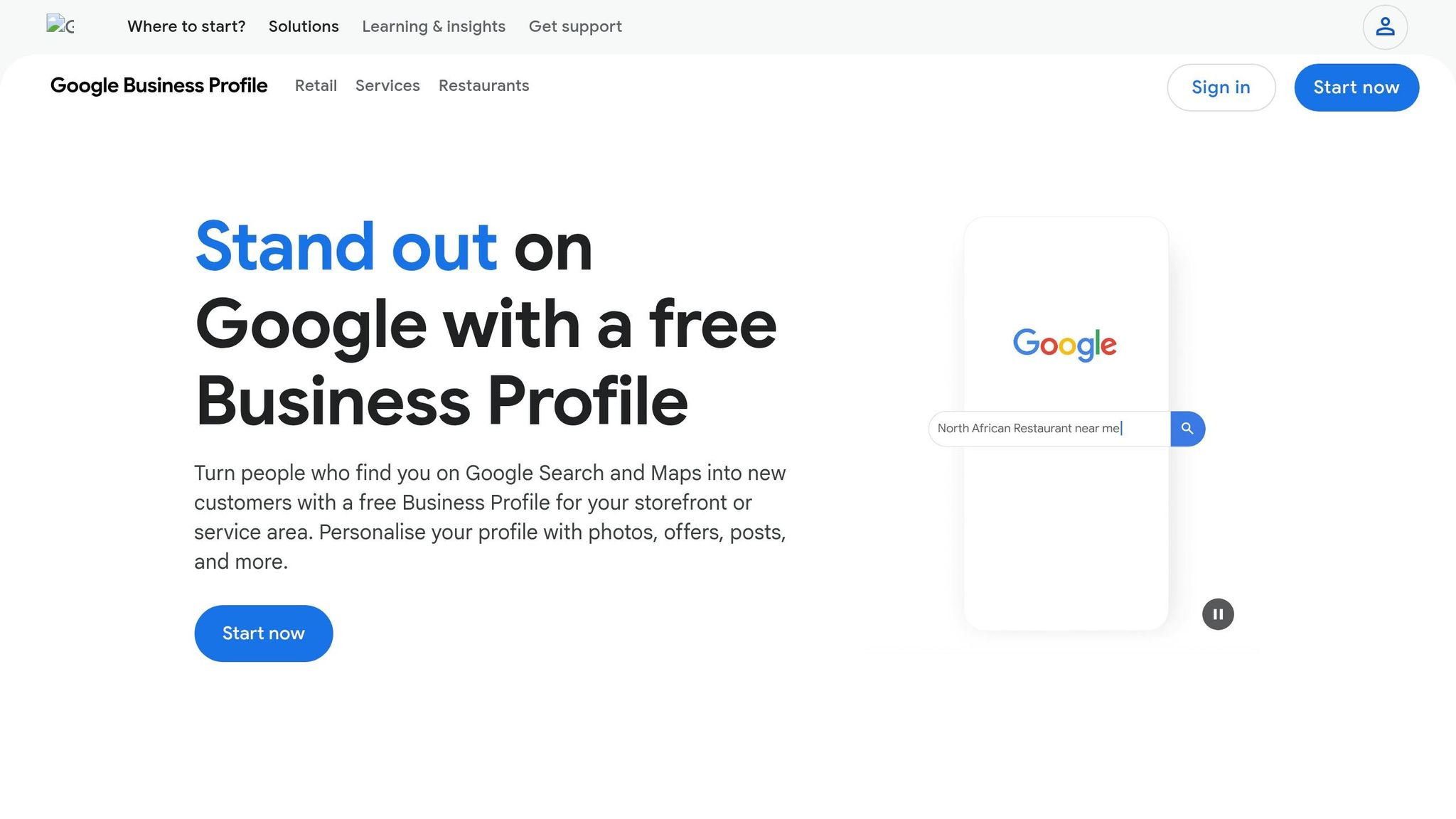
Your local keyword strategy shouldn’t stop at your website. Extend it to your Google Business Profile and other online directories. Add relevant keywords to sections like Services, Products, and Menus to increase your visibility in search results. Be sure to select all applicable attributes - like "wheelchair-accessible" or "free Wi-Fi" - to match specific search filters.
Customer reviews are another goldmine for local keywords. Check the "Place Topics" summary to identify frequently mentioned terms and incorporate them naturally into your service descriptions or review responses.
Finally, ensure NAP consistency - your Name, Address, and Phone number should be the same across every platform, from Yelp to TripAdvisor. Inconsistent information can confuse search engines and hurt your rankings. Also, keep your business hours up to date, especially during holidays, to avoid frustrating potential customers.
How to Track Your Local Keyword Performance
Once you've started using local keywords to drive customer actions, the next step is keeping an eye on how well they're working. But don't just focus on clicks - track the outcomes that matter most, like phone calls, direction requests, and sales. As Sebastian Żarnowski, Co-founder & CEO of Localo, puts it:
"If your local SEO is working, it should move real-world numbers. Phone calls. Direction requests. Sales. That's what matters."
To make sense of the data, organize your tracking into clear, measurable categories.
Which Metrics to Monitor
For effective tracking, divide your metrics into three main categories: visibility, engagement, and conversion.
Visibility: Keep tabs on profile impressions, map views, and AI search appearances.
Engagement: Look at review velocity, photo views, and how long users stay on your site from local search.
Conversion: Focus on high-intent actions like phone calls or direction requests. Use tools like Google Search Console to separate branded searches (people searching your business by name) from discovery searches (people finding you through services or categories).
Pay close attention to your rankings for "money keywords" - terms like "emergency plumber Boston" or "wedding photographer Austin" that directly lead to revenue. Start by tracking these daily, then move to weekly reviews to spot trends without overreacting to daily shifts. For context, a strong Click-Through Rate (CTR) for positions 1–3 is usually 15–30%, while positions 4–10 tend to see a CTR of 3–10%. Keep an eye on "striking distance" keywords (those in positions 4–10) and make timely content tweaks to push them into the top three, where the traffic is highest.
And don’t worry if website traffic doesn’t spike. Many customers now find what they need - like business hours, reviews, or your phone number - directly on Google Maps or in the Local Pack without visiting your site. These zero-click conversions are a normal part of today’s local search landscape. As Samuel Godfrey, CEO of Luminous Digital Visions, explains:
"A website that gets 500 visitors and 25 phone calls beats a website that gets 5,000 visitors and 10 phone calls."
Using Gatsboy's Tools for Local SEO Success

Tracking all these metrics manually can be overwhelming, so automated tools can make life a lot easier. Gatsboy’s Local Tracking add-on ($99/month) simplifies the process by monitoring your rankings across Google Search, Google Maps, and your Google Business Profile. It helps you track position changes, spot keywords gaining or losing traction, and keep an eye on competitors before they become a threat.
One standout feature is its focus on "striking distance" keywords, identifying small ranking boosts that could lead to big traffic gains. Weekly automated reports eliminate the need for constant manual checks, which is especially helpful since Google updates its search algorithm roughly 4,000 times a year.
For businesses looking to stay ahead in AI-driven search results, Gatsboy’s AEO (Answer Engine Optimization) service ($147/month) is another option. It ensures your business shows up when people ask AI assistants for local recommendations. Both tools integrate seamlessly with the Gatsboy dashboard, giving you one place to track rankings, conversions, and strategy adjustments.
Conclusion
Local keywords are a must-have for small businesses aiming to connect with customers ready to make a purchase. Using targeted phrases like "emergency plumber in South Boston" instead of a broad term like "plumber" ensures your business grabs the attention of local customers who need your services.
One of the best parts of local SEO is how it builds momentum over time. Each review you earn, every local landing page you create, and every tweak to your Google Business Profile helps solidify your presence in future searches. Unlike paid ads that vanish once the budget runs dry, local keyword optimization keeps working for you. In fact, many small businesses experience a 300–500% return on investment within just 12 months of consistent effort. That kind of growth shows just how powerful a well-executed local SEO strategy can be.
To make the most of it, fine-tune your Google Business Profile with specific categories and services, craft landing pages for the neighborhoods you serve, and use natural language that mirrors how your customers search. Focus on tracking meaningful metrics - like phone calls, direction requests, and sales - rather than just website visits.
Your next customer is out there searching right now. Fine-tune your local keyword strategy today and claim your spot at the top of local search results.
FAQs
How many local keywords should I target first?
Start by selecting a handful of local keywords - somewhere between 5 to 10 - that closely align with your business and what potential customers are actively searching for. Keeping it focused like this allows you to boost your local search visibility without overcomplicating your strategy.
Do I need separate pages for each city or neighborhood I serve?
Deciding whether to create separate pages for each location depends on your business goals and the area you serve. For example, having dedicated pages for each location can boost your local SEO by targeting specific keywords like "plumber in South Boston." These pages can also include localized content and contact details, making them more relevant to users in that area.
However, if your service area is small or overlaps significantly, a single, well-optimized page with localized sections might be just as effective. The key is to balance relevance and user experience while ensuring your content aligns with your audience's needs.
How long does it take local keywords to improve calls and visits?
It can take anywhere from a few weeks to a few months for local keywords to start driving more calls and visits. The timeline largely depends on how consistently you optimize your content and the time required for local search ranking factors to take effect. Staying patient and making regular updates are crucial for achieving visible progress.
Related Blog Posts
Únete a nuestra comunidad de 15,000+ propietarios de negocios
Artículos populares
Artículos populares sobre su sitio web y la comercialización de su pequeña empresa


