



10 Profitable Small Business Ideas To Start in 2026
Small Business Advice
Looking to start a small business in 2026? Here are 10 profitable ideas tailored to current trends and market demands:
AI-Powered Local Service Consulting: Help small businesses implement AI tools for automation. Earn $3,000–$15,000/month with low startup costs.
No-Code Website Agency: Build websites using no-code platforms. Charge $1,500–$5,000 per project, plus recurring maintenance fees.
Wellness Coaching Platform: Offer personalized health and fitness coaching. Charge $1,000–$2,500 per program with minimal startup costs.
Print-on-Demand Eco-Merchandise: Sell eco-friendly products with no inventory. Profit margins range from 30–50%.
Smart Home Installation Service: Install and integrate smart home devices. Charge $500–$50,000 per project, depending on complexity.
Virtual Health and Fitness Training: Provide online fitness programs. Earn $50,000–$200,000/year with margins of 70–85%.
Niche E-Commerce Dropshipping: Sell locally sourced or specialty products. Focus on sustainability-conscious buyers for higher margins.
Personalized Meal Prep Delivery: Deliver tailored meals for busy customers or fitness enthusiasts. Generate $40,000–$100,000/year as a solo operator.
Digital Marketing for Local Trades: Help tradespeople like plumbers and electricians generate leads online. Charge $249/month or more for marketing services.
AI-Optimized Booking and Review Management: Automate scheduling and customer reviews for small businesses. Earn $300–$2,500/month per client.
Key Trends Driving These Ideas:
Growing reliance on AI, automation, and digital tools.
Increased demand for eco-friendly and personalized services.
Rising focus on health, wellness, and convenience.
These opportunities combine low startup costs, recurring revenue potential, and scalability, making them ideal for entrepreneurs in 2026.
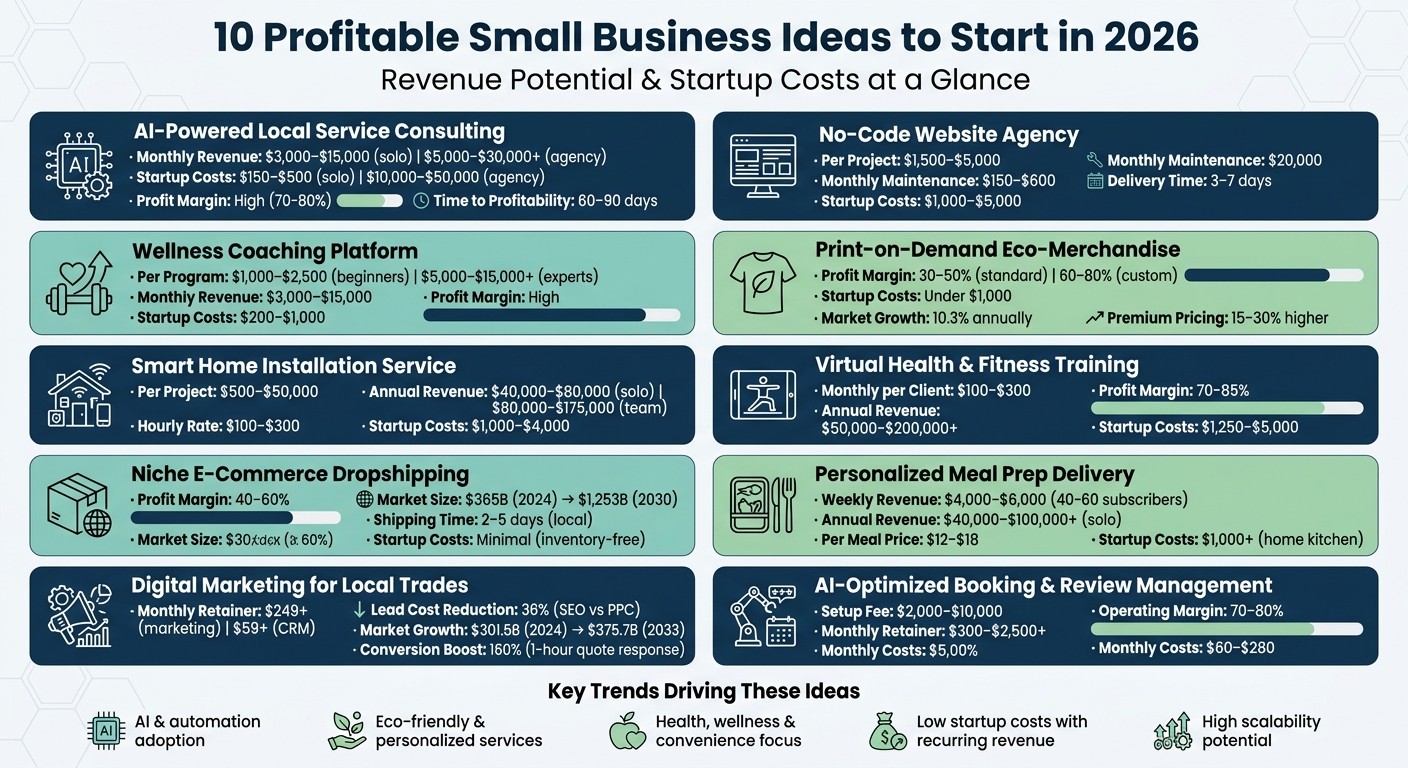
10 Profitable Small Business Ideas for 2026: Revenue Potential and Startup Costs Comparison
8 High Income Businesses to Start in 2026
1. AI-Powered Local Service Consulting
AI-powered local service consulting allows small and medium-sized businesses (SMBs) to adopt automation without the need for a dedicated tech team. With the global AI market expected to surpass $500 billion by 2026, the demand for consultants who can translate advanced AI tools into practical business solutions is skyrocketing. Currently, 58% of small businesses already rely on AI consulting, and 77% believe AI gives them a competitive edge over larger companies. In fact, 88% of organizations are using AI in at least one business function.
Projected Profitability in 2026
This consulting model is highly profitable because it focuses on selling expertise rather than billable hours. Independent consultants typically earn between $3,000 and $15,000 per month, while small agencies can bring in $5,000 to over $30,000 monthly. With low overhead costs, expenses for tools and APIs range from $200 to $1,000 per client. Consultants often charge retainers between $2,000 and $10,000 per month. Startup costs are minimal, ranging from $150 to $500 for independent consultants and $10,000 to $50,000 for micro-agencies. Many businesses in this space achieve profitability within 60 to 90 days, thanks to the growing demand for AI solutions.
Addressing Market Needs
Small businesses are often overwhelmed by the sheer number of AI tools available and lack the expertise to implement them effectively. Studies show that companies using AI have seen an 82% boost in workforce efficiency. By offering fractional leadership at 20–30% of the cost of hiring a full-time Chief AI Officer, consultants make strategic guidance accessible to businesses earning $1 million to $20 million annually. As Julia McCoy, Founder of First Movers, explains:
"Small teams are competing with enterprises that have 100x their resources... the businesses winning aren't the ones with the most resources. They're the ones using AI to multiply the resources they have."
This approach not only levels the playing field but also ensures smaller companies can implement AI without breaking the bank.
Scalability and Growth Potential
Once you've established a profitable foundation, scaling your consulting services becomes the logical next step. Specializing in industries like real estate, healthcare, or legal services can accelerate implementation by 40–60%, while also allowing you to charge 2–3 times more than generalist consultants. Start by building a portfolio with discounted initial projects to create measurable case studies - such as hours saved or revenue growth. Standardizing your processes into templates can turn custom projects into repeatable, scalable services. Consider offering tiered packages, such as:
AI Readiness Assessments: $2,000–$8,000
Strategy and Roadmap Services: $8,000–$25,000
Pilot Implementation: $15,000–$50,000
Full Operational Deployment: $50,000–$150,000+
This structured approach not only simplifies scaling but also makes your services more appealing to potential clients.
Target Audience Demand
The ideal clients for AI consulting are businesses with 10–200 employees. These companies are often too small for major consulting firms but too complex for basic, off-the-shelf AI solutions. Focus on high-impact areas like automating document processing, streamlining intake procedures, and optimizing appointment scheduling. By 2033, the AI consulting market for small businesses is expected to grow to $73 billion, with an annual growth rate of 26.49%. Most AI implementations achieve a positive ROI within 4–8 months, making this an attractive investment for SMBs.
This shift toward digital transformation highlights the importance of strategic adaptation for entrepreneurial success. Consultants can further support clients by integrating strong digital infrastructures, such as the offerings available at Gatsboy.
2. No-Code Website Agency for Small Businesses
No-code website agencies are riding the wave of technology trends, offering small businesses a quicker and less expensive alternative to traditional web development. By 2026, starting a no-code website agency could be a game-changer, replacing costly development projects (which can run $50,000–$150,000) with fast, budget-friendly setups. Despite the growing digital landscape, 42% of small businesses still don’t have a mobile app. Meanwhile, over 70% of U.S. small businesses plan to integrate AI more deeply into their operations by 2026. As Anna Pawlowska puts it:
"The U.S. small-business landscape is being reshaped by AI, remote work, the subscription economy, and booming demand for digital services".
This evolution not only slashes expenses but also speeds up project delivery times.
Projected Profitability in 2026
The success of no-code agencies hinges on speed and recurring income. What used to take four to nine months can now be done in just three to seven days using no-code platforms. Agencies typically charge $1,500–$5,000 for initial setups and $150–$600 monthly for ongoing maintenance. AI tools can cut staffing needs by as much as 15%, keeping overhead low and allowing for a high volume of completed projects. By combining one-time builds with subscription services, agencies can establish steady cash flow. Digital agencies are on the rise, with experts predicting this to be one of the top entrepreneurial opportunities in 2026.
Alignment with Emerging Trends
No-code platforms are increasingly incorporating AI to simplify the design process. This trend supports the rise of "citizen developers", where agencies step in as specialists for small businesses that don’t have the bandwidth to use these tools themselves. Fixed-price, productized packages help agencies scale efficiently without adding to their workload. Beyond basic websites, many agencies are now offering services like AI integration and workflow automation, bundling these extras to boost contract value.
Scalability and Growth Potential
Scalability for no-code agencies lies in specialization and systematization. By focusing on specific industries - like creating websites for therapists or booking systems for contractors - agencies can charge premium rates while streamlining operations. Documented workflows and reusable templates make it possible for small teams to handle work that once required much larger operations. Growth opportunities also include turning active services into passive income streams, such as selling custom-designed themes on platforms like Shopify. With the global SaaS market projected to surpass $230 billion by 2027, the potential for growth is immense.
Target Audience Demand
Targeting niche small businesses allows agencies to deliver substantial savings and rapid returns. Ideal clients are small businesses with 10–50 employees seeking affordable, efficient solutions to establish their online presence. These businesses often need specialized tools - like scheduling systems, lead management pipelines, or customer review platforms - to address their specific challenges. While traditional development can cost $50,000–$150,000 and take months, no-code agencies can deliver high-quality websites in under two weeks, saving clients over $100,000 in just two years. Platforms like Gatsboy embody this model by offering done-for-you websites with features like business dashboards, booking systems, and payment processing - exactly the kind of all-in-one solutions small businesses will demand in 2026.
3. Wellness Coaching Platform
As digital services continue to expand, wellness coaching is stepping into the spotlight as a way to deliver highly personalized care. By 2026, this field is set to flourish, reflecting a significant change in how Americans approach health. For instance, with nearly 12% of U.S. adults using GLP-1 drugs for weight loss, there's a growing need for metabolic coaching to help maintain muscle mass during rapid weight reduction. At the same time, 74% of people report being so stressed they feel overwhelmed or unable to cope, fueling demand for burnout recovery programs. U.S. consumers are now spending over $500 billion annually on wellness, and experts predict that $1 trillion in healthcare spending will shift toward digital-first, proactive, and personalized care.
Projected Profitability in 2026
The business model for wellness coaching focuses on selling outcomes rather than just time. Coaches typically charge $1,000–$2,500 for 8–12 session packages, while seasoned experts can earn between $5,000 and $15,000+ per program. For digital wellness coaches, monthly earnings range from $3,000 to $15,000, depending on their niche. Group coaching offers even greater potential, allowing coaches to work with 4–12 clients simultaneously at 40% to 60% of their 1:1 rate per person, significantly boosting their hourly income. Startup costs are relatively low - typically $200 to $1,000 for certifications, scheduling tools, and payment systems - making this a high-margin and accessible business.
Alignment with Emerging Trends
Wellness platforms in 2026 are embracing digital tools to tailor services like never before. The concept of "Intelligent Health" is gaining traction, with platforms combining AI-driven automation and personalized coaching at scale. Wearable devices now play a critical role, providing real-time data on metrics like heart rate, sleep quality, and recovery, which AI uses to adjust training programs dynamically. Programs for adults aged 50 and older are particularly popular, ranking as the #2 global fitness trend for 2026. These programs prioritize longevity and cognitive health over aesthetics. Additionally, the creator economy is expanding by 26% annually, offering wellness experts opportunities to monetize their expertise through memberships, challenges, and online courses. Wellness travel is also booming, growing at 12% per year, outpacing most tourism sectors.
Scalability and Growth Potential
The key to scaling wellness coaching lies in integrating a "digital layer" into live services. This includes apps, on-demand content, and habit-tracking tools that keep clients engaged between sessions, increasing their lifetime value without requiring additional time or space. Many coaches start with 1:1 sessions to refine their approach and gather testimonials, then shift to group programs or subscription-based memberships for consistent revenue. Passive income streams like workout templates and nutrition e-books also add to profitability, with niche-specific plans selling for around $49. Corporate wellness is another lucrative avenue, with U.S. employers spending an average of $742 per employee annually on wellness programs. Monthly retainers for corporate services range from $500 to $3,000, depending on the scope.
Target Audience Demand
Specialization is the name of the game for wellness coaches looking to maximize profits. Focusing on underserved niches - like GLP-1 users who need guidance on muscle preservation, women navigating menopause, or professionals recovering from burnout - can make a big difference. According to Sam Nash, specialists in areas such as "strength training for women over 40" can charge 20–40% more than generalists. The demand for personal trainers is also on the rise, with employment expected to grow 14% through 2033, nearly three times faster than the average for all jobs. By targeting clients who see wellness as essential, rather than optional, coaches can enjoy lower churn rates and higher client lifetime value.
4. Print-on-Demand Eco-Merchandise Store
The print-on-demand model fits well with sustainability efforts since products are made only after a customer places an order. This eliminates waste and cuts storage costs. By 2026, this approach is thriving, with 61% of global consumers prioritizing eco-friendly purchases and 81% of Gen Z buyers considering a brand's ethics before making decisions. The global print-on-demand industry is projected to hit $43.07 billion by 2026, growing at an annual rate of 10.3%, while the broader sustainability market is expected to reach $79.65 billion by 2030. This eco-conscious model positions businesses for success in a market increasingly focused on sustainability.
Projected Profitability in 2026
Eco-friendly merchandise often commands higher prices. For example, sustainable products generally sell for 15–30% more than traditional ones, and organic cotton t-shirts can retail for 50–100% higher prices while costing only 20–40% more to produce. Despite rising living costs, consumers are still willing to pay about 9.7% more for sustainable goods. Popular items like tote bags offer profit margins of 40–55% with retail prices ranging from $17–$30, while mugs deliver margins of 40–60%, selling for $12–$20 each. Most print-on-demand eco-businesses aim for net profit margins between 30–50%. Startup costs are low - usually under $1,000 - since businesses don’t need to invest in inventory upfront.
Alignment with Emerging Trends
The rise of stricter plastic regulations and zero-waste movements is fueling demand for eco-friendly and upcycled products. Circular economy principles are also gaining ground, with 70% of Gen Z actively participating in social or political causes, driving demand for products that reflect their values. A great example is the Zero Waste Store, co-founded by Sarah Cieslinski and JJ Follano, which grew its annual sales from $6,000 to $2 million in just one year by offering plastic-free, thoughtfully packaged products for eco-conscious customers.
Scalability and Growth Potential
Strong profit margins and favorable trends make scaling a print-on-demand eco-business both achievable and strategic. Entrepreneurs can use bulk upload tools to list products across platforms like Etsy, Amazon, and Shopify, automating fulfillment and reducing manual work. Starting small with 3–5 designs allows businesses to gauge demand before expanding. Gabriela Martinez from Printful highlights the benefits of this model:
"Print-on-demand is a more sustainable business model than traditional bulk manufacturing since it doesn't require excess inventory".
Bundling products into "Zero-Waste Starter Kits" can increase the average order value while helping customers adopt sustainable habits. Email marketing is another powerful tool, converting at rates 3–5 times higher than social media for repeat sales.
Target Audience Demand
Specializing in niche markets is key to standing out in the eco-merchandise space. Focus on specific groups like vegan lifestyle enthusiasts, organic-only parents, or zero-waste travelers instead of trying to appeal to everyone. Display certification badges like GOTS, FSC, or OEKO-TEX on product images to build instant trust. Go beyond listing materials - explain the environmental impact, such as how many plastic bottles were recycled to create a polyester garment. With 62% of consumers aged 18 to 34 adjusting their buying habits to combat climate change, the demand for purpose-driven, sustainable products continues to grow.
5. Smart Home Installation Service
Smart home technology has quickly become a staple in many households. Over 60% of American homes now have at least one smart device, but integrating and troubleshooting these gadgets can be a headache for many consumers. This is where professional installers step in, ensuring seamless integration across devices. The U.S. smart home market, valued at $11.37 billion in 2026, is expected to grow at an annual rate of 14.2%, reaching $18.3 billion by 2035.
Projected Profitability in 2026
Professional installers typically charge between $100 and $300 per hour, depending on the complexity of the project. Costs for installations vary widely:
Basic setups (e.g., smart speakers, bulbs, video doorbells): $500–$1,500
Mid-range systems (e.g., multi-room automation, smart locks, programmable thermostats): $2,000–$8,000
Premium whole-home integrations: $10,000–$50,000+
The smart home installation market is expected to grow from $4.6 billion in 2024 to $22.8 billion by 2032. For solo entrepreneurs, annual earnings can range from $40,000 to $80,000 in the first year, while small teams of 2–5 members might generate $80,000 to $175,000 annually. Startup costs are relatively low, typically falling between $1,000 and $4,000. These figures highlight the potential for growth, especially as consumer needs and sustainability trends continue to evolve.
Alignment with Emerging Trends
Demand for professional smart home services aligns with broader trends like aging in place and energy efficiency. For instance, 77% of adults over 50 prefer to stay in their homes as they age, driving demand for modifications like grab-bar sensors, automated lighting, and smart safety systems. Meanwhile, eco-conscious homeowners are turning to energy-efficient upgrades. Smart thermostats, for example, can cut heating and cooling costs by 20–30%. In states like California, utility companies offer rebates of $50 to $125 for thermostat installations, and many insurance providers offer discounts of 5–20% for homes equipped with professionally monitored smart security systems.
Scalability and Growth Potential
This business model is well-positioned for growth, especially since in-person technical expertise is crucial and unlikely to be replaced by AI. Entrepreneurs can boost revenue by offering subscription maintenance plans, charging $50 to $200 monthly for services like technical support, firmware updates, and troubleshooting. With 98% of consumers starting their search for home services online, having a strong Google Business Profile with high-quality before-and-after photos is vital. Becoming an authorized dealer for premium systems like Control4, Lutron, or Savant can also add credibility and justify higher rates.
Target Audience Demand
Focusing on niche markets can make this business even more attractive. Specializing in areas like senior safety modifications or eco-friendly energy upgrades can set a business apart. Partnering with local real estate agents is another smart move, as they often recommend smart home upgrades to increase property values before listing. The North American smart home market is projected to hit $145.6 billion by 2030, with a compound annual growth rate of 22%. Additionally, 77% of home service professionals expect business growth by 2026, with 40% forecasting growth rates above 10% annually.
6. Virtual Health and Fitness Training
Virtual training is reshaping the fitness world, leveraging technology to make workouts more accessible and flexible. The industry has grown into a lucrative business model, with the U.S. personal training market now worth over $15 billion and expanding at about 8% annually. One of the biggest draws? Online coaching offers profit margins between 70% and 85% - the highest in the fitness sector. Unlike traditional gym-based training, which ties earnings to hours worked, virtual models allow trainers to work with clients worldwide, even while they sleep.
Projected Profitability in 2026
Virtual trainers typically charge $100 to $300 per month per client for tailored programs that include weekly check-ins. Starting costs - covering certification, liability insurance, and essential tech platforms - range from $1,250 to $5,000. Solo online coaches can realistically earn $50,000 to $200,000 annually. For those scaling up with group programs or digital products, earnings can surpass $200,000. Hybrid models, blending in-person sessions with digital programming, tend to bring in $75,000 to $150,000 per year.
Alignment with Emerging Trends
By 2026, fitness will be heavily influenced by "intelligent health", where trainers use AI and wearable technology to create highly personalized programs. With 36% to 44% of adults now owning wearables, trainers can access real-time data on metrics like heart rate variability, sleep quality, and recovery. This approach can boost training results by up to 40% compared to static programs. Additionally, new fitness programs are emerging for clients on weight loss medications, while programs for older adults are gaining traction, ranking as the second most popular global fitness trend for 2026. Mental well-being is also a key driver, with 78% of exercisers citing it as their main motivation.
Scalability and Growth Potential
Virtual training breaks the income cap that limits traditional personal trainers. AI tools like Bizzby streamline marketing, sales, bookings, and invoicing, saving up to 20 hours of admin work weekly for just $199 a month. AI assistants can also generate personalized workouts instantly, enabling a single coach to handle over 150 clients efficiently. With the creator economy growing by 26% annually, building a dedicated audience through a website and email list is crucial. Trainers who specialize in underserved niches - such as prenatal/postnatal fitness, menopause-focused strength training, or corporate burnout recovery - can charge two to three times more than generalist trainers. These tools and strategies make it easier to target niche markets with specific fitness needs.
Target Audience Demand
The most profitable opportunities lie in addressing the needs of specific groups. Adults aged 65 and older are now the most frequent gym-goers, though they prefer terms like "Active Aging" or "Functional Strength" over "senior fitness". Remote work has also increased the demand for time-efficient workout options. Hybrid fitness members, who combine in-person and digital services, tend to train more consistently and stay loyal longer. Eamonn Curley from ABC Glofox highlights this shift:
"The market has bifurcated into high-tech scalability and high-touch medical specialization".
This combination of high profit margins and advanced digital tools positions virtual training as a leading small business opportunity in 2026.
7. Niche E-Commerce Dropshipping for Local Products
Niche dropshipping is evolving, blending local sourcing with efficient logistics to cater to modern consumer demands. By focusing on locally sourced products, businesses can reduce shipping times and appeal to sustainability-conscious buyers. The global dropshipping market, which reached $365 billion in 2024, is expected to surpass $1,253 billion by 2030, growing at an annual rate of 22% between 2025 and 2030. This aligns with the broader trend of minimizing traditional product-related costs, which often account for nearly one-third of e-commerce expenses annually.
Projected Profitability in 2026
Dropshipping, when approached strategically, can yield profit margins of 40% to 60%, far exceeding the typical 10% to 30% range [54,56]. The model requires minimal upfront investment since entrepreneurs only pay for products after receiving customer orders. Platforms like Shopify Collective and DropCommerce enable partnerships with verified domestic suppliers, cutting shipping times to just 2–5 days. According to Brian Peters, Partnerships Lead at Shopify:
"Dropshipping [is] still a massive part of a merchant's journey, and there's always an opportunity to do it better - more quality products, faster shipping, better search/UX".
Focusing on niche categories, such as ergonomic home office setups or eco-friendly pet products, allows for higher markups. Customers in these segments tend to prioritize quality over price. For instance, the global car accessories market is projected to exceed $807 billion by 2031, while pet owners spent over $143 billion in 2023 [55,57].
Alignment with Emerging Trends
Sustainability is no longer optional - it’s an expectation. A majority of consumers (74%) have adjusted their shopping habits to reduce their environmental impact, and 40% actively avoid non-sustainable brands [55,57]. This shift opens doors for dropshipping stores offering eco-conscious products, such as clean beauty items or plastic-free alternatives made from recycled or bamboo materials. Younger generations, like Gen Z and Gen Alpha, are particularly drawn to brands that champion transparency and shared values, often discovering them through social media.
Recent examples highlight the potential of this approach. In 2025, LastObject’s crowdfunding campaign for reusable alternatives to single-use plastics hit its goal in just 22 minutes, eventually raising $700,000 from over 19,000 backers. Similarly, Mush Studios gained traction with a quirky rug design that went viral on TikTok, amassing 23 million views in its first year. These cases underscore the power of social commerce in driving niche product success.
Scalability and Growth Potential
Dropshipping’s flexibility allows entrepreneurs to test ideas without committing to inventory. Starting small - with a single product or a basic landing page - can help gauge local interest before scaling up. To build trust, it’s essential to vet suppliers thoroughly and address potential delays. Tools like Google Trends can pinpoint where demand is concentrated, while Meta Audience Insights can help identify niche market sizes. Combining online sales with local delivery services can also capture overlooked market segments. Notably, custom and handmade items often achieve profit margins of 60%–80%.
For a streamlined online presence, tools like small business websites offer a comprehensive solution, integrating features like online payments, booking management, and customer reviews. This allows entrepreneurs to focus on growing their business instead of dealing with technical setup.
Target Audience Demand
The most promising opportunities lie with consumers who value ethical consumption and community impact. Remote workers, for instance, often look for ergonomic and visually appealing home office upgrades. Meanwhile, wellness-focused shoppers seek clean skincare and natural pet products [26,55]. Using the Jobs-to-be-Done framework, successful dropshipping stores can address functional needs (saving time), emotional needs (boosting confidence), and social needs (creating a sense of belonging).
Customer reviews on platforms like Amazon or Etsy can reveal unmet needs or common frustrations, providing insights into market gaps. Launching with a clear niche - such as "minimalist home office accessories" or "eco-friendly pet wellness" - positions stores to stand out from generic retailers. By combining ethical sourcing with targeted market demands, this model aligns seamlessly with the low-investment, agile business trends shaping 2026.
8. Personalized Meal Prep Delivery
Personalized meal prep delivery services cater to the growing demand for healthy, convenient meals, especially for those juggling hectic schedules. With the global food and beverage market projected to hit around $7.41 trillion by 2026, this business model provides a smart way to offer tailored nutrition without requiring customers to spend hours in the kitchen. It’s also an attractive option for new entrepreneurs due to its low startup costs and potential for recurring revenue.
Projected Profitability in 2026
The numbers paint an encouraging picture for personalized meal prep businesses. A solo operator serving 40–60 weekly subscribers can generate $4,000–$6,000 per week, translating to annual earnings from about $40,000 to over $100,000 in the first year. By pricing meals competitively and offering subscription packages based on meal counts, profitability becomes achievable. The key lies in keeping food costs between 25–35% of the selling price while building a loyal subscriber base for steady revenue.
Startup expenses are relatively low compared to traditional food businesses. Entrepreneurs can start cooking from home kitchens (if local cottage food laws allow) for around $1,000 or rent shared commercial kitchen spaces for $15–$35 per hour. This flexibility makes it easy to experiment with specialized menus - like keto meals for diabetics or nutrition plans aimed at improving mobility - before scaling operations.
Alignment with Emerging Trends
Current consumer preferences are moving away from ultra-processed foods in favor of simple, clean ingredients and transparent sourcing. This shift creates opportunities for local meal prep businesses that emphasize personal preparation and high-quality ingredients. Andrew McDevitt, Co-founder of Stedi Meals, sums it up well:
"The hardest thing to get right in fitness is the nutrition and most people don't often have time to spend cooking and prepping and getting the calories right."
The rise of functional nutrition, which prioritizes gut health, fiber, and balanced meals, also aligns perfectly with the personalized meal prep model. Customers are increasingly looking for tailored solutions that support their specific dietary and health goals.
Scalability and Growth Potential
This business model offers strong growth potential, especially when paired with smart operational strategies. Subscription-based revenue provides a reliable foundation, and partnerships with local gyms, yoga studios, or corporate offices can expand the customer base without heavy advertising costs.
Efficient delivery is another area for optimization. By improving delivery routes, costs can drop from $8–$10 per delivery to just $4–$6. Additionally, using ghost kitchens - professional facilities designed for delivery services - can help scale production without the expenses associated with running a full restaurant.
Stage | Weekly Subscribers | Annual Revenue |
|---|---|---|
Part-Time | 10–20 | $20,000–$40,000 |
Full-Time Solo | 40–60 | $40,000 to over $100,000 |
Scaled Company | 100+ | $150,000+ |
Target Audience Demand
The personalized meal prep model appeals to a wide range of customers, including busy professionals, fitness enthusiasts, and health-conscious families. Remote workers appreciate the convenience of healthy meals that help them stay productive, athletes rely on precise macronutrient tracking for peak performance, and parents value quick, nutritious family dinners. When these services meet specific needs, customers are often willing to pay premium prices of $12–$18 per meal.
To keep customers engaged, offering a rotating menu of 5–8 weekly options strikes a balance between variety and efficient production. Retaining subscribers is key to building a sustainable business, and tools like integrated online payment systems and booking platforms allow entrepreneurs to focus on food quality and customer relationships instead of technical challenges.
9. Digital Marketing for Local Trades
Local tradespeople like plumbers, electricians, HVAC technicians, and contractors are experiencing a shift toward digital tools, opening up opportunities for marketing agencies that specialize in this niche. With 72% of home service businesses planning to increase their marketing budgets by 2026, there's a growing demand for experts to help these trades generate leads. This business model requires minimal startup costs and can scale quickly by serving multiple clients at once, offering the potential for strong earnings.
Projected Profitability in 2026
The financial potential in this space is clear. Marketing plans for contractors typically start at $249 per month, while CRMs begin at $59 per month. These tools yield measurable results, such as cutting lead costs from $115 (common with Google PPC) to $74 through organic SEO - a 36% reduction that clients immediately appreciate. For entrepreneurs with digital skills, this creates a compelling opportunity.
Alignment with Emerging Trends
Technology is reshaping how local trades attract customers. AI-powered voice searches like "emergency plumber open now" depend on structured data, with platforms like Gemini and Perplexity recommending businesses based on this information rather than traditional website content. Tools like AI voice agents and automated SMS systems allow trades to respond to leads within a minute, even while on the job. As Chris Lonergan from Footbridge Media points out:
"For contractor SEO in 2026, showing up in search isn't enough. You need to be the source the AI tools quote from."
Google's algorithm updates also prioritize "review velocity" - the consistency and recency of reviews - over the total number, creating ongoing opportunities for agencies to automate review requests.
Scalability and Growth Potential
The key to scaling lies in automation. Processes like LocalBusiness Schema markup and automated review systems make it easier to onboard and serve new clients efficiently. The Google Guaranteed badge, available through Local Service Ads (LSAs), converts at three times the rate of standard display ads, offering a quick way to demonstrate value to clients.
Short-form videos on platforms like TikTok and YouTube Shorts are another effective tool. According to Footbridge Media:
"Authentic beats perfect. Every single time."
Simple before-and-after videos of projects, which require little technical expertise, can generate significant engagement. Agencies can also boost revenue by setting up referral partnerships between complementary trades, like roofers and gutter cleaners.
Target Audience Demand
The North American home improvement market is expected to grow from $301.5 billion in 2024 to $375.7 billion by 2033, signaling a large, underserved market. Many tradespeople excel at their craft but struggle with digital marketing, creating a need for agencies that can bridge the gap. Businesses that send digital quotes within one hour see a 160% boost in conversion rates, and ServiceTitan users report a 15% revenue increase and an 18% rise in leads after adopting integrated CRM and marketing automation. These results make it easier to justify monthly retainers by showing clear returns in booked jobs and revenue growth.
10. AI-Optimized Booking and Review Management Service
AI is reshaping how businesses handle their front-desk operations, turning time-consuming tasks into seamless, 24/7 processes. Many small businesses face challenges like missed calls, unanswered messages, and manual scheduling, while competitors leverage instant responses to stay ahead. A recent study shows that 95% of small businesses are eager to automate but lack the know-how to do so effectively. This creates a prime opportunity for entrepreneurs to offer AI-driven booking and review management services. Acting as a digital front desk, these solutions handle appointments, capture leads, and help build a strong online reputation.
Projected Profitability in 2026
AI automation agencies enjoy operating margins of 70–80%, with monthly costs ranging from just $60 to $280. Initial setup fees can range between $2,000 and $10,000, while monthly retainers typically fall between $300 and $2,500 or more, depending on the service's complexity. For businesses managing multiple clients, AI-native services can achieve net margins of 92–97%, even with monthly revenues of $10,000 to $25,000. The global AI business process automation market is projected to hit $19.6 billion in 2026, reflecting a 38% growth from the previous year. This surge underscores a growing reliance on digital automation across industries.
Alignment with Emerging Trends
Customer expectations are shifting rapidly. AI chatbots now respond in about 10 seconds, and by 2026, they are expected to handle 60–80% of customer service tickets. This reduces response times from 4 hours to just 5 minutes while cutting costs by 40%.
Online reviews are another critical factor. With 93% of consumers influenced by reviews when making purchasing decisions, automated systems that request feedback after service completion can significantly boost review volume. Businesses can see 3–5 times more reviews per month and an average rating increase of 0.5 stars within 90 days. AI tools can refine this process further by analyzing sentiment - redirecting unhappy customers to private feedback channels and encouraging satisfied clients to post publicly on platforms like Google.
Scalability and Growth Potential
This business model thrives on productized workflows rather than custom-built solutions. For instance, setting up a basic AI agent for reputation management takes only 5–10 minutes. This efficiency allows one operator to manage 10–50 clients without needing additional staff. Targeting "under-reviewed" businesses - those with fewer than 30 reviews - can be especially profitable, as these businesses often struggle to attract new customers due to a lack of social proof.
Specializing in specific industries can also lead to higher earnings. By focusing on a niche, service providers can charge 2–3 times more than generalists. Instead of hourly billing, pricing is based on the value delivered - typically 20–30% of the annual labor costs saved through automation. For specialized workflows, setup fees can range from $5,000 to $15,000, with monthly retainers reaching up to $4,000.
Target Audience Demand
For small business owners, automating tasks like scheduling, invoicing, and review requests can save 20–30 hours per week, freeing up time to focus on growing their business. Additionally, 64% of business owners believe AI will boost productivity by 2026. Gartner predicts that by 2026, 40% of enterprise software applications will feature task-specific AI agents, up from less than 5% in 2024. While 79% of organizations have already adopted AI agents to some degree, many small businesses still lack the expertise to implement these tools effectively.
Real-world success stories highlight the benefits of AI automation. In 2026, Sun and Moon, a beauty and wellness brand, used an AI-powered inbox to manage inquiries, achieving a 30% conversion rate and handling 1,500 new contacts each month. LUBUDS Group streamlined its reservation process with a structured WhatsApp workflow, reducing manual coordination during peak hours. Meanwhile, Travel Expert Group cut response times by 25% and tripled its qualified lead capture rate. These results demonstrate the value of monthly retainer models, offering measurable improvements in bookings and revenue.
Entrepreneurs can also tap into platforms like Gatsboy, which provides an all-in-one solution for small businesses. Gatsboy integrates online bookings, Google Reviews, and customer management into a single platform, enabling businesses to run a 24/7 digital front desk without requiring advanced technical skills.
Conclusion
The ten business ideas shared here highlight opportunities that align market demand with emerging technologies and individual skills. From AI-driven local service consulting to personalized meal prep delivery, each idea tackles specific challenges that consumers and businesses are likely to face in 2026. They combine real-world needs with the potential for leveraging your unique strengths.
As Ben Angel, Entrepreneur Network Contributor, wisely said:
"The future belongs to those who reinvent strategically, not randomly".
This quote serves as a reminder to evaluate your skills and experiences carefully. The best business ideas often sit at the crossroads of your expertise and a pressing problem you can solve repeatedly. Think about it: What challenges do you truly understand? What skills can you quickly put into action? And most importantly, can this idea sustain consistent profits?
Modern tools are game-changers for anyone looking to stay competitive in 2026. AI and no-code platforms empower individuals or small teams to achieve what once required entire companies. Whether it's using AI to streamline customer service, employing no-code tools to build small business websites, or reaching global audiences through digital platforms, these technologies make it possible to operate more efficiently than ever. For example, the online education market is projected to surpass $375 billion by 2026, and global ecommerce sales could approach $8 trillion by 2028.
Adaptability is another key to success, especially as consumer trust increasingly shifts toward niche brands and individual experts. Building a personal brand, specializing in a specific niche, and staying on top of industry trends are crucial. Tools like Google Trends can help you spot emerging opportunities, while certifications in areas like QuickBooks or AI tools can instantly boost your credibility. Ultimately, the blend of AI, no-code platforms, and personalized services underscores the importance of combining technology with a deep understanding of your target audience.
FAQs
Which of these ideas is best for a complete beginner?
For those just starting out, some of the best small business ideas for 2026 are ones that don’t demand much experience, have low startup costs, and are easy to get into. Freelancing, tutoring, or providing local services are great choices because they rely on skills that are simple to pick up. Service-based ventures like virtual assistance or social media editing are also excellent options. They’re flexible, affordable to start, and allow beginners to develop their abilities while growing their business at a manageable pace.
How do I validate demand before I spend money starting?
To make sure there's real demand before diving in, start by leveraging AI tools to test your ideas. These tools can help you check if your concept aligns with both market needs and your own expertise. Dig into the idea of product-market fit by researching what’s already selling and what customers actually want.
You can also run small-scale tests, like offering a basic version of your product or service. This approach allows you to measure interest and gather valuable feedback without committing to large upfront expenses.
What’s the fastest way to get my first paying customers?
The fastest way to land your first paying customers is by tapping into targeted outreach and making the most of your current network. Zero in on a specific niche with well-defined needs and present them with a solution that stands out. Use platforms like social media or online ads to connect, or go for a more personal approach with tailored messages, special discounts, or even free trials. Building trust and showing the value of what you offer right from the start can turn potential leads into paying customers in no time.
Related Blog Posts
Únete a nuestra comunidad de 15,000+ propietarios de negocios
Artículos populares
Artículos populares sobre su sitio web y la comercialización de su pequeña empresa


