



How Small Brands Automate Anniversary Offers
Small Business Marketing
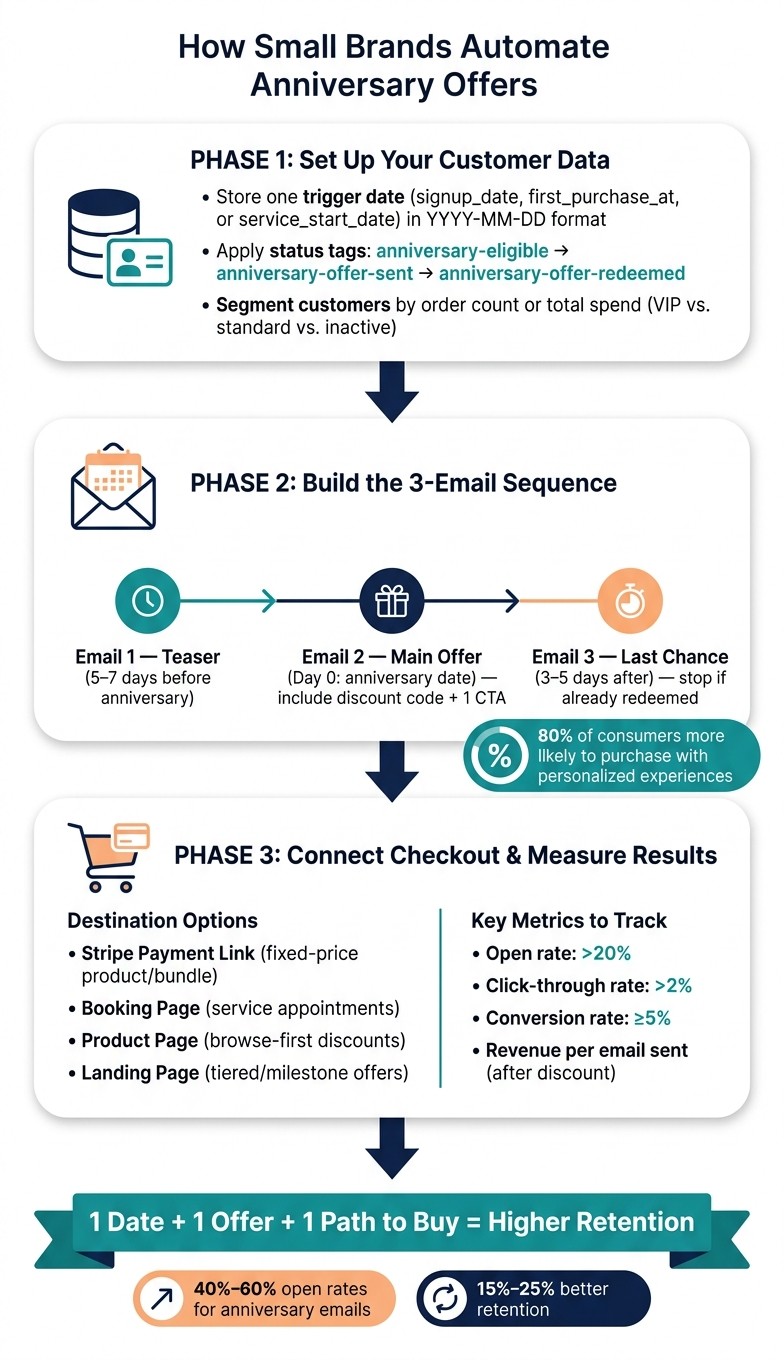
Anniversary offers work because timing does most of the work. A message tied to a signup date, first order, or service start date can see 40%–60% open rates and link to 15%–25% better retention.
If I were setting this up, I’d keep it simple:
Pick one date I already track
Use one clear offer with a 7- to 14-day deadline
Trigger a short 3-email sequence
Stop reminders after redemption
Send people to the right next step: checkout, booking, product page, or landing page
Track clicks, conversions, and revenue per email sent
The core idea is simple: store one date, send the offer on that date each year, and make redemption easy. The brands that do this well usually avoid fancy flows. They use clean data, a short sequence, and clear tracking.
What stands out in this article is the process: start with the data you already have, segment by customer value, connect the offer to Stripe Payment Links or bookings, and test only one thing at a time.
If you want a short takeaway, it’s this: one date + one offer + one path to buy beats a messy campaign almost every time.
How to Automate Anniversary Offers: 3-Step No-Code Workflow
How to send automated emails on important dates
Set Up Customer Data for Automation
For the data layer, you need three things: an email address, one trigger date, and status tags.
Use Tags for Status and Date Fields for Triggers
Use date fields to start sends. Use tags to control who should get them. A date field like signup_date, first_purchase_at, or service_start_date triggers the automation on the right day each year. A tag shows where the customer is in the flow.
Here’s a simple tag setup that fits most small brands:
Tag | Purpose |
|---|---|
| Enters the workflow |
| Sent initial offer |
| Stops reminders |
Store dates as YYYY-MM-DD so no-code tools can read them the right way.
Capture Dates from Forms, Payments, and Bookings
Pull the date from forms, payments, or bookings. With Gatsboy, advanced forms, Stripe Payments, and online bookings all sit in one dashboard, which helps keep forms, payments, bookings, and date fields aligned.
If some existing customers are missing a date, send a short preference update email and offer a small reward for sharing it.
Once the date is stored, the automation can run on its own without manual cleanup.
Build Simple Segments for Better Offers
One discount for everyone is a margin killer. It also misses a simple point: not every customer should get the same offer.
Segment by order count or total spend so each customer gets a reward that fits their value and activity level. Repeat buyers can get stronger offers, like a free add-on or a higher discount tier. Inactive customers may respond better to a lighter reactivation offer, like: "We'd love to see you again."
Use these segments to send customers into different anniversary offers.
With the date field, tags, and segments set, the next step is building the annual trigger.
Build a No-Code Anniversary Workflow
Set an Annual Trigger and Send at the Right Time
Use an annual date trigger based on created_at or first_purchase_at, store dates in YYYY-MM-DD format, and set the workflow to repeat every year.
Send the first email 5 to 7 days before the anniversary. That gives you enough room to warm people up with a teaser before the main offer goes out. It also helps to schedule the email for the customer's morning, so it arrives while they're actually checking email during the day.
Once that trigger is in place, turn it into a short sequence built around one offer and one clear next step.
Send a Short Email Sequence with One Clear Call to Action
Use a simple three-email sequence.
Timing | Goal | |
|---|---|---|
Teaser | 5–7 days before | Tease the offer |
Main Offer | Day 0 (anniversary date) | Send the code and one call to action |
Last Chance | 3–5 days after | Create urgency |
Use merge tags to pull in the customer's first name and the milestone itself, like "1 year since your first purchase", instead of sending the same flat message to everyone. That extra detail matters. 80% of consumers are more likely to make a purchase when brands offer personalized experiences.
Keep each email focused. One email, one call to action.
Add Coupon Logic and Stop Reminders After Redemption
Set the code so each customer can use it only once. Add a fixed expiration window too, so the offer ends when you say it does.
Before the reminder email goes out, add a wait step or condition to check whether the coupon has been redeemed. If the customer already used it, mark them as redeemed and stop the rest of the sequence. If not, send the reminder.
From there, connect the code to Stripe Payment Links and send buyers back to your website.
Connect Stripe Payment Links and Route Customers Back to Your Website
Set Up Discounts and Stripe Payment Links

Send customers straight to checkout. A direct Stripe payment link is often the simplest way to turn an email click into a sale.
Pair the offer with a single discount code or a dedicated payment link. That keeps checkout simple and makes it easier to see which anniversary offer was used. Set the price before you send anything.
Branded payment links can build trust and beat generic URLs. If you're using Gatsboy's Stripe Payments integration, you can manage payments from your business dashboard and keep the experience in line with the rest of your site. The main idea is simple: match the checkout path to the type of offer.
Send Customers to a Landing Page, Product Page, or Booking Page
Pick the destination based on how much context the offer needs.
Destination | Best Use Case |
|---|---|
Stripe Payment Link | Specific product or bundle with a fixed price |
Booking Page | Service appointments that need a time slot |
Product Page | General discounts where customers browse first |
Landing Page | Tiered rewards or milestone offers that need more explanation |
If you need an instant deposit during booking, no-shows can drop by 92%. That's a big deal. It makes the anniversary offer easier to run for you and easier to commit to for the customer. Gatsboy's online bookings and booking pages help keep the path on-brand from the email click to the confirmation screen.
Ask for Feedback or Reviews After Redemption
After the sale, keep things moving with a short follow-up.
Once payment or booking is confirmed, send a brief review request. Anniversary and milestone emails often get reply rates above 10%, so you're still reaching people while the experience is fresh. Keep it tight: two lines and one direct link. Gatsboy's reviews management and feedback tools keep payment, confirmation, and follow-up in one dashboard, so you don't have to handle each step by hand. Then watch which path converts best.
Measure Results and Refine the Offer
Once the anniversary email is live, use the data to see what needs work. Maybe the offer is off. Maybe the send time is wrong. Maybe the redemption window is too short. The numbers will tell you where to look.
Track Opens, Clicks, Conversions, and Revenue per Send
Start with clicks, conversions, and revenue per email sent. Those metrics show business impact. Use opens as a secondary signal.
For anniversary emails, aim for:
Open rate: above 20%
Click-through rate: above 2%
Conversion rate: 5% or higher
Track redemptions with unique codes so you can tie each sale back to the campaign. Then split the results by segment. That makes it much easier to compare VIP offers against standard ones.
Revenue per email sent (RPS) is the clearest metric for comparing this campaign with other marketing channels. And make sure you calculate it after the discount. Otherwise, the return can look better than it is.
Compare Discount Types and Expiration Windows
If the numbers look weak, test the offer itself. In many cases, the offer type and the length of the redemption window shape results more than brands expect.
Offer / Window | Notes |
|---|---|
Percentage Discount | Best for higher-ticket brands; easy to understand |
Fixed-Dollar Discount | Best for low-priced, repeat-purchase products |
Free Add-on / Gift | Protects margin and adds value without cutting price |
Short Window (48–72 hrs) | Drives urgency |
Long Window (14–30 days) | Fits slower, considered purchases like clothing or home decor |
If redemption rates are low, try extending the window before you change the discount amount. Sometimes people just need more time. If the problem is urgency, test a shorter final window or send a last-chance reminder a few days after the first email.
Conclusion: Keep the System Simple, Trackable, and Repeatable
Pick one anniversary date, store it cleanly in your contact records, and let the trigger handle the send each year. Connect the email to a Stripe payment link or a booking page, then route customers back to your site for the actual transaction.
Review the workflow monthly. Check upcoming milestones, sends, redemptions, and revenue per email sent. Test one variable at a time: discount type, expiration window, or send timing.
FAQs
What date should I use for an anniversary offer?
For most anniversary offers, use the exact date of the customer’s first purchase or the date they joined your mailing list. That shop-iversary is the moment they became an active customer.
You can also use a 30-day window around the one-year mark to help catch their next purchase.
How do I stop reminder emails after someone redeems the offer?
Track redemptions inside your automation workflow. When a customer redeems the offer, log that action and trigger a rule to remove them from the rest of the reminder sequence.
If your system supports it, check purchase or redemption status before each scheduled reminder. That way, you avoid sending repeat emails to people who already took action, and the message still feels personal.
What kind of anniversary offer works best for small brands?
The best anniversary offers for small brands are personalized, relevant gestures that center on recognition, not just generic discounts.
Good options include limited-time coupon codes, free shipping, bonus loyalty points, or complimentary samples. When you tailor the offer to a customer’s purchase history or use tiered rewards, you can drive repeat purchases and help customers feel seen.
Related Blog Posts
Join our community of 15,000+ business owners
Popular articles
Popular articles about your website and marketing your small business


