



Top US Small Business & Startup Grants
Small Business Advice
Grants can provide much-needed funding for small businesses without requiring repayment. In the U.S., over $2 billion in grant funding is available annually through federal, state, and private programs. These opportunities are especially helpful for underrepresented groups, like women and minority entrepreneurs, who often face challenges accessing traditional funding.
Key Highlights:
Types of Grants: General, demographic-specific (e.g., women or minority-owned businesses), and federal innovation grants.
Popular Grants:
Amber Grant: $10,000 monthly for women-owned businesses.
FedEx Small Business Grant: Up to $50,000 for innovative ideas.
SBIR Program: Up to $2 million for R&D-focused businesses.
Eligibility: Varies by program, often requiring specific business ownership, location, or industry focus.
Challenges: Competitive process with acceptance rates under 15% for federal grants; applications can take 3–9 months.
Quick Tips:
Register early on SAM.gov for federal grants.
Tailor applications to each grant’s goals and requirements.
Use free resources like Small Business Development Centers for guidance.
Grants can be a great funding tool when paired with other strategies. Start early, stay organized, and explore programs that align with your business goals.
Free Money for Your Small Business: Startup Grants Guide
General Small Business Grants
Big-name companies and organizations often provide grants to small businesses across the U.S., covering a wide range of industries.
One example is the Intuit QuickBooks and Mailchimp Small Business Hero Program, which awards $20,000 grants to three winners every quarter. However, this program requires an independent nominator - self-nomination isn’t allowed. To qualify, nominees must be at least 18 years old and operate a business within the 50 states or Washington, D.C.. In May 2025, Intuit recognized Perry's Joint, a business run by Perry Bennett, for its incredible community impact. Perry's Joint not only donates annual earnings to fund student scholarships but also stepped up during the Eaton fire by providing food and shelter, all while creating summer job opportunities for local youth. The grant helped the business build financial stability and expand its community efforts.
Other programs worth noting include the FedEx Small Business Grant Contest, which offers financial support to businesses with innovative ideas, and the Venmo Small Business Grant, which focuses on helping very small businesses through monetary awards. Additionally, the Hello Alice Small Business Growth Fund provides grants to businesses looking to scale their operations.
Each of these programs operates on its own schedule - some are quarterly, while others are annual. Be sure to check the specific eligibility criteria for each grant, as some may require completing tasks like a digital readiness course before applying. These general grants serve as a great starting point and can complement more specialized demographic or federal grants discussed later in this guide.
Grants for Specific Demographics
Beyond general funding options, certain programs are tailored to address the unique challenges faced by specific groups of entrepreneurs. These grants aim to remove barriers and provide resources for underrepresented communities.
Amber Grant for Women-Owned Businesses
The Amber Grant is designed to support women entrepreneurs. To qualify, applicants must be women aged 18 or older who own at least 50% of a business based in the U.S. or Canada. This grant is open to businesses at all stages, whether they are just starting, pre-revenue, or fully established. Nonprofit organizations with 501(c) status are also eligible to apply.
SoGal Foundation for Minority-Owned Businesses
The SoGal Foundation focuses on empowering Black women and nonbinary entrepreneurs by offering cash grants between $5,000 and $10,000. Along with financial support, recipients gain lifetime "ask-me-anything" access to SoGal Foundation and SoGal Ventures for advice on strategic fundraising. To be eligible, applicants must self-identify as Black women or Black nonbinary individuals (including those of mixed race), run a legally registered business, and have plans to seek investor funding to scale their ventures. The program prioritizes businesses with scalable, high-impact solutions aiming to grow into billion-dollar enterprises. Applications are accepted throughout the year.
USDA Rural Business Development Grants
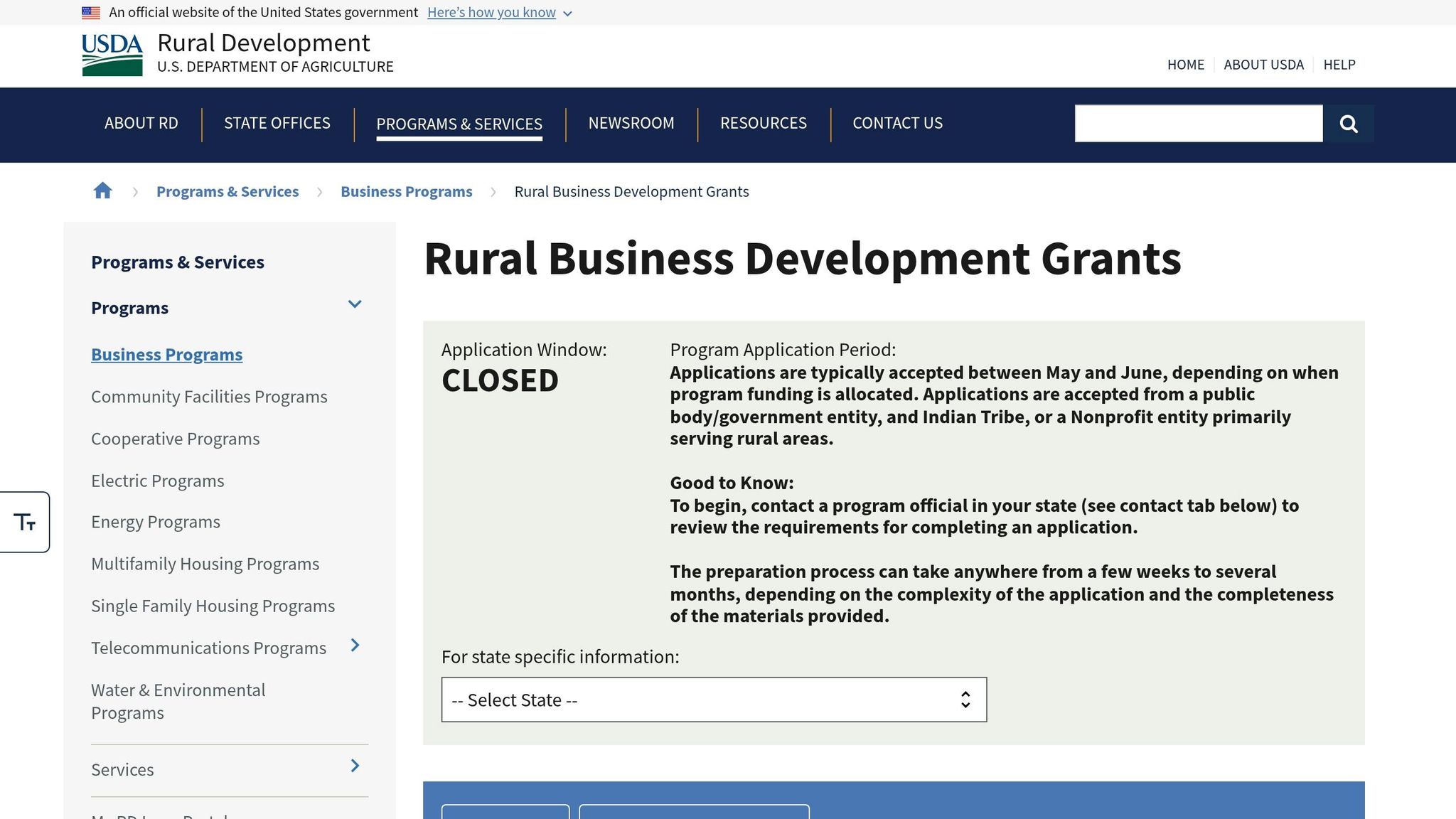
The USDA Rural Business Development Grants program is designed to promote growth in rural areas through Enterprise and Opportunity grants. Eligible applicants include public bodies, government entities, Indian Tribes, and nonprofits serving rural communities. These organizations provide indirect benefits to small businesses, such as revolving loan funds, technical support, and business incubators. Entrepreneurs in rural areas can connect with these entities to access low-interest loans and federally funded business counseling. Projects must serve areas with populations under 50,000.
These specialized grants complement broader funding opportunities, offering targeted support for diverse entrepreneurial needs.
Federal and Innovation Grants
Federal innovation funding goes beyond general and demographic-specific grants, focusing on the research and commercialization needs of progressive businesses.
The federal government provides non-dilutive capital for advanced R&D. However, keep in mind that the statutory authority for SBIR and STTR programs will end on September 30, 2025. Before diving into applications, reach out to the participating agencies to confirm the availability of new solicitations and the status of active awards.
Small Business Innovation Research (SBIR)
Nicknamed "America's Seed Fund", the SBIR program supports U.S.-based small businesses in pursuing Federal R&D projects with commercial potential. The program operates in three phases:
Phase I: Feasibility studies, offering $50K–$275K for 6–12 months.
Phase II: Full R&D, with funding between $400K and $1.8M over 24 months.
Phase III: Commercialization, which relies on non-federal funding.
Eligibility requirements include being a for-profit business based in the U.S., with at least 51% ownership by U.S. citizens or permanent residents, and fewer than 500 employees. In 2021, the program granted nearly 7,000 awards to over 4,000 recipients, with most successful applicants having fewer than 10 employees. The program is credited with adding 65,578 jobs to the U.S. economy each year. To apply, you'll need a Unique Entity ID (UEI) from SAM.gov. Additionally, many states offer "Phase 0" programs, which provide matching funds to help cover the costs of preparing a federal Phase I proposal.
For businesses focused on energy-related innovations, the Department of Energy (DOE) offers tailored SBIR/STTR programs to address industry-specific challenges.
Department of Energy Grants (SBIR/STTR)
The DOE dedicates over $300 million annually to energy-related SBIR/STTR projects, funding approximately 400 Phase I and 200 Phase II grants across more than 60 topics. DOE Phase I awards typically range from $200K to $250K, while Phase II awards fall between $1.1M and $1.6M.
The main distinction between SBIR and STTR lies in collaboration requirements. While SBIR allows businesses to work independently or with partners, STTR mandates a formal partnership with a non-profit research institution, such as a university or federal lab. DOE-supported areas include grid modernization, renewable energy (like solar-powered DC microgrids and agrivoltaics), carbon capture and storage, hydrogen production, and cybersecurity. A mandatory Letter of Intent must be submitted as outlined in the Funding Opportunity Announcement to qualify for a full application.
With program statuses subject to change, it's essential to stay informed through official agency resources like science.osti.gov.
Eligibility and Application Tips
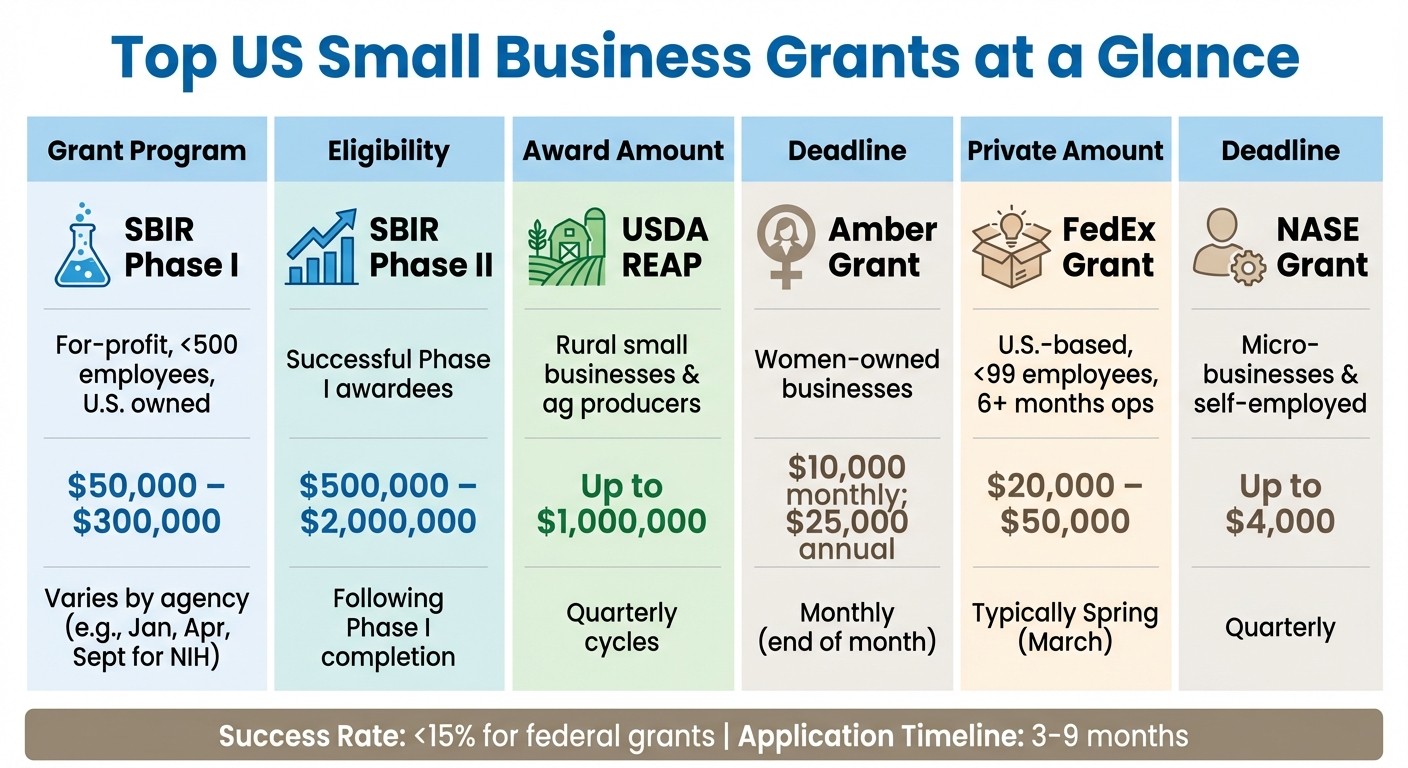
Top US Small Business Grants Comparison: Eligibility, Awards, and Deadlines
Getting grant funding isn’t just about having a great business idea - it’s about being well-prepared and detail-oriented. With fewer than 15% of applicants securing federal small business grants (and some programs dipping below 5% acceptance rates), knowing what funders prioritize and avoiding common mistakes can significantly boost your chances.
Comparison Table of Top Grants
Grant Program | Primary Eligibility | Award Amount | Typical Deadline |
|---|---|---|---|
SBIR Phase I | For-profit, <500 employees, U.S. owned | $50,000 – $300,000 | Varies by agency (e.g., Jan, Apr, Sept for NIH) |
SBIR Phase II | Successful Phase I awardees | $500,000 – $2,000,000 | Following Phase I completion |
Rural small businesses & ag producers | Up to $1,000,000 | Quarterly cycles | |
Amber Grant | Women-owned businesses | $10,000 monthly; $25,000 annual | Monthly (end of month) |
FedEx Grant | U.S.-based, <99 employees, 6+ months ops | $20,000 – $50,000 | Typically Spring (March) |
Micro-businesses & self-employed | Up to $4,000 | Quarterly |
Refer to the table above as a quick guide, and keep these practical tips in mind when crafting your application.
Tips for Writing a Winning Grant Application
Start by registering early on SAM.gov to obtain your UEI (Unique Entity Identifier). This process can take up to four weeks, so don’t wait until the last minute [24,36]. Also, aim to submit your application at least a week before the deadline to avoid any last-minute technical issues [2,37].
Be specific about how you’ll use the funds. Include an itemized budget supported by vendor quotes [2,37]. Clearly define your goals with measurable outcomes, such as projected revenue growth, job creation, or benefits to your community. Surprisingly, 20% to 30% of applications are rejected due to simple formatting errors, like exceeding word limits or forgetting attachments.
"An SBIR proposal is not an academic paper. The emphasis is on innovation, feasibility, and commercialization - not on exhaustive literature reviews or theoretical foundations."
– Rachel Nguyen, Granted AI
Tailor your proposal to align with the grant’s mission. Research past winners to understand what the program values. If the grant emphasizes innovation, highlight the technological gap your business addresses and use language that mirrors the grant announcement [37,38]. Keep in mind that local and state government grants often have better success rates for small businesses (25% to 50%) compared to federal programs.
Take advantage of free resources before submitting. Small Business Development Centers (SBDCs) and Women's Business Centers (WBCs) offer free mentoring and application reviews [4,35]. Additionally, reaching out to a federal agency’s program manager can help confirm that your idea aligns with their solicitation topic.
Using Digital Tools to Secure Grants
Having a strong digital presence does more than just make your business look good - it can actually simplify the often complex grant application process. Grant reviewers scrutinize everything from your business idea to your operations and financial health. A professional online profile sends a clear message of trustworthiness, while digital tools help you keep up with the documentation and financial transparency grantors expect.
With only about 10% of applicants successfully securing funding, every detail counts. Platforms like Gatsboy are designed to help small businesses create polished websites that showcase their legitimacy. Beyond appearances, a solid digital setup can help you track growth, manage leads, and keep your financial records organized. These operational elements are exactly what grant reviewers look for, and the right tools can help you present them effectively.
"If your bookkeeping is disorganized, you'll struggle to compile required financial statements - or worse, face compliance issues after receiving funding." – Beancount.io
Staying on top of deadlines and requirements is another critical piece of the puzzle. Whether you use a project management app or just a well-organized spreadsheet, these tools can help you avoid costly mistakes like missing deadlines or submitting incomplete documents. If you're already using Gatsboy's dashboard, its built-in features for tracking leads, bookings, and customer engagement can translate directly into the measurable data that grant reviewers value.
Digital tools aren't just helpful during the application phase - they're essential for managing post-award compliance too. These tools can provide a clear financial record for progress reports and ensure you're following spending guidelines, reducing the risk of clawbacks or legal troubles. Setting up these systems before you apply not only boosts your credibility but also makes managing the grant much smoother if you're awarded funding.
Conclusion
Navigating the U.S. grant system takes careful planning, persistence, and strong digital organization. Corporate grants often offer an easier starting point for eligible businesses, while federal grants tend to be highly competitive. With fewer than 15% of applicants securing funding, it’s important to treat the grant application process as a long-term effort.
Having a solid digital presence can make a big difference. It shows grant reviewers that your financials are well-organized and that your business is on a path to measurable growth. This not only boosts your credibility but also simplifies compliance after receiving a grant. Tools like Gatsboy can assist by providing dashboards and management features to track the operational data that reviewers prioritize.
Grants work best when paired with other funding methods, like loans or self-funding. Think of grants as a way to enhance your overall capital strategy. Start by identifying programs that align with your goals and strengths, get your financials in order early, and use digital tools to stay on top of the 3- to 9-month application process. By weaving grants into a broader financial plan and staying organized, small businesses can create a solid foundation for long-term growth.
FAQs
Which grants fit my business stage?
The ideal grants for your business depend on where you are in your journey. If you're running an early-stage startup, programs like SBIR (Small Business Innovation Research) or STTR (Small Business Technology Transfer) could be a great fit. These federal initiatives provide non-dilutive funding, perfect for businesses focused on research and development.
If your business serves rural or community-focused areas, you might want to look into USDA grants, which are tailored to support such initiatives. Additionally, SBA (Small Business Administration) programs, like Community Advantage Loans, are designed to assist businesses in underserved communities.
To improve your chances, consider applying for several grants that align with your goals and the unique focus of your business.
How do I find state and local grants?
If you're looking for state and local grants to support your small business, start by exploring resources that offer state-specific guides. These guides typically break down everything you need to know, including eligibility criteria, application processes, and available funding options.
Some platforms go a step further by showcasing grants designed for specific purposes like business expansion, hiring new employees, or driving innovation. By diving into these resources, you can uncover opportunities that align with your industry and location, giving your business the boost it needs.
What documents should I prepare first?
To get started, collect documents that confirm your business is active, legally compliant, and fits the required size and type criteria. These typically include proof of registration, tax filings, and financial statements. If you're applying for a specific grant, review its eligibility guidelines carefully. You might need extra paperwork, such as proof of ownership or documentation of your current tax status. Having these materials ready ahead of time will make the application process much smoother.
Related Blog Posts
Join our community of 15,000+ business owners
Popular articles
Popular articles about your website and marketing your small business


