



Why Consistent Brand Voice Builds Trust
Small Business Marketing
Your brand voice is how your business communicates - its personality, tone, and style - across all platforms, including social media channels. Consistency in this voice is critical because it builds trust, which is essential for customer loyalty and driving sales.
Here’s why it matters:
81% of U.S. consumers need to trust a brand before buying.
A consistent brand voice can increase revenue by up to 23% and improve visibility by 3.5×.
Inconsistent messaging confuses customers and erodes confidence, while a steady voice fosters familiarity and reliability.
To maintain consistency:
Define clear voice guidelines for tone and style.
Audit key customer touchpoints regularly to ensure alignment.
Use tools and processes that help unify messaging across teams and platforms.
Consistency not only strengthens customer trust but also simplifies workflows, making it easier for teams to produce aligned content. Over time, this builds loyalty and boosts business growth.
1. Consistent Brand Voice
Customer Trust Impact
People are naturally drawn to consistency - it feels dependable. When a brand maintains the same tone and style every time you interact with it, that familiarity builds trust. In fact, 88% of American consumers choose to buy from brands they trust. It might take 5 to 7 impressions for someone to remember your brand, but those impressions only lead to trust if your messaging stays consistent. A steady voice creates a reliable image that customers associate with your brand, no matter the platform.
"When your brand voice is consistent, this trust grows as people know what to expect from you. They know what you're about and what you stand for." - Ramona Sukhraj, HubSpot
Cross-Channel Messaging
Consistency isn’t just about trust - it’s also about creating a seamless experience across every platform. Whether customers find you on Instagram, your website, or through an email, they expect the same tone and message. 90% of U.S. consumers want a consistent branded experience across all marketing channels. And when brands get it right, clear messaging can boost how people perceive them by up to 70%.
"Consistent brand messaging means your audience encounters the same version of your business... whether they're reading a blog post, landing on your homepage, watching a reel, or getting on a discovery call." - Sparked
To ensure consistency, check that your website copy, social media content, and email campaigns all share the same tone and values. A good practice? Audit at least 10 key touchpoints - like your homepage, email templates, social media bios, and customer support replies - to confirm everything aligns with your brand’s voice.
Operational Efficiency
A consistent brand voice doesn’t just build trust - it simplifies your team’s workflow. When everyone - writers, marketers, and customer service reps - follows the same guidelines, there’s less confusion, fewer revisions, and faster content creation.
"Writers, marketers, sellers, and service reps all work faster when they're using the same playbook." - Ramona Sukhraj, HubSpot
As your business scales, this kind of efficiency becomes even more critical. Clear brand guidelines make processes smoother, even for AI tools. For example, small businesses using tools like Gatsboy's AI Content Generation feature can apply brand guidelines directly, creating on-brand content for their websites without starting from scratch every time.
2. Inconsistent Brand Voice
Customer Trust Impact
When your brand's tone wavers, people notice - and doubt creeps in. This uncertainty can stall decisions and erode confidence. Here's a telling statistic: 86% of consumers consider authenticity a deciding factor when choosing which brands to support. If your brand voice feels scattered or inconsistent, it risks coming across as fake. Each off-brand moment chips away at the trust you've worked so hard to build.
Cross-Channel Messaging
Picture this: a sleek and polished Instagram ad leads to a landing page filled with casual slang. That kind of shift feels jarring.
"When your voice shifts this dramatically from one step to the next, it can confuse people and make them want to bounce." - Ramona Sukhraj, HubSpot
"If each touchpoint feels like it came from a different company, trust erodes a little every time." - Madeleine Costa, Founder and CEO, Succeeding Small
Customers don't separate your Instagram, website, or email campaigns - they see your brand as one cohesive entity. So when the tone or style changes between channels, it weakens your brand's identity and credibility.
This external inconsistency often reflects internal struggles. Misaligned messaging creates confusion for teams, making content creation more complicated and less effective.
Operational Efficiency
The fallout from inconsistency isn't just external - it hits internal workflows too. Without clear, shared guidelines, every piece of content becomes a guessing game. Writers, marketers, and sales reps may interpret the brand voice differently, leading to endless revisions and mixed messaging throughout the buyer's journey.
"The real problem goes beyond inconsistent messaging. Sales teams communicate differently than marketing. Customer success speaks in a tone that contradicts the website... That friction slows deals, erodes trust, and costs revenue." - Nathan Thompson, Content Strategist, Fullcast
This misalignment doesn’t just slow things down - it also leaves money on the table. A cohesive voice can drive revenue, and for small businesses, that difference can be critical.
Tools like Gatsboy (https://gatsboy.com) offer a solution. By integrating features like online bookings and reviews management, platforms like this help small businesses maintain a consistent brand voice across all channels, streamlining workflows and reinforcing customer trust.
How Brand Consistency Builds Trust and Drives Business Growth
Pros and Cons
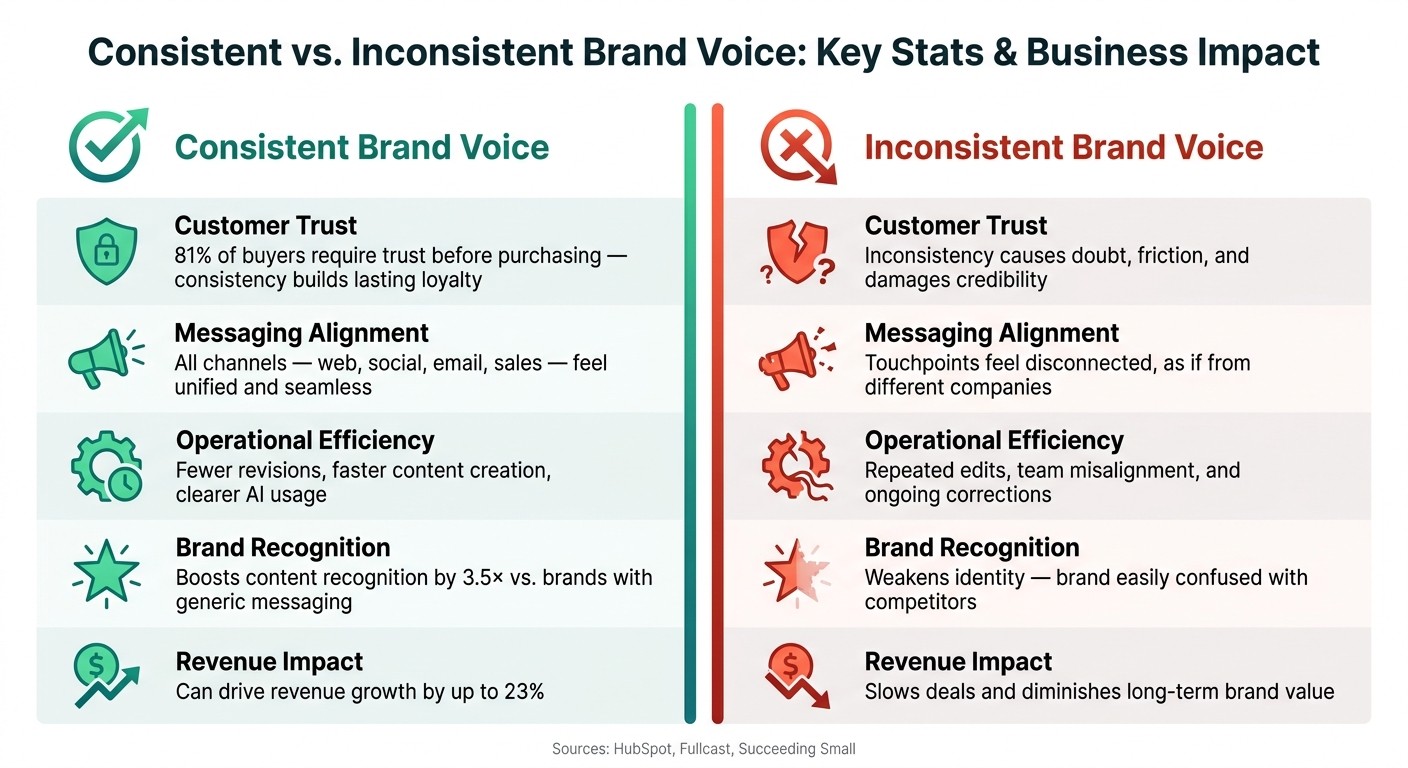
Consistent vs. Inconsistent Brand Voice: Key Stats & Business Impact
A brand voice plays a crucial role in shaping revenue, team productivity, and customer trust. The table below illustrates how consistency - or lack thereof - affects key business areas.
Consistent Brand Voice | Inconsistent Brand Voice | |
|---|---|---|
Customer Trust | Builds lasting loyalty; 81% of buyers require trust before making a purchase | Causes doubt and friction; damages credibility |
Messaging Alignment | Ensures all channels - web, social, email, sales - feel unified | Makes touchpoints feel disconnected, as if from different companies |
Operational Efficiency | Results in fewer revisions, quicker content creation, and clearer AI usage | Leads to repeated edits, team misalignment, and ongoing corrections |
Brand Recognition | Boosts content recognition by 3.5× compared to brands with generic messaging | Weakens identity, making your brand easily confused with competitors |
Revenue Impact | Can drive revenue growth by up to 23% by speeding up buyer decisions | Slows deals and diminishes long-term brand value |
These stats underscore the importance of maintaining a unified voice across all areas of your business.
A well-defined voice also simplifies scaling content production, whether through team expansion or AI tools. When your voice is clear, even AI-generated content aligns with your brand's personality and values.
"When prospects encounter the same personality and values in your marketing content, sales conversations, and customer success interactions, they develop confidence in your organization. That confidence accelerates decision-making and reduces the friction that slows deals." - Nathan Thompson, Content Strategist
This comparison highlights how consistency not only streamlines internal workflows but also enhances the customer experience. Tools like small business websites can amplify this consistency by integrating features like online payments and review management, ensuring your brand voice remains strong and cohesive online.
Conclusion
A consistent brand voice isn't just a nice-to-have - it’s a critical business tool. Every message that aligns with your brand builds trust, while even a single misstep can chip away at it. Over time, these small actions create a foundation of loyalty, recognition, and increased revenue.
Here’s a compelling stat: 81% of consumers say they need to trust a brand before making a purchase. And businesses with a consistent voice can see revenue growth of up to 23%.
If you’re ready to strengthen your brand voice, here are four actionable steps:
Define your voice traits: Choose 3–5 clear descriptors (like "friendly yet professional") and create a simple "do/don't" guide for your team.
Develop a tone matrix: Map out how your brand voice should adapt across different channels - social media, email, customer support - while staying true to its core identity.
Appoint a voice guardian: Assign someone to oversee content consistency and act as the go-to expert on your brand's tone.
Conduct an annual audit: Revisit your voice guidelines yearly to ensure they evolve alongside your business.
Remember, your website is often the first place customers interact with your brand. It should reflect your voice clearly and consistently. Consistent messaging across all channels is what keeps customers coming back. Tools like Gatsboy can help small businesses streamline this process, offering features like Google Reviews management and advanced forms to ensure every touchpoint aligns with your brand.
"When your voice shifts across platforms, you signal organisational chaos. Customers wonder which version represents the real business." - Invoke Media
A unified, consistent voice eliminates that confusion. It reassures customers that your business is dependable, professional, and deserving of their trust. And in today’s competitive landscape, that trust might just be your greatest advantage.
FAQs
How do I define my brand voice in 3–5 traits?
To shape your brand voice in 3–5 traits, start by pinpointing the core personality traits that best represent how your brand interacts with its audience. These could be descriptors like "clear," "warm," or "bold." Once identified, create a voice style guide that includes specific do's, don'ts, and practical examples for each trait. The goal is to choose traits that are memorable, specific, and actionable, ensuring your communication stays consistent and feels genuine across every platform.
How can I keep one brand voice across social, email, and support?
Start by defining 3–5 key traits that embody your brand's personality. Think of traits like warm, bold, or approachable. These traits should guide how your brand communicates across every platform.
To keep things organized, create a simple tone matrix and a one-page cheat sheet. These tools can help your team quickly reference how to adapt the brand voice for different channels, whether it's social media, email, or customer support.
Consistency doesn’t happen by accident. Regular training sessions, thorough content reviews, and tailored guidance for specific teams - like support and sales - are essential. These steps ensure everyone stays aligned, creating a unified experience that builds trust with your audience.
What’s the fastest way to audit my key touchpoints for consistency?
Take a moment to assess your recent content across major channels. Start with your homepage, then move on to the last five emails, ten social media captions, and your most recent proposals. The goal? Ensure your brand voice stays consistent everywhere.
For a quicker process, consider using AI tools. These can help you pinpoint tone mismatches and phrases that don’t align with your brand. Regularly reviewing your content helps catch inconsistencies early and keeps your messaging on track.
Related Blog Posts
Únete a nuestra comunidad de 15,000+ propietarios de negocios
Artículos populares
Artículos populares sobre su sitio web y la comercialización de su pequeña empresa


