



5 Pros and Cons of DIY Website Builders
Website Tips
DIY website builders make it easy to create a website without coding or hiring a developer. They’re affordable, starting at $16–$29/month, and offer drag-and-drop tools with pre-made templates. However, hidden costs, time investment, and limitations can add up. For instance, building a basic site may take 60–80 hours, potentially costing $5,000–$15,000 in lost revenue. Plus, customization, scalability, and SEO options are often restricted.
Alternatively, services like Gatsboy offer a done-for-you solution with a professional website delivered in 7–10 days for a one-time $500 fee. This saves time, avoids hidden costs, and provides full ownership with no ongoing subscriptions. Below is a quick comparison of both options:
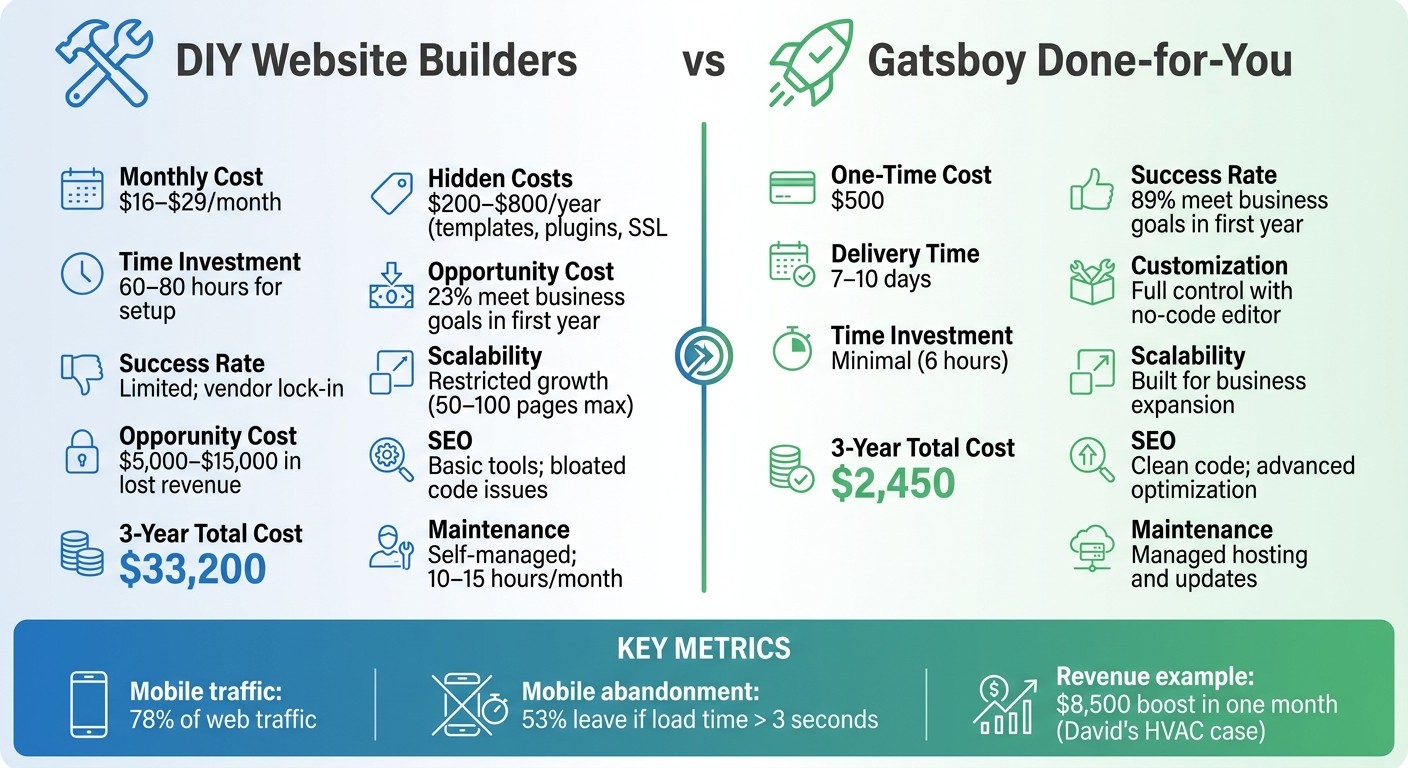
DIY Website Builders vs Done-for-You Services: Cost and Time Comparison
I Ranked Every Website Builder [TIER LIST]
Quick Comparison
Feature | DIY Website Builders | Gatsboy Done-for-You |
|---|---|---|
Cost | $16–$29/month + extras ($200–$800/year) | $500 one-time fee + minimal hosting |
Time | 60–80 hours for setup | 7–10 days for delivery |
Customization | Limited; vendor lock-in | Full control with no-code editor |
Scalability | May restrict growth | Built for business expansion |
SEO | Basic tools; bloated code issues | Clean code; advanced SEO options |
Maintenance | Self-managed; time-intensive | Managed hosting and updates |
DIY builders are ideal for those with time and a tight budget who don't need essential website features right away, but for faster results and fewer headaches, a done-for-you service like Gatsboy may be a better fit. Choose based on your goals, budget, and how soon you need your site live.
1. DIY Website Builders
For small business owners looking to establish an online presence quickly, it's important to weigh the costs, limitations, and upkeep of DIY website builders. These platforms provide drag-and-drop tools and ready-made templates, eliminating the need for coding skills. While they simplify the process, they require a time investment and come with certain restrictions. Hosting, security updates, and basic maintenance are typically included in the subscription, which costs about $200 to $800 per year.
Cost
At first glance, DIY builders seem affordable. Monthly plans usually start at $16 to $29, a fraction of the cost of hiring a professional developer, whose fees range from $8,000 to $25,000. However, additional expenses can add up quickly. Premium templates may cost $50 to $200, specialized plugins can run $10 to $50 per month, and SSL certificates might be an extra charge if not included.
The biggest hidden expense is your time. Creating a basic 4- to 6-page site can take 60 to 80 hours for someone without experience. That’s time you’re not spending on other priorities, like sales or customer service. For many business owners, this translates to $5,000 to $15,000 in lost revenue.
"Wix looks cheap until you realize what you're actually paying for." - Erick Crowne, Desoto Bits & Bytes
Beyond monetary costs, DIY builders may also limit your ability to fully customize your site.
Customization
DIY platforms offer varying levels of flexibility. Some rely on structured templates with limited options, while others allow for more detailed adjustments. Recent advancements, like AI-powered design tools, have made it easier to create polished designs using simple text prompts. However, these platforms operate on proprietary systems, meaning your website is essentially "rented." Moving it to another host can be difficult - or even impossible.
This "DIY paradox" often leaves business owners juggling web development tasks alongside their core responsibilities. For instance, Mike from Mike's Consulting spent 180 hours over eight months building a site that only generated $2,400, leading to an estimated $27,000 in lost revenue because he couldn’t focus on sales.
Customization limits also impact your site's long-term growth potential.
Scalability
DIY platforms are great for getting started, but they often fall short as your business grows. Many lack the technical flexibility needed for advanced SEO tweaks or custom features. Without access to coding or CSS controls, fixing technical issues that affect site performance can be nearly impossible. This "technical debt" can hurt your site's ability to rank in competitive markets.
Although newer platforms now offer no-code integrations for payments, CRM systems, and analytics, only 23% of DIY websites meet their business goals in the first year, compared to 89% of those built using professional support. The difference often lies in whether the platform can adapt to your evolving needs or forces you to start over later.
SEO
SEO is a common pain point for DIY websites. Even if your site looks polished, it might contain "bloated code" or hidden errors that search engines penalize. Without backend access, fixing these issues yourself can be a challenge. And with 78% of web traffic now coming from mobile devices, a slow-loading site can drive users away - 53% of mobile users abandon a site if it takes longer than 3 seconds to load.
"Many people who made their own websites ended up coming to us... because only with time and experience they realized there were issues they either knew nothing about or had no control over." - Northnet Media
To ensure your site is discoverable, consider consulting an SEO expert early on. While DIY platforms handle basic optimization, achieving competitive rankings often requires technical fixes beyond their capabilities.
Maintenance
One benefit of DIY builders is that hosting and security updates are included in the subscription, sparing you the $200 to $500 monthly maintenance fees charged by professional developers. The platform manages server upkeep, software updates, and basic security. However, content updates, performance monitoring, and troubleshooting are still your responsibility, requiring about 10 to 15 hours per month.
Over time, this ongoing effort adds up. In three years, the total cost of a DIY approach - including your time - can reach $33,200, compared to $2,450 for a modern website builder with professional support. The question is whether you’d rather spend that time managing technical tasks or focusing on growing your business.
2. Gatsboy's Done-for-You Websites
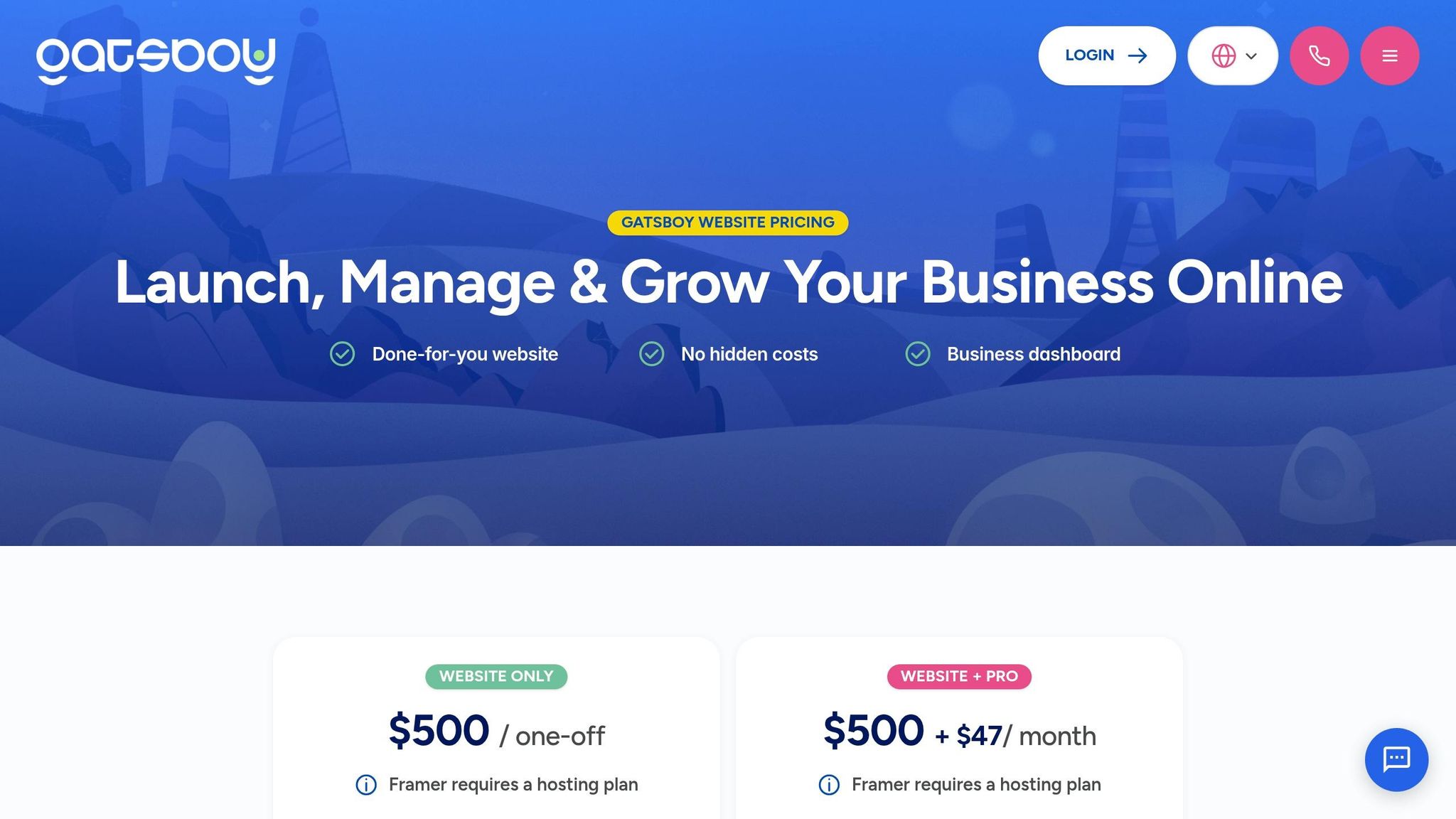
For small business owners looking for a professional website without dedicating endless hours to the process, Gatsboy offers a straightforward, done-for-you service. Instead of spending 60–80 hours building a site, Gatsboy delivers a fully functional 5-page website in just 7–10 days. The price? A one-time fee of $500, with full ownership transferred to you upon completion.
Cost
Using DIY website builders often comes with hidden expenses - subscription fees and, more importantly, the cost of your time. Think about it: every week spent on your site could mean $1,000 to $2,000 in lost revenue. And delaying your launch by eight months? That could cost a small business an average of $40,000 in potential earnings. Gatsboy, on the other hand, keeps things simple with a one-time $500 fee, plus minimal hosting costs, keeping your total investment between $500 and $1,000 for the same period.
"While YOU focus on building your own website, you'll have a hard time balancing other revenue-generating tasks... While I focus on building your website, I do all the work for you, freeing you up to continue making money."
– Katelyn Dekle, Owner, Launch the Damn Thing
Simon W. from Bowburn Travel praised Gatsboy for delivering an "outstanding website" and making the process "effortless". With over 3,000 websites completed for a community of 15,000+ small business owners, Gatsboy’s predictable pricing ensures a stress-free experience.
Customization
Gatsboy doesn’t just stop at affordability - it prioritizes ease of customization too. Websites are built using Framer, a no-code editor that offers full control after launch, so you don’t need technical skills to make updates. Unlike platforms where you’re essentially renting your site, Gatsboy gives you complete ownership. Ella B. from Brightline highlighted how the platform delivers "control without complexity", making it easy for her team to manage their site daily.
The service also includes features like a business dashboard, smart tools for lead collection and bookings, and integrations with Google Reviews, Stripe Payments, and advanced forms, all designed to streamline your operations.
Scalability
Gatsboy websites are built on modern web architecture, enabling them to grow alongside your business. By using static HTML files served through a global CDN, they avoid the performance issues common with DIY platforms, ensuring fast load times even during traffic surges. For businesses needing extra features, add-ons like AEO (AI search optimization at $147/month) and Local Tracking ($99/month) can be integrated without requiring a complete rebuild.
SEO
When it comes to SEO, Gatsboy ensures you’re in control. You can easily manage metadata and structured data, avoiding the "bloated code" problems that plague many DIY platforms. Static site generation also helps search engines crawl your site more efficiently, reducing the risk of technical errors. For local businesses, the Citations add-on ($247 one-time) submits your site to 50 top directories, helping establish a strong local presence.
Maintenance
With hosting and security updates handled through Framer, you’ll spend less time fixing issues and more time focusing on your business. Lottie N. from Image & Co shared how Gatsboy’s team was "kind and professional" when resolving any web-related problems. The included business dashboard simplifies daily tasks like managing leads, bookings, and customer messages, so you won’t need to rely on technical support for every little update.
Pros and Cons
When deciding between a DIY website builder and a done-for-you solution, it’s important to weigh the trade-offs carefully. Your choice will depend on factors like time, control, and long-term value, all of which impact your business growth.
DIY website builders are often attractive to those watching their budgets, with monthly fees ranging from $16 to $29. But what’s not always obvious are the hidden costs - premium templates ($50–$200), necessary plugins ($10–$50 per month), and transaction fees. These extras can quickly inflate your expenses, sometimes tripling your initial estimate.
"The 'cheap' option usually isn't [cheap] if your website needs to actually bring in customers."
– Erick Crowne, Business Owner
Another drawback of DIY platforms is vendor lock-in. Most don’t allow you to export your site code, which means if you outgrow the platform, you’ll likely need to rebuild your site from scratch. This can result in lost SEO progress and additional costs.
On the other hand, Gatsboy offers a done-for-you service for a one-time fee of $500. This includes a fully functional website delivered in 7–10 days, full ownership of your site, and no ongoing subscription fees.
Here’s a side-by-side look at the key differences between DIY builders and Gatsboy:
Feature | DIY Website Builders | Gatsboy Done-for-You |
|---|---|---|
Cost | $16–$29/month plus hidden fees and 60–80 hours of your time | $500 one-time fee plus minimal hosting; 7–10 days to launch |
Customization | Limited to preset templates; vendor lock-in hampers migration | Full control via a no-code Framer editor with complete ownership |
Scalability | Platform ceilings may restrict growth beyond 50–100 pages | High scalability with seamless integration capabilities |
SEO | Bloated code and limited backend access for fixes | Clean code and expert SEO optimization |
Maintenance | Self-managed - with significant time spent troubleshooting | Managed hosting and security with a simplified business dashboard |
For instance, imagine your business generates $5,000 a month. A six-month delay in launching your site could cost you $30,000 in lost revenue. While DIY builders might seem like the cheaper option at first, they often lead to higher costs over time - not just in money, but also in time and missed opportunities. Gatsboy eliminates the uncertainty by delivering a professional website quickly, so you can focus on growing your business.
This comparison highlights the key factors to consider before making your decision.
Conclusion
Balancing cost, time, and growth potential is key when deciding how to build your website. The right choice depends on your available time, technical expertise, and how quickly you want to get to market.
If you’re willing to dedicate 60–80 hours to setup, troubleshooting, and SEO optimization, a DIY website builder might work for you. However, keep in mind that only 23% of DIY websites meet their business goals in the first year. Plus, hidden costs and the value of your time can push first-year expenses anywhere from $5,250 to $16,300 when you consider opportunity costs.
For businesses focused on growth, the numbers tell a different story. Gatsboy offers a professional, SEO-optimized website in just seven days for a one-time fee of $500. This solution provides full ownership, an easy no-code editor for updates, and eliminates the hassle of ongoing maintenance.
Think about your 90-day business goals. If acquiring customers and generating revenue is a priority, getting online quickly may outweigh saving a few hundred dollars upfront. Take David from David’s HVAC as an example - he invested $480 in a modern solution and saw an $8,500 revenue boost in just one month, with only six hours of setup time.
Ultimately, the best choice isn’t necessarily the cheapest - it’s the one that gets you online quickly, performs well, and allows you to focus on growing your business. Prioritize speed and performance to stay focused on serving your customers.
FAQs
How do I know if a DIY builder is enough for my business?
Deciding whether to use a DIY website builder for your business comes down to your specific goals, technical know-how, and long-term plans. If you’re looking for a fast and cost-effective way to create a simple online presence, DIY builders are a solid choice. But if you’re aiming for advanced functionality, room to grow, or a custom design, they might not meet your needs. Think about what you need right now and where you want to take your business in the future to determine if hiring a professional is the better option.
What hidden costs should I budget for with DIY website builders?
When opting for DIY website builders, it's essential to budget for additional expenses. These can include hiring professionals for more advanced customizations, purchasing high-quality stock images, investing in premium plugins, and addressing integration challenges. These costs can quickly exceed the platform's basic subscription fee.
Will a DIY-built site hurt my SEO and page speed?
DIY website builders can sometimes affect your site's SEO and page speed if not handled properly. These platforms often come with constraints, such as limited storage or bandwidth, which can slow your site down when those limits are reached. On top of that, if you're not familiar with SEO best practices, it can be tough to make your site as visible as you'd like on search engines. While these tools are designed to be easy to use, keeping your site optimized still requires attention to detail to avoid issues with performance or search rankings.
Related Blog Posts
Join our community of 15,000+ business owners
Popular articles
Popular articles about your website and marketing your small business


