



How Testimonials Improve Local SEO Rankings
Small Business Marketing
Customer testimonials are a powerful tool for improving local SEO rankings. They help businesses stand out in search results by building trust, increasing engagement, and adding keyword relevance. Here’s how:
Boost Trust: Google values reviews as a sign of credibility. Businesses with higher ratings and more reviews are more likely to appear in the Local 3-Pack.
Increase Engagement: Star ratings and reviews attract clicks, signaling relevance to search engines.
Enhance Keyword Relevance: Testimonials often include location-specific and service-related keywords, helping Google understand your business better.
For example, a dental practice that encouraged reviews mentioning "teeth whitening in Clearwater" saw improved rankings and more customer inquiries.
Key Stats:
98% of consumers check reviews before choosing a local business.
Review signals account for 17% of local SEO ranking factors.
Businesses in top Map Pack spots have 47% more reviews than competitors.
To maximize the impact of testimonials:
Collect reviews consistently, aiming for 3–5 new ones monthly.
Respond to all reviews promptly, highlighting services and locations.
Display testimonials prominently on your website, using tools like Gatsboy for seamless updates.
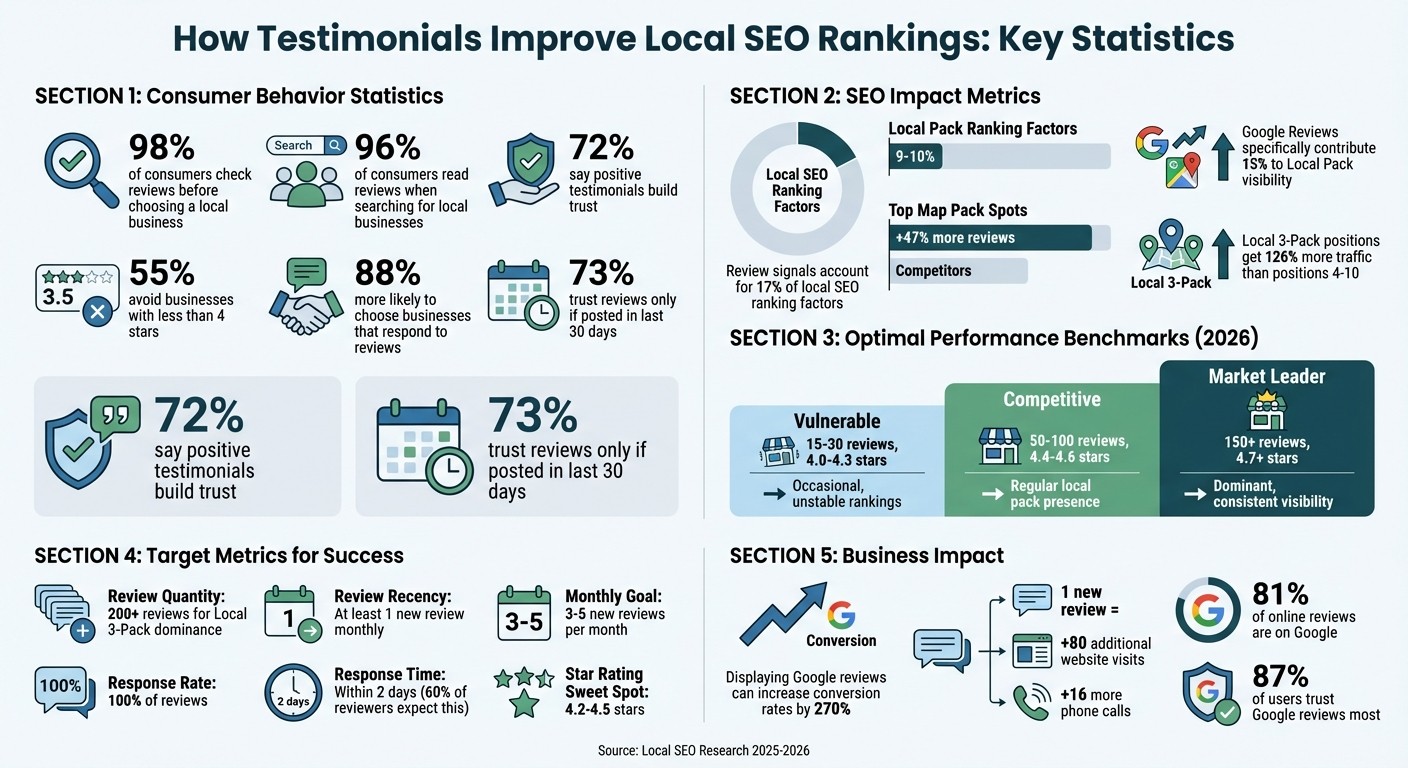
How Customer Testimonials Impact Local SEO Rankings: Key Statistics and Benchmarks
⭐ Sneaky Local SEO Review Strategy (IT WORKS)
How Testimonials Affect Local SEO Rankings
Testimonials play a crucial role in improving local SEO by building trust, boosting engagement, and signaling keyword relevance. These factors align with how Google's algorithm evaluates businesses, providing actionable insights to optimize your review strategy.
Building Trust with Potential Customers
Google views testimonials as an important indicator of a business's prominence - essentially, how well-known and trusted you are in your community. When your Google Business Profile gathers genuine reviews, it signals to the algorithm that real customers endorse your services. This bolsters your business's E-E-A-T, particularly the trustworthiness aspect.
Here’s a telling statistic: 96% of consumers read reviews when searching for local businesses, and 55% of them avoid businesses with less than four stars. Interestingly, businesses with ratings between 4.0 and 4.5 stars tend to get the most clicks. A flawless 5.0 rating can actually seem less credible, as consumers often trust a mix of ratings more.
Take the example of Barbara Oliver Jewelry in Williamsville, NY. When they added a dedicated testimonials page in 2016, new visitors spent an average of 4 minutes on that page alone. This demonstrates how reviews not only build trust but also keep potential customers engaged before they even reach out.
This trust factor works twofold: it reassures potential customers while also improving engagement metrics - something search engines closely monitor.
Improving Engagement Metrics
Search engines rely on user behavior to evaluate quality. When a business displays star ratings in search results, it tends to attract more clicks. A higher click-through rate signals to Google that your listing meets searcher intent, which can lead to improved rankings and greater visibility.
Here’s another key stat: 88% of consumers are more likely to choose a business that actively responds to reviews. Consistent review responses and a steady flow of 4–8 new reviews per month show Google that your business is active and engaged. On the flip side, profiles with outdated reviews may give the impression that your business is no longer operating at its peak.
Review Profile | Local Pack Appearance | Competitive Advantage |
|---|---|---|
15-30 reviews, 4.0-4.3 stars | Occasional, unstable rankings | Vulnerable to competitors |
50-100 reviews, 4.4-4.6 stars | Regular local pack presence | Competitive in most markets |
150+ reviews, 4.7+ stars | Dominant, consistent visibility | Market leader positioning |
Adding Keyword Relevance
Customer testimonials naturally include the language people use in searches, which helps Google identify your business's relevance. For instance, if a reviewer mentions "best chiropractor in Clearwater" or "shingle roof replacement", Google picks up on these phrases as signals of service relevance. This process works in three key ways:
Service relevance: Reviews confirm you provide specific products or services.
Location relevance: They associate your business with certain neighborhoods or cities.
Intent signals: Keywords like "emergency" or "same-day" match urgent customer needs.
Review responses also contribute to this by creating additional indexed content. For example, replying with, "We’re glad we could assist with your HVAC repair", reinforces the connection between your business and that service in Google's understanding. Reviews often include long-tail keywords you might not think to add to your website, further expanding your reach across diverse search queries.
"When customers mention your specific services, neighborhoods, or products in their reviews, Google uses that language as a relevance signal." - Kathleen Celmins, Founder, Glow Social
How to Collect and Display Testimonials
Boost your local SEO by actively gathering testimonials and showcasing them in the right places.
Getting Customers to Leave Reviews
Timing is everything when asking for reviews. Approach customers right after a "wow moment" – like after onboarding, delivery, or when they've clearly expressed satisfaction. This is crucial because 72% of consumers say positive testimonials build their trust in a business.
Make it easy for customers to leave feedback. Share direct links to your Google Business Profile or a short review form with just three to five fields. For physical stores, QR codes on receipts or exit signs can encourage immediate responses.
Automation can take the hassle out of review collection. Set up email or SMS sequences triggered by milestones like a completed purchase, a resolved support ticket, or a finished project. Send the first request right away, follow up on Day 3, and send a final nudge on Day 7. For e-commerce, wait 7–14 days after delivery, but for service businesses, aim to ask within 24 hours or even on-site.
When requesting Google reviews, focus on "sharing your experience" to comply with Google's guidelines. Offering ethical incentives like discount codes or raffle entries for honest feedback can increase participation, but always follow FTC disclosure rules.
"Don't ask just once. In-person plus an email follow-up (or two) is usually best." - Phil Rozek, Local Visibility System
Once you’ve collected testimonials, it’s time to strategically display them for maximum impact.
Placing Testimonials on Your Website
Position testimonials where they can influence decisions. Add them to service pages near calls-to-action, during checkout to reduce cart abandonment, and on your homepage to establish trust right away. Showing authentic social proof as soon as visitors land on your site can make a big difference.
A dedicated testimonials page, or "Wall of Love", can also be a great asset. This can help capture traffic from searches that include your brand and "reviews." For example, Barbara Oliver Jewelry in Williamsville, NY, saw 9% of overall page visits and 5% of search engine landings come from their reviews page. This shows how effective a well-organized testimonials page can be for both engagement and search visibility.
For businesses with multiple locations, including city-specific testimonials can enhance local relevance. Link these testimonials from your selling pages and integrate them into your site’s navigation. Use JSON-LD schema markup to share star ratings with search engines, which can help you gain rich snippets in search results.
Be transparent with all feedback and respond to on-site testimonials just as you would on third-party platforms. Responding matters – 40% of consumers believe businesses should acknowledge feedback.
For an effortless and up-to-date display, consider using tools to automate the process.
Using Gatsboy's Google Reviews Integration
Gatsboy’s Google Reviews integration makes it simple to showcase testimonials by syncing directly with your Google Business Profile. It automatically updates every 24 hours, ensuring your reviews stay current without manual effort. This is especially important since 81% of online reviews are on Google, and 87% of users trust them the most.
The integration is no-code – just paste a single line of code into your website. It filters reviews, applies JSON-LD schema markup for rich snippets, and keeps your site’s performance intact, so your Core Web Vitals remain strong.
Gatsboy also offers customizable display options, including grids, carousels, and "Wall of Love" layouts, so your testimonials can align with your brand’s style. Displaying Google reviews on your site can increase conversion rates by 270%, and even a single new review can bring about 80 additional website visits and 16 more phone calls.
Optimizing Testimonials for Local SEO
Fine-tuning your testimonials can give your local SEO a meaningful boost. Once you've gathered and displayed reviews effectively, the next step is to optimize them to improve your local visibility. How you manage, respond to, and encourage reviews can make a big difference in how search engines rank your business.
Including Local Keywords in Testimonials
Google pays attention to the content of reviews, especially when it comes to local relevance. When customers naturally mention your services and location in their testimonials, it helps search engines understand your business's focus and geographic area.
"Reviews are no longer just a trust signal, they're a powerful SEO tool when used strategically. In 2025, keywords inside your testimonials help search engines understand what you do, where you do it, and why you deserve to rank." - SEO Consulting Experts
Ask your customers specific questions to guide their feedback, like, "What service did we assist you with today?" or "Is there a team member you'd like to highlight?" You can also personalize your request by referencing the service and location. For instance, you might say, "We appreciate you choosing us for your emergency roof repair in St. Petersburg".
Here's an example: A dental practice in Clearwater, Florida, updated its follow-up emails to ask patients about their treatments. Within two months, the practice's Google Business Profile gained reviews mentioning terms like "teeth whitening in Clearwater" and "dental implants." As a result, the practice climbed in Map Pack rankings for those keywords and saw an increase in phone inquiries.
While keyword-rich testimonials are essential, maintaining a steady stream of new reviews is equally important.
Keeping Testimonials Current
Fresh reviews show that your business is active and relevant. Google places more weight on recent testimonials, with reviews written within the past 30 days carrying significantly more influence than those older than six months. Instead of collecting a large number of reviews at once, aim for a consistent flow of 3–5 new reviews each month.
Consumers also value recent reviews - 39% filter reviews to see the most recent feedback. They want to know what your business is like today, not years ago. For example, a plumbing company in Chicago increased its review count from 15 to 87 over six months by consistently asking for feedback. This steady growth helped the business jump from #12 to #2 in the local pack, leading to a 340% rise in organic leads and an extra $45,000 in monthly revenue.
To maintain this momentum, consider sending friendly reminders via email or text a week or two after providing your service.
Responding to Reviews
Managing reviews doesn’t stop at collecting them - responding to reviews is just as important. Timely responses are not only great customer service but also a strong SEO signal. Each time you reply, you demonstrate to Google that your business is engaged and active. Plus, the text in your responses can reinforce your local relevance when you mention specific services and locations.
"Replying to reviews isn't just about good manners - it's a public-facing SEO task. Every single time you respond, you're sending a clear signal to Google that your business is active, engaged, and cares about its customers." - Damon Chen, Founder, Testimonial
Quick responses matter: 60% of reviewers expect a reply within two days, and 40% believe feedback should be acknowledged. Negative reviews deserve special attention - 54% of customers will avoid a business if the owner's response doesn’t address the issue, and 46% will steer clear if the owner argues with customers in the review section. Keep your replies professional and solution-oriented, and naturally include keywords related to your services and location.
Measuring Testimonial Impact on Local SEO
Tracking the impact of testimonials on your local SEO efforts is essential for understanding their effectiveness. By analyzing the right metrics and tools, you can identify what’s working and where to direct your energy to boost your rankings and, ultimately, your revenue.
Tracking Local SEO Performance
One of the best ways to monitor your progress is through Google Business Profile (GBP) Insights. This tool provides data on key customer actions like calls, direction requests, and website clicks. After receiving a wave of new testimonials, check these metrics to see if there’s a noticeable link between the number of reviews and customer engagement.
Your ranking in the Local 3-Pack (the top three results in Google Maps) is a game-changer. Businesses in these coveted spots enjoy 126% more traffic than those ranked 4–10. Tools like BrightLocal and Whitespark can help you track your Local 3-Pack rankings for vital keywords.
"Reviews account for approximately 10% of all local SEO ranking factors, with Google Reviews specifically contributing 15% to Local Pack visibility." - Ken W. Button, Technical Director, Button Block
Another key metric is review velocity, or how many reviews you’re getting each month. A steady flow of 2–4 new reviews signals to Google that your business is active and well-maintained. This aligns with the fact that recency remains a top-5 ranking factor for 2026. Additionally, 73% of consumers trust reviews only if they’ve been posted in the last 30 days, so keeping reviews fresh is critical.
Don’t overlook AI visibility. Regularly query platforms like ChatGPT, Gemini, and Perplexity to see if your business is being recommended for local services. With 87.4% of AI-driven referral traffic coming from ChatGPT, this is a growing traffic source. Also, track your brand’s search volume in Google Search Console - an increase in searches for your business name often predicts AI citations.
Metric | Target Benchmark for 2026 | Impact Area |
|---|---|---|
Review Quantity | 200+ reviews | Local 3-Pack Dominance |
Review Recency | At least 1 new review monthly | Ranking Maintenance |
Response Rate | 100% of reviews | Trust & Engagement |
Response Length | ~140 words | Top-3 Ranking Correlation |
Star Rating | 4.2–4.5 stars | Consumer Trust "Sweet Spot" |
Measuring Conversion Rates from Testimonials
While metrics like GBP actions and Local 3-Pack rankings show how well you’re performing in search, conversion rates reveal how testimonials impact your bottom line. Use Google Analytics to segment organic traffic by "local intent" searches (e.g., those including “near me” or your city name). Compare the conversion rates of visitors who view your testimonials page with those who don’t to gauge how much your social proof contributes to revenue.
"When customers are spending 3+ minutes on any page of a local business website, you can feel quite confident that they are really engaging with the business." - Miriam Ellis, Local SEO Subject Matter Expert, Moz
To calculate the return on investment (ROI) of your reviews, multiply the increase in GBP actions by your average conversion rate and customer value.
Additionally, keep an eye on referral traffic from AI domains like chat.openai.com. With half of all buyers now starting their purchase journey in AI chatbots instead of traditional search engines, this traffic source is only going to grow. Tools like Brand24 or Mention can help you track online discussions about your business, which can influence AI recommendation algorithms.
Conclusion
Testimonials play a key role in boosting local search performance. They build trust, improve engagement metrics, and naturally incorporate location-specific keywords. With reviews influencing about 9% of local pack ranking factors, they are a critical component for improving visibility on Google Maps and in search results.
"Reviews are no longer just a trust signal, they're a powerful SEO tool when used strategically." - SEO Consulting Experts
A steady flow of new testimonials shows Google that your business is active and customer-focused. By responding to reviews, encouraging feedback that highlights your services and location, and showcasing testimonials prominently on your site, you can improve rankings, attract more customers, and generate even more reviews. These efforts work together to strengthen your local SEO and drive higher engagement.
Using automation tools like Gatsboy's Google Reviews integration can make this process even smoother. This system keeps your testimonials fresh and impactful by managing collection, applying schema markup for star ratings, and displaying them on your website. With these tasks handled, you can focus on delivering excellent service while your review strategy continues to work in your favor.
FAQs
How many reviews do I need to rank in the Local 3-Pack?
Businesses typically need about 40–50 Google reviews to secure a spot in the Local 3-Pack. However, this number can vary based on factors like your industry, location, and the level of competition. In some situations, even 10–15 reviews might be enough to start showing up in local search results. The key is to consistently gather reviews to boost your visibility over time.
What should I say when responding to reviews for SEO?
When replying to reviews, it's important to stay professional, personalized, and relevant. Start by thanking the reviewer, address any specific points they mention, and, where it fits naturally, include keywords related to your business.
For example, you could say:
"Thank you for your kind words! We're thrilled you enjoyed [your service]. If you ever need anything, don't hesitate to reach out."
Doing this not only builds a positive connection with your customers but also signals relevance to search engines, which can help improve your local SEO.
How can I add Google review stars to my website?
To showcase Google review stars on your website, you can embed Google reviews using plugins or widgets that include schema markup. This approach not only displays star ratings in Google search results but also enhances credibility with your audience.
Other options include embedding live reviews, adding screenshots, or featuring a review carousel directly on your site. To maximize the impact, use schema markup like AggregateRating. This can help improve your local SEO and increase click-through rates from search results.
Related Blog Posts
Únete a nuestra comunidad de 15,000+ propietarios de negocios
Artículos populares
Artículos populares sobre su sitio web y la comercialización de su pequeña empresa


